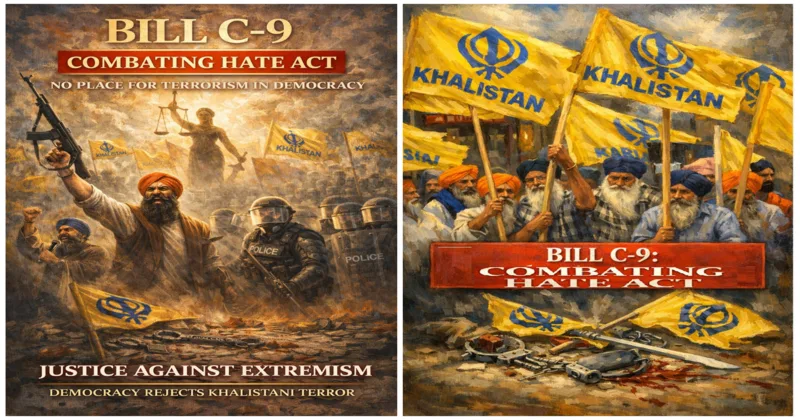
When Bharat stood on the global stage, upholding its unwavering policy against terrorism and employing evidence-based diplomacy, many nations chose to overlook the issue, dismissing it merely as a regional concern. However, time has proven that India’s concerns and warnings are rooted less in its own self-interest and more in the broader cause of global peace and security. Today, the ‘Combating Hate Act’ passed by the Canadian Parliament serves to validate this very truth. Indeed, this legislation, which imposes a ban on Khalistani terrorism and its associated symbols, can be hailed as a historic victory for India’s long-standing diplomatic tenacity and its unwavering resolve regarding national security.
In essence, the ‘Combating Hate Act’- recently passed by the Lower House of the Canadian Parliament- sends a significant message within the realm of international politics: that “terrorism cannot be shielded under the guise of freedom of expression.” Under the provisions of this bill, the public display of flags and propaganda material belonging to banned organisations, such as Babbar Khalsa, has been declared illegal. Furthermore, activities involving the intimidation or obstruction of individuals outside religious sites have also been categorised as criminal offences.
It is a well-known fact that, for years, India has consistently raised its grave concerns regarding Khalistani elements active in Canada on various global platforms. For a long time, these activities were viewed through the lens of “free speech”; however, a realisation has now emerged that the “Khalistani ideology” is not merely a form of ideological dissent but rather an integral part of organised extremism and separatism. Consequently, the Canadian government has stated that the objective of this legislation is not to curtail freedom of expression, but rather to prevent its misuse. Waving Khalistani flags, glorifying terrorist organisations, and engaging in their propaganda and dissemination; all such acts are now being brought within the purview of the law.
It is also pertinent to note that this bill has not been free from internal dissent in Canada; groups opposed to India’s continued progress remain active there as well. This is precisely why many members within parties such as the Conservatives and the NDP have opposed this decision, characterising it as an encroachment upon freedom of expression. Yet, amidst these protests, a significant fact remains: for the first time, the Canadian government has taken concrete steps articulated in such clear and unequivocal terms to curb “Khalistani activities.”
When viewed in a broader perspective, this entire sequence of events emerges as a major diplomatic triumph for India. India never confined this issue to the realm of a bilateral dispute; instead, it framed it within the larger context of international terrorism. Through the presentation of evidence, intelligence inputs, and sustained dialogue on global platforms, India successfully established that a faction of the Khalistani movement has been inextricably linked to violent and terrorist activities.
It is also a well-known fact that the Sikh community has long maintained a significant presence in Canada, within which a small yet influential faction has consistently promoted “Khalistani” ideology. Through rallies, referendums, and public demonstrations, these activities gradually emerged in the mainstream public sphere. Bharat has repeatedly clarified that these extremist endeavours are not merely political expressions; rather, they constitute a direct challenge, perpetrated from foreign soil under the guise of protest to India’s sovereignty and security. Furthermore, these activities pose a grave threat to Canada itself.
Initially, India’s assertions were not taken seriously; however, over time, observers witnessed numerous incidents in Canada that vindicated India’s concerns. Violent protests in public spaces, anti-India sloganeering, and the desecration of national symbols collectively signalled that the situation was far from normal.
Moreover, the dissemination of these ideologies via digital platforms, along with the associated funding networks, continued to expand globally. The strain that emerged in India-Canada relations, particularly after 2023, further exacerbated the gravity of this issue. The diplomatic dispute triggered by the assassination of Hardeep Singh Nijjar compelled both nations to re-evaluate their stance on this subject. While a phase of mutual recrimination ensued, it simultaneously became evident that this issue could no longer be ignored from the perspective of national security and law and order.
It was also observed that this situation had begun to disrupt the social equilibrium within Canada itself. Tensions surrounding places of worship, growing mistrust between communities, and increasing acrimony in public life prompted the government to take stringent measures. For this very reason, the new legislation has criminalised acts of intimidation or obstruction outside religious institutions.
A significant aspect of the ‘Combating Hate Act’ is that it proposes to eliminate the religious exemptions currently present in hate speech legislation. Undoubtedly, this move signals that Canada no longer intends to permit any form of extremism to hide behind a religious guise. Consequently, from India’s perspective, this entire development holds immense significance.
It symbolises a shift in the global mindset, a shift for which India has long been striving. The international community is now beginning to acknowledge that any form of terrorism- whether ideological, digital, or symbolic ultimately poses a threat to global peace.
Furthermore, this underscores the fact that India’s foreign policy in this regard has been both remarkably farsighted and diplomatically astute. Through dialogue, concrete evidence, and international cooperation, India consistently articulated its concerns regarding Khalistani terrorism to Canada- a stance it has ultimately succeeded in having accepted.
Today, as democratic nations like Canada take concrete steps in this direction, it naturally constitutes a major moral and diplomatic victory for India. The message here is clear: any activity undermining India’s unity, integrity, and sovereignty is no longer merely an internal Indian matter; in the contemporary world, it has evolved into a subject of global concern.
In this context, it must be noted that Canada’s firm stance against Khalistani activities is the culmination of a protracted process- one in which India played a decisive and active role. This victory belongs to an ideology that champions a zero-tolerance policy toward terrorism and stands firmly for global peace. Moreover, this Canadian decision; manifested in the ‘Combating Hate Act’- has once again proven in India’s favor that when national interest is held paramount, a battle fought with truth and unwavering resolve inevitably leads to victory.