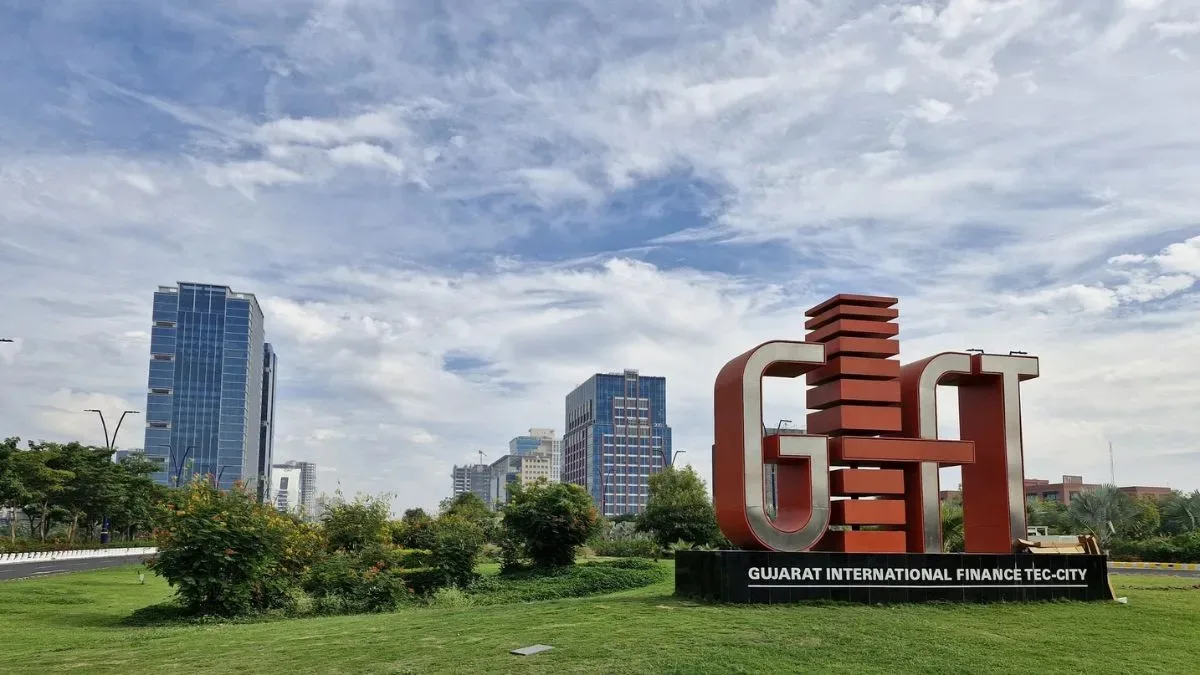
India’s push to establish itself as a global financial hub has reached a significant milestone, with GIFT City crossing the $100 billion mark in both its banking ecosystem and monthly exchange turnover. Highlighting this achievement, Gujarat Chief Minister Bhupendra Patel described GIFT City as a “fully operational international financial hub,” underlining how the project has moved beyond vision into tangible economic impact.
Emphasising the pace of growth, Patel noted that GIFT City is not merely an infrastructure development but a strategic initiative that is reshaping India’s position in global finance. He pointed out that the rapid expansion in banking assets, capital market activity, and financial services reflects increasing global confidence in India’s financial architecture. The Chief Minister also stressed that the ecosystem being built at GIFT City is designed to attract international capital, facilitate cross-border transactions, and create a globally competitive financial environment within India itself.
This milestone, he suggested, is a reflection of policy continuity, regulatory innovation, and infrastructure planning coming together – turning what was once a long-term vision into a functioning financial centre with global relevance.
Why GIFT City is more than a name
In recent years, GIFT City has steadily evolved from a policy vision into a functioning reality. Situated between Ahmedabad and Gandhinagar, it represents India’s first serious attempt to build a fully integrated international financial services centre within its own borders—one that can compete with established global hubs. What makes GIFT City particularly noteworthy is not just the ambition behind it, but the scale at which finance, technology, regulation, and infrastructure are being developed together in a coordinated manner.

A Financial Ecosystem that is already operational
GIFT City today hosts over 1,150 registered entities under the International Financial Services Centres Authority (IFSCA), clearly indicating that it is no longer a conceptual project but an operational ecosystem. The numbers themselves reflect the pace at which this ecosystem is expanding. Banking assets have grown sharply from around $14 billion in 2020 to over $100 billion. Capital markets activity has reached nearly $80 billion in fund targets, while monthly exchange turnover has crossed $100 billion, signalling strong liquidity. Additionally, more than 200 bonds worth close to $70 billion have been listed, and over 300 funds have been launched with significant committed capital.
Alongside this, the derivatives market and cross-border trading mechanisms are gaining traction, positioning GIFT City as a functioning financial marketplace rather than just a future pipeline.
Diverse participation across sectors
The ecosystem in GIFT City extends well beyond traditional banking and finance. It spans a wide range of high-value sectors, including insurance and reinsurance with participation from global players, as well as aircraft and ship leasing, where hundreds of assets are already being managed. The city is also seeing growth in fintech and global capability centres (GCCs), along with advisory and legal services.
Recent participation from firms such as Jio BlackRock, IIFL, and leading legal networks highlights the increasing diversity and depth of engagement across financial services.
Talent and employment pipeline
The expansion of institutions within GIFT City is being matched by a growing commitment to talent development and employment. Several global and domestic firms, including Deloitte, PwC, HCL Technologies, and Wipro, have outlined hiring plans that run into thousands of roles over the coming years.
By 2030, the planned infrastructure across domestic tariff areas (DTA) and special economic zones (SEZ) is expected to support over 1.3 lakh jobs. This indicates a structured and long-term approach to building workforce capacity across consulting, finance, and technology sectors.
Regulatory design and ease of doing business
One of the defining features of GIFT City is its regulatory architecture. More than 30 frameworks aligned with international standards have been introduced under the IFSCA. These include unified licensing systems for fintech and service providers, local foreign currency settlement mechanisms, and simplified compliance structures.
Together, these measures aim to reduce friction in global financial operations and allow firms to function efficiently within India while maintaining global competitiveness.
Infrastructure built for scale
GIFT City’s infrastructure sets it apart from conventional urban projects. It is India’s first city to feature a fully integrated underground utility tunnel network that supports water, electricity, cooling, drainage, and waste systems. In addition, district cooling, automated waste collection, and centralised utility distribution have been implemented.
Planned expansions include significant increases in water and sewage treatment capacity, a doubling of district cooling infrastructure, and further expansion of underground utility networks. At the surface level, the city has been designed with pedestrian-friendly pathways, intelligent traffic systems, metro connectivity, and integrated mobility solutions that link it seamlessly to Ahmedabad and Gandhinagar.
A ‘Live, Work, Thrive’ model
Beyond its business infrastructure, GIFT City is being developed as a complete urban ecosystem. The vision includes residential units for thousands of professionals, international schools offering global curricula, and well-planned parks, sports arenas, and recreational zones. In addition, retail spaces, food hubs, and cultural centres are being developed to ensure a vibrant lifestyle environment.
This integrated approach is aimed at making the city not just a place of work, but a truly livable urban space.
Education, innovation, and fintech growth
GIFT City is also emerging as a hub for education, innovation, and fintech. International universities such as Deakin University and the University of Wollongong have already established campuses, with more institutions expected to follow. Collaborations with institutions like IIT Gandhinagar and global universities are helping build a strong research and talent pipeline.
At the same time, the fintech ecosystem is expanding through innovation hubs, startup onboarding initiatives, certification programs, and accelerator platforms, including targeted programs aimed at supporting women entrepreneurs.
Capital markets and banking depth
The financial backbone of GIFT City continues to deepen with each passing year. More than 200 fund management entities are now operational, and 37 banks—including global names like HSBC, Citi, and JP Morgan—have established a presence.
The introduction of foreign currency settlement systems now allows global transactions to be processed locally, reducing dependence on offshore centres and strengthening India’s ability to retain and manage financial flows within its own ecosystem.
Global and Domestic Engagement
GIFT City’s growing prominence is also reflected in its international outreach. Engagements have taken place at major global forums such as the World Economic Forum in Davos, as well as with financial ecosystems in Milan, Zurich, and Hong Kong. There has also been active engagement across Germany and Austria, particularly in the insurance and fintech sectors.
These interactions have generated significant interest in areas such as fund structuring, ESG investments, and cross-border financial partnerships. On the domestic front, the ecosystem is being strengthened through banking forums involving over 100 institutions, investor engagement platforms like Vibrant Gujarat, and industry events including reinsurance summits.
This dual strategy ensures both global integration and strong domestic alignment.
Steady institutional evolution
The development of GIFT City has been a gradual process spanning more than a decade, with policy continuity playing a crucial role. The project was originally conceptualised during Narendra Modi’s tenure as Chief Minister of Gujarat and has since grown into a national financial initiative.
Rather than a sudden transformation, it reflects steady and incremental progress across regulatory, infrastructural, and institutional dimensions, all working in tandem.
The crossing of the $100 billion milestone marks more than just financial growth—it signals a deeper transformation in India’s economic architecture. GIFT City is no longer an experiment. It is an emerging global financial centre where capital, talent, and innovation converge within India’s borders.
In that sense, the name “GIFT” is no longer symbolic. It represents India’s assertion that it is ready not just to participate in global finance—but to shape it.