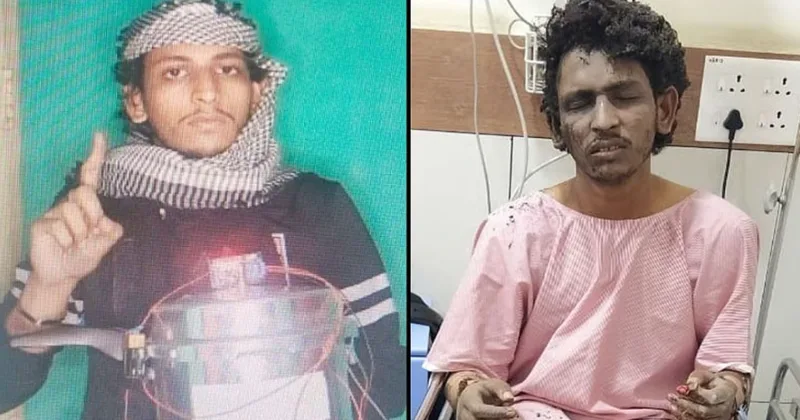
Bengaluru: In a significant development, proceedings before the National Investigation Agency (NIA) Special Court on March 28 marked a crucial turning point in the 2022 Mangaluru cooker blast case, with prime accused Mohammed Shariq formally confessing to his role in the attack. The court, after detailed hearings, accepted his confession petition, bringing the case to a decisive stage.
Shariq, who has been in judicial custody since his arrest, had earlier denied all allegations during trial proceedings. The NIA had filed a detailed chargesheet in 2024 against Shariq and co-accused Syed Yasin, outlining their alleged involvement in the blast and links to extremist networks. During initial hearings, Shariq maintained his innocence and rejected the charges.
However, in a dramatic shift, Shariq submitted a confession petition in December 2025. In his plea, he admitted that the charges mentioned in the NIA chargesheet were true. “I had placed an improvised explosive device (IED) inside a cooker and caused the explosion. I regret my actions and request the court to proceed against me as per law,” he stated. After nearly three months of scrutiny, the NIA court has now accepted his confession, recording it as part of the proceedings.
The blast occurred on November 19, 2022, at around 4:40 pm in the Kankanady police limits of Mangaluru. Shariq was travelling in an autorickshaw when the cooker bomb exploded mid-transit, leaving both him and the driver seriously injured. The case, initially registered by local police, was later handed over to the NIA after suspected terror links emerged. The accused were booked under the Unlawful Activities (Prevention) Act (UAPA).
Investigations revealed that Shariq, a native of Thirthahalli in Shivamogga district, was influenced by radical ideologies linked to ISIS and SIMI. He was part of a Shivamogga-based module and had earlier been linked to cases involving provocative wall graffiti in Mangaluru and a trial blast near the Tunga river.
Probe agencies further uncovered that the accused had planned to target religious locations, including Dharmasthala Temple and Kadri Manjunath Temple. The IED was fitted inside a cooker with a timer mechanism. However, a critical error in setting the timer—reportedly fixed for a much shorter duration instead of the intended delay—led to the device exploding prematurely inside the autorickshaw.
Parallel investigations by the Enforcement Directorate (ED) have exposed the financial backbone of the operation. The ED had earlier attached ₹29,000 from the bank account of co-accused Syed Yasin under the Prevention of Money Laundering Act (PMLA).
Officials revealed that funds for the operation were routed through illegal bank accounts and cryptocurrency channels. An ISIS-linked online handler identified as “Colonel” allegedly provided training to Shariq and others in assembling IEDs via encrypted platforms such as Telegram and Wickr. Another accused, Maj Munir, is believed to have facilitated financial transactions by sharing details of unverified bank accounts.
Investigators said approximately ₹2.86 lakh was transferred to the accused through covert channels. The funds were withdrawn as cash through point-of-sale agents and used for procuring explosive materials, renting safe houses in Mysuru, and conducting reconnaissance across Karnataka, Tamil Nadu, and Kerala.