Welfare and Identity: The new grammar of voting in Assam
June 6, 2026
  • Read Ecopy
  • Circulation
  • Advertise
  • Careers
  • About Us
  • Contact Us
Android AppiPhone AppArattai
Organiser
  • ‌
  • Bharat
    • Assam
    • Bihar
    • Chhattisgarh
    • Jharkhand
    • Maharashtra
    • View All States
  • World
    • Asia
    • Europe
    • North America
    • South America
    • Africa
    • Australia
  • Editorial
  • International
  • Opinion
  • RSS @ 100
  • More
    • Op Sindoor
    • Analysis
    • Sports
    • Defence
    • Politics
    • Business
    • Economy
    • Culture
    • Special Report
    • Sci & Tech
    • Entertainment
    • G20
    • Azadi Ka Amrit Mahotsav
    • Vocal4Local
    • Web Stories
    • Education
    • Employment
    • Books
    • Interviews
    • Travel
    • Law
    • Health
    • Obituary
  • Subscribe
    • Subscribe Print Edition
    • Subscribe Ecopy
    • Read Ecopy
  • ‌
  • Bharat
    • Assam
    • Bihar
    • Chhattisgarh
    • Jharkhand
    • Maharashtra
    • View All States
  • World
    • Asia
    • Europe
    • North America
    • South America
    • Africa
    • Australia
  • Editorial
  • International
  • Opinion
  • RSS @ 100
  • More
    • Op Sindoor
    • Analysis
    • Sports
    • Defence
    • Politics
    • Business
    • Economy
    • Culture
    • Special Report
    • Sci & Tech
    • Entertainment
    • G20
    • Azadi Ka Amrit Mahotsav
    • Vocal4Local
    • Web Stories
    • Education
    • Employment
    • Books
    • Interviews
    • Travel
    • Law
    • Health
    • Obituary
  • Subscribe
    • Subscribe Print Edition
    • Subscribe Ecopy
    • Read Ecopy
Organiser
  • Home
  • Bharat
  • World
  • Operation Sindoor
  • Editorial
  • Analysis
  • Opinion
  • Culture
  • Defence
  • International Edition
  • RSS @ 100
  • Magazine
  • Read Ecopy
Home Politics

Welfare and Identity: The new grammar of voting in Assam

How delivery, dignity and decisive leadership are reshaping electoral politics of the state and paving the way for an NDA victory

Dr Prosenjit NathDr Prosenjit Nath
Mar 29, 2026, 04:00 pm IST
in Politics, Bharat, Analysis, Assam
Follow on Google News
FacebookTwitterWhatsAppTelegramEmail

In Assam today, a voter is as likely to remember the day her welfare instalment arrived as she is to recall the anxieties of identity that have shaped the state for decades. This duality captures a deeper transformation underway—one that reflects not confusion, but clarity. Voting in Assam is not fragmenting; it is evolving into a more layered, more discerning exercise. And at the centre of this shift stands a governance model that has successfully aligned welfare delivery with cultural assurance giving the NDA a decisive edge.

In a modest household on the outskirts of Guwahati, a woman checks her phone for a familiar message: the monthly instalment under the Orunodoi scheme has been credited. The ₹1,000-₹1,250 she receives each month is modest, but dependable. It helps with food, medicine and school expenses—the essentials that sustain dignity. Yet, when asked about politics, her concerns quickly expand beyond welfare. She speaks of land, identity and the future of her community. That shift is not contradictory it is revealing.

For decades, Assam’s electoral politics was anchored almost entirely in identity. The aftershocks of the Assam Agitation, the complexities of migration and unresolved questions of citizenship created a political culture deeply rooted in belonging and protection. That legacy still matters. But what has changed is that identity no longer operates in isolation. It now coexists with a powerful, visible architecture of welfare and development.

The scale of welfare outreach under both the state and central governments has been unprecedented. The Orunodoi scheme alone covers over 26 lakh beneficiaries, primarily women. Meanwhile, the Pradhan Mantri Garib Kalyan Anna Yojana has ensured that nearly 80 per cent of Assam’s population received free food grains during and after the pandemic. These are not distant policy abstractions; they are tangible, recurring interactions between the citizen and the state. Every instalment credited, every ration delivered, reinforces a sense of reliability of a government that is present and responsive.

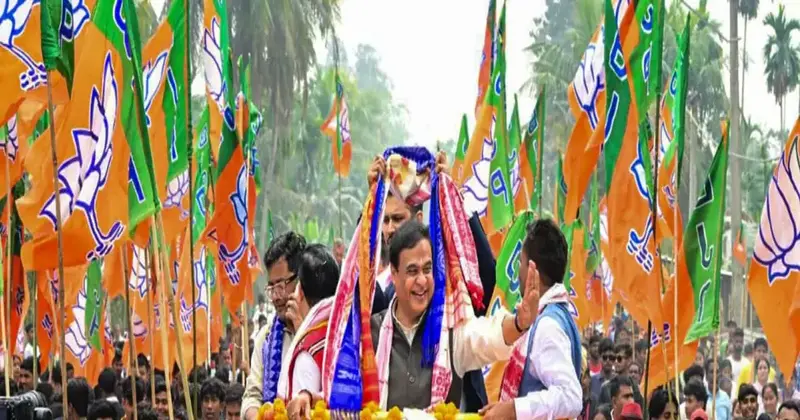
Under the leadership of Himanta Biswa Sarma, governance in Assam has acquired a distinct character efficient, direct and communicative. Welfare is not merely distributed; it is clearly attributed. Beneficiaries know what they are receiving and from whom. This clarity is politically significant. It transforms governance from an invisible process into a visible relationship, strengthening trust between the state and the voter.

This model is further reinforced by the broader national framework under Narendra Modi. The synergy between state and Centre has enabled a seamless flow of schemes, infrastructure investments and administrative coordination. Roads, bridges, digital connectivity and public services have improved at a pace that is both noticeable and measurable. Assam’s rising Gross State Domestic Product(GSDP) is not just a statistic it reflects a lived reality of expanding opportunity and growing confidence.

The political impact of this transformation is already visible. In the 2021 Assembly elections, female voter turnout slightly surpassed that of men, reaching around 79 per cent. This is not a marginal detail it is a structural shift. Women, particularly in rural and semi-urban Assam, are no longer peripheral participants in democracy; they are central decision-makers. Welfare schemes like Orunodoi have played a crucial role in this empowerment, giving women both economic agency and political voice.

Yet, to assume that welfare alone drives voting behaviour would be a misreading of Assam’s political psyche. Identity remains a potent force. Debates around the Citizenship Amendment Act(CAA) and the National Register of Citizens continue to shape perceptions, even when they are not at the forefront of electoral campaigns. Concerns over demographic change and cultural preservation have not disappeared they have simply become more calibrated.

What is striking, however, is how these identity concerns are now being addressed. Unlike the past, where identity politics often translated into agitation and instability, the current approach under the NDA has been one of balance and resolution. The emphasis has shifted from perpetual mobilisation to institutional handling—ensuring that concerns are acknowledged without allowing them to spiral into unrest. This has brought a degree of political stability that Assam had long been denied.

Regional variations further complicate the picture. In Upper Assam, the memory of indigenous assertion remains strong, shaping a vigilant political outlook. In the Barak Valley, linguistic and minority concerns play a more pronounced role. Lower Assam presents yet another set of dynamics, influenced by its unique demographic composition. There is no monolithic “Assam voter” only a mosaic of perspectives that intersect during elections.

And yet, across these differences, a common thread is emerging: voters are increasingly unwilling to choose between welfare and identity. They expect both. They want economic security without cultural compromise, development without displacement and governance without neglect. This expectation has fundamentally altered the electoral equation.

Also Read: Language Without Borders: How the Brahuis carry Tamil and Telugu culture into the northwest

The NDA’s strength lies precisely in its ability to address this dual demand. Welfare schemes provide immediate relief and stability, while a firm stance on identity reassures communities about their long-term future. This is not a coincidence; it is a carefully constructed political framework that aligns delivery with conviction. Critically, voters are not passive recipients in this process. They are evaluators. They measure performance, compare alternatives and make informed choices. Welfare may generate goodwill, but it does not guarantee loyalty. Identity may shape instincts, but it does not override everyday realities. It is in navigating this complexity that the NDA has established its advantage.

Assam’s elections, therefore, are not becoming simpler they are becoming more sophisticated. They reflect a negotiation between the immediate and the enduring, between what the state provides and what society seeks to preserve. And in this negotiation, the NDA has consistently demonstrated both competence and clarity. The result is a political landscape where outcomes are no longer dictated by a single issue, but by a composite judgement. And on that composite scale of delivery, development and decisive leadership the NDA stands well ahead.

In Assam today, the voter is not torn between development and identity. She is demanding both and rewarding those who can deliver without forcing a trade-off. That expectation is not just shaping elections; it is defining the future of governance in the state. And if current trends are any indication, it is a future that points clearly towards another decisive victory for the NDA.

Topics: AssamElectionspoliticsAsam Chief Minister Himanta Biswa SarmaWelfare
Dr Prosenjit Nath
Dr Prosenjit Nath
The writer is a technocrat, political analyst, and author. [Read more]
ShareTweetSendShareSend
✮ Subscribe Organiser YouTube Channel. ✮
✮ Join Organiser's WhatsApp channel for Nationalist views beyond the news. ✮
Previous News

Adani defence delivers first batch of 2,000 Prahar LMGs to Indian Army, ahead of schedule

Next News

No room for cash or liquor: ECI’s tough action seized Rs 400 crore ahead of 2026 polls

Related News

Oplus_16908288

Love Jihad in Assam: Accused Ashique Ali who stabbed minor Hindu girl killed in police encounter

An eternal civilization cannot be eradicated! The Sanatana Dharma debate beyond politics and ideology

The Uniform Civil Code debate in Assam has reignited questions around equality, cultural identity and constitutional reform in India

Equality Without Assimilation: Why Assam’s UCC debate goes beyond legal uniformity

UCC Bill 2026 tabled in Assam Assembly

Assam Govt introduces UCC in assembly: Bill aims to curb polygamy, requires registration of all live-in relationship

Assam Assembly Echoes With Sanskrit and Tribal Tongues in Historic Oath Ceremony

History created inside Assam Assembly; Oath in Sanskrit and 3 tribal languages echoes the diversity of Bharat

3 Bangladeshis caught at the Digar Khal naka checkpoint in Assam

Entered India in 2012, now fleeing home: 3 Bangladeshis caught trying to slip out through Meghalaya

Load More

Latest News

From Armenia and Greece to Cyprus, India's defence diplomacy is creating new pressure points for Turkey

How India’s Mediterranean Push and Indo-Pacific rise unsettle Turkey’s strategic calculus

Gadag seer enters 33-day Shiva Yoga Samadhi for world peace and welfare

Karnataka: Sri Rachoteshwara Shivacharya Mahaswamiji begins rare 33-day sealed Shiva Yoga Samadhi in Gadag

Indian surgeon conducts world’s longest cardiac telesurgery; Made-in-India robot echoes indigenous medical prowess

Pro-Khalistan slogans raised, Bhindranwale posters displayed at Sri Akal Takht Sahib

Operation Blue Star Anniversary: Pro-Khalistan slogans raised, Bhindranwale posters displayed at Sri Akal Takht Sahib

Inspired by Bhagwan Shiva's teachings, this ancient breathing practice helps calm the mind and reduce stress

Ancient Yogic Breathing for Modern Stress: How the Shiva method cultivates peace & self-awareness

The Vedic age saw remarkable women sages, known as Rishikas, who composed hymns and shaped India's spiritual and philosophical heritage

Rishikas of Vedic Age: How Gargi, Maitreyi & other women shaped ancient India’s spiritual and philosophical tradition

Police in AAP-Ruled state of Punjab lathi charge sit-in protesters

Punjab: ITI candidates seeking jobs lathi-charged outside PSPCL HQ; opposition slams AAP Govt over police action

From constables to DGP, India's police system follows a structured chain of command that governs law enforcement across the country

From Constable to DGP: Understanding India’s police hierarchy, powers & recruitment system

The terracotta dice that challenges historical assumptions and highlights India's millennia-old civilisational heritage

How a 4,500-year-old terracotta dice is reviving the debate on India’s civilisational continuity & Vedic heritage

The Porumamilla inscription and the ancient science behind a reservoir that survived 650 years

India’s 655-Year-Old Water Policy: The Porumamilla inscription that turned stone into a manual of hydrology

Load More
  • Privacy
  • Terms
  • Cookie Policy
  • Refund and Cancellation
  • Delivery and Shipping

© Bharat Prakashan (Delhi) Limited.
Tech-enabled by Ananthapuri Technologies

  • Home
  • Search Organiser
  • Bharat
    • Assam
    • Bihar
    • Chhattisgarh
    • Jharkhand
    • Maharashtra
    • View All States
  • World
    • Asia
    • Africa
    • North America
    • South America
    • Europe
    • Australia
  • Editorial
  • Operation Sindoor
  • Opinion
  • Analysis
  • Defence
  • Culture
  • Sports
  • Business
  • RSS @ 100
  • Entertainment
  • More ..
    • Sci & Tech
    • Vocal4Local
    • Special Report
    • Education
    • Employment
    • Books
    • Interviews
    • Travel
    • Health
    • Politics
    • Law
    • Economy
    • Obituary
  • Subscribe Magazine
  • Read Ecopy
  • Advertise
  • Circulation
  • Careers
  • About Us
  • Contact Us
  • Policies & Terms
    • Privacy Policy
    • Cookie Policy
    • Refund and Cancellation
    • Terms of Use

© Bharat Prakashan (Delhi) Limited.
Tech-enabled by Ananthapuri Technologies