Bharat is marching ahead to become a viksit Nation by 2047, focussing on accelerating Bharatiya economy keeping at par with a middle income developed Nation. Thrust has been given on boosting manufacturing sector and making quality products in the country, at par with international standards. For that, innovation in technology will be needed, and innovation is fuelled by research in basic sciences. Until when Bharat shall depend on imported technology? Bharat is lagging behind in producing research breakthroughs and hence innovations. It should be noted however that Bharat’s ranking in the Global Innovation Index (GII) has risen significantly from 81st in 2015 to 38th in 2025.
Most of the basic research leading to S&T publications must come from PhD programs of the University system and government research laboratories. Quality and quantity of doctorates produced in the country determine the health of its research ecosystem. Our problem is not with the number, but with the quality of these PhDs. So, the question before us is – “Why are we lagging behind in impact making publications and hence innovations?” If Bharat has to fulfil its dream of becoming a Viksit Nation by 2047, we must address these issues. We need a paradigm shift in Education, Research & Innovation (ERI), and the highlights of this issue may be summarised as follows.
Uplift research infrastructure at State universities
One of the visions of NEP2020 states that Institutions of Higher Education need to be transformed from just degree awarding Institutions to Institutions of ‘Learning’ and empowering students for ‘Problem Solving’. For this, students must be ‘excited’ and be ‘passionate’ about the subject/topic, which could be achieved through ‘Education Inspired by Cutting-edge Research. By getting students engaged in cutting-edge R&D Projects in the Institution or elsewhere from UG level.
Thus, we need R&D for science and technology Innovation in Higher Education system. Challenges like climate change, life-style diseases, food Security, water security, health security, and existential threats etc demand new S&T innovations to solve them and cope with them. The Government and private Sector must invest more funding on focused R&D to cope with these. However, Central Govt. laboratories and Institutions alone can’t do it, and this is where the role of the University sector comes in – Universities must make much larger contribution to S&T Innovations in the coming decades.
The backbone of all innovations is basic research and can be gauged by high quality publications. Our number of “Impact making” publications remains small compared to USA, EU and China. One reason for this is that the State & private Universities are not contributing significantly to impact making publications. To improve this significantly, first we must first understand the ailments of the system, which can be outlined as :
Faculty recruitment: Cutting Edge Research could be done only if the faculty is the best available in the country, and we must utilise our talented brains who wants to return back home after getting educated/trained abroad.
Poor Science & Technology Infrastructure
To excel in innovation and research in S&T, a vibrant academic environment & research culture are required. If the environment in the school/college excites and attracts the students to study science and to passionately pursue ‘Knowing the Unknown’, we may call it a vibrant academic environment. Faculty need to motivate and facilitate the students for this to happen. Flexible time to work for the Ph.D students, regular seminars on exciting developments in S & T by faculty and students, nationally and internationally renowned scientists as distinguished visitors to give lectures and interact with students, may help.
Most Ph.D students do PhD programs to just have a degree hoping that it will fetch a good job. As a result, maybe more than 90% of our PhDs do not become independent researcher after PhD. There are no/minimal postdoctoral opportunities in universities. We need to change that. The PhD should not be just a degree, it is a training to become an independent researcher and contribute to excellence in science. We (Faculty and Students) are happy just to do something trivial research, publish a couple of papers anywhere and complete PhD. State Universities may engage in “Locally important but Globally relevant” research. The desire for Excellence is missing!
Focus on Quality, and not quantity of research papers
If a country produces 100,000 research articles in a year, and number of citations of these articles in the year of publication and two years after puts 1200 of these articles in the top 1% cited articles in the world, then the Research Index is counted as 1.2. The order of this index is –

So, higher the Research Index, more is the impact making research papers, and better the quality of research is! Bharat’s performance has not been encouraging. We’re publishing more, with less citation. Bharat ranks fourth globally in research publications now, producing more papers than most of Europe combined. Ramanujan himself wouldn’t make it to pass the screening round today – he had low publication count, no h-index worth mentioning, no collaboration pipeline. We are creating a system optimised for visibility through numbers, rather than breakthroughs. To address this issue, one solution may be – promotions criteria should be based on quality, and not quantity of research papers. Faculties are under lot of pressure to qualify various criteria that focusses on number of research papers and h-indices. A scientist coming from a top foreign Institution with six papers of superior quality, won’t qualify criterion of our home Institutions for appointment, as they require minimum of say 10/15 papers. We need to change this, we need to appreciate excellence. We need to avoid serious misconduct like plagiarism and data manipulation, which is driven by pressure to publish more papers needed for promotion. That demand gets met by predatory journals that guarantee publication for a fee with minimal peer review.
Excellence requires the courage to back transformative work even when it doesn’t produce enough number of research papers. Building genuine research prestige takes decades. MIT became MIT by sustaining commitment for 30 years without demanding immediate returns.
Recruit our foreign-educated talent who wish to return back home
Sadly, it is a common phenomenon that when our talented brains who go abroad for education, want to return back home, our Institutional ecosystem system acts like a unpleasant repellant. When our brightest minds try to return back home, when they apply for permanent scientist/faculty positions in the Institutions/Universities of the country, they are not responded to, the way they should have been. In 2008, China started the ‘Thousands Talent Plan’, paying them starting bonus of one million Yuan, handsome research funding, housing subsidies, meal allowances, paid home visits, and subsidised schooling for children—everything designed to make the transition back to China as seamless and rewarding as possible. Since 2008, China has recruited approximately 7,000 scientists, academics, and entrepreneurs back from overseas.
A parliamentary panel report from March 2025 revealed that more than 50% of professor positions at IITs, IIMs, NITs, and IISERs remain unfilled—and this isn’t because candidates don’t exist, since thousands of qualified Indians work at universities around the world. The system has simply lost the ability to absorb what it produces. Lobbies backed by internal ecosystem of the Institution, community, region, or even research area determine who gets hired, irrespective of merit at times.
Talent is the backbone of the knowledge economy, and the nation that acquires and deploys it will shape the technologies and industries of tomorrow. A talented scientist working in our laboratory is our asset for research and innovation. If she works in someone else’s laboratory, it is as good as if we have lost her talent that could have contributed instead to our resources. These are incurring serious looses to our scientific and research ecosystem. This acts against national interests. If we can absorb our brilliant scientists who went abroad to pursue higher studies, it can catalyse the research & innovation culture of the nation.
Holistic implementation of NEP 2020
NEP2020 is a very ambitious educational policy, that aims to bring about a paradigm shift in education system of Bharat. It focusses on holistic development of children, imparting skill and value education to them, filling children and youth with a sense of pride in being Bharatiya, and making them aware of knowledge & wisdom, science, economy, economical, and knowledge system of Ancient Bharat. It aims to generate valuable human resource who while taking pride in being Bharatiya, will contribute to National building and will serve the mankind. Thus, it is very important that NEP2020 is implemented holistically, in “letter and spirits”, not merely on paper.
For that, it is essential that all the stakeholders comprehend it essence by heart, feel the urge to implement it holistically, not merely carrying on with it as a burden. This is turn can be achieved when mindset of teachers, parent, policymakers will transform. Urge to serve Maatribhumi with dedication, honesty, without indulging in malpractices is need of hour. Moreover, AI and modern tools of pedagogy must be used judiciously and wisely in classrooms. Teachers must train students on how to use AI as a tool, not as substitute to human brain with a heavy reliance on use of AI. Balanced synergy of academia-industry-innovation is much needed today.
Quality of Teachers at schools at colleges
One of the major issues with education system of Bharat is quality of teachers in schools and colleges, both in Government and private. This serves as a vicious cycle, with negative feedback. To ensure this:
• B.Ed. programme must be made more intensive and updated, in synchronisation with NEP2020.
• Recruitment of teachers must be strictly based on quality. Just scoring high marks in examinations do not make sure if a person will be a good teacher. Method of delivery of lecture, methodology to engage and connect with students, is equally important.
• Teachers need to keep pace with latest developments in methodology of teaching. For that, regular training programmes/refresher courses must be conducted.
• Methodology to impart value and skill education from schools need to be developed and applied practically. Teachers themselves are role model.
School education forms backbone of higher education. So, maximum focus needs to be put on quality of school education in synchronisation with NEP.
Funding on Education & Research
Leading economies spend about 6%–7.5% of their GDP on education, with Japan at 7.4%, China at 6.1%, the US at 6%, UK at over 6%. The National Education Policy (NEP) 2020 reaffirms a long-standing goal (originally recommended by the Kothari Commission in 1966) to increase public investment in education to 6% of GDP. India has consistently allocated. 4.1%–4.6% of its GDP to education between 2015 and 2025.
In the proposed budget of FY2026-27, 39% of the total education expenditure is allocated to higher education sector, while 61% to school education and and literacy. As per data published in September 2025 on OECD, Main Science and Technology Indicators (MSTI) Database, March 2025 (https://oe.cd/msti), the Gross Domestic Expenditures spent on R&D as percentage of GDP are:
- Israel 6.35%
- Korea 4.96%
- USA 3.45%
- Germany 3.11%
- China 2.58%
- Australia 1.66 %
- Spain 1.49 %
- Italy 1.31 %.
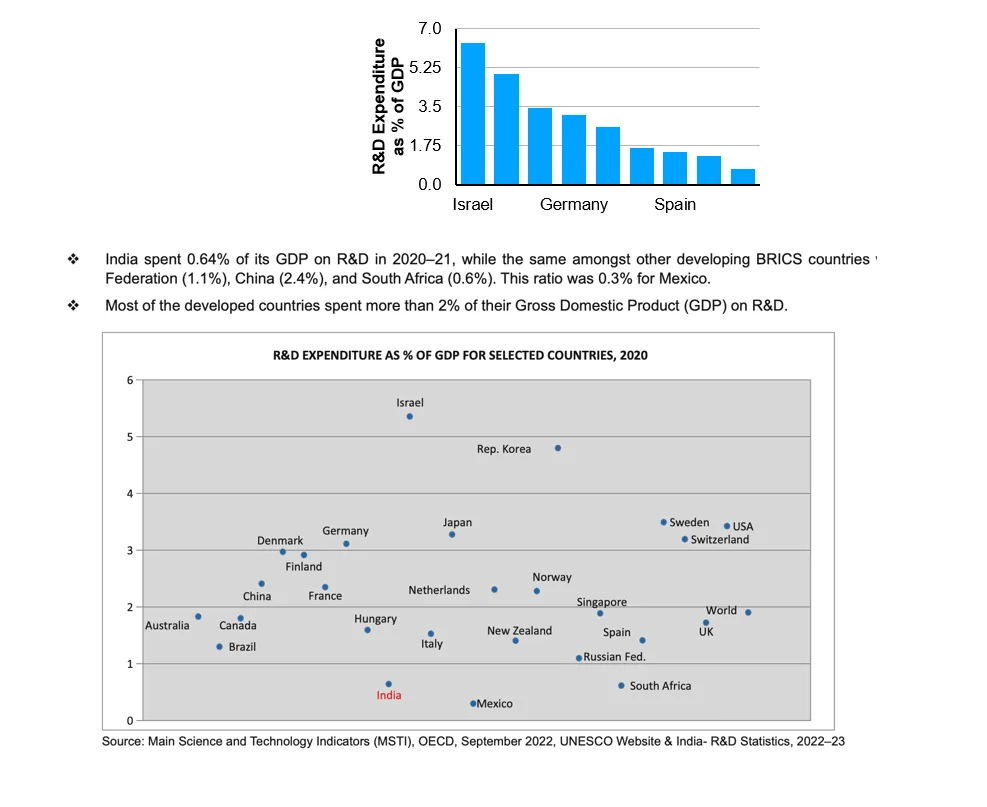
As per a press release on 5 Feb 2026 on pib.gov.in, India’s Gross Expenditure on Research and Development (GERD) is 0.6-0.7 per cent of GDP.
Thus, it is clear that Bharat must increase budget allocation in education and research sector, to catalyse innovation.
ViksitBharat@2047 is vision of Government of India launched in 2023 by PM Modi. Viksit means – to transform Bharat into a developed Nation, that encompasses various aspects of development, including inclusive economic growth, social progress, environmental sustainability, peace and good governance, with a strong focus on participation of the youth in this transformation. The vision is based on 4 pillars – Youth, Poor, Women, Annadata (farmers). Objectives of ViksitBharat@2047 are:
• Zero poverty
• 100% good quality school education
• Access to high quality, affordable and comprehensive Health Care
• 100% skilled labour
• 70% of women in economic activity
• Farmers making our country the food basket of the world
We must ‘think big & dream high.’ Today research fields are evolving very rapidly, and we need to keep pace with the latest developments in R&D. Keeping focus on quality (not quantity) of research in basic sciences to produce cutting-edge research & innovation, thereby contributing to making of ViksitBharat@2047 is need of hour today. Everyone of us must work to achieve this vision, through contribution to education sector, as education is the backbone of knowledge economy. More importantly, we need to integrate ancient Indian Knowledge System (IKS) with modern technology, so that locally important and globally relevant traditional knowledge of different regions of Bharat may be percolated to text books right from school level. Let’s not forget that Sanskriti (culture) and Parampara (traditions) which have transcended across several thousands of years for living Nation Bharat that have tested rough weathers of time, can never be wrong its people.