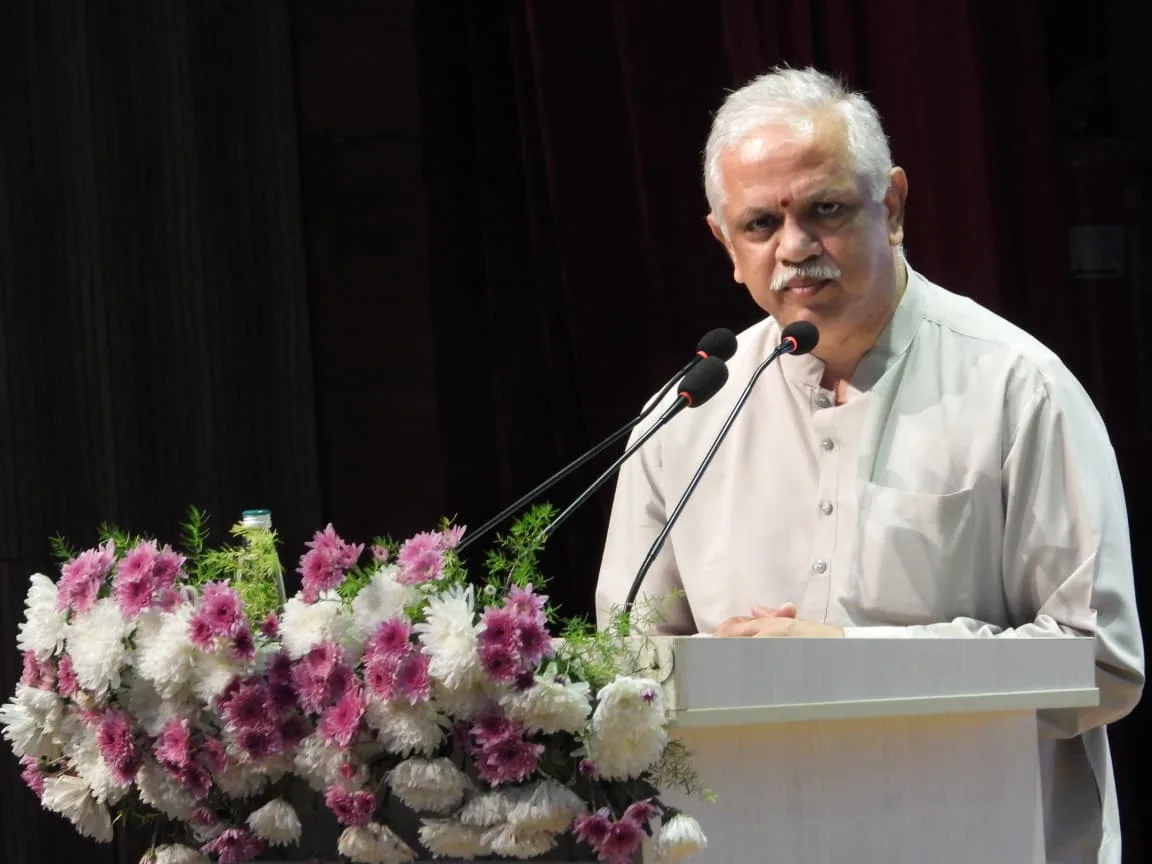
For a strong and healthy nation, our society must transition from being rule-based to value-based, said B.L. Santhosh, National General Secretary (Organisation) of the Bharatiya Janata Party. Referring to Bhagwan Rama as an eternal ideal, he said that an individual can attain greatness through values.
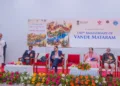
He made these remarks during the session titled “Philosophy to Policy: Contemporary Political, Economic and Civilisational Challenges – Bharatiya Perspectives” on the concluding day of the three-day international seminar “Integral Humanism: India’s Worldview”, held from March 25 to 27, 2026, at Karnataka State Open University. The seminar was organised jointly by Prajna Pravah and the Dr Syama Prasad Mookerjee Research Foundation (SPMRF).
He noted that while implementing the Indian worldview, challenges arise at multiple levels—individuals, society, education, policymakers, and governance. A major obstacle, he said, is the influence of Western thought and lifestyle. He questioned how decolonisation can succeed when even its proponents carry colonial mindsets.
Santhosh also highlighted that ideologically weak voters create weak governance systems, stressing the need for aware and value-driven citizens. He called for reduced state control and greater community-led governance.
Another panellist, Prof. K.V. Raju, member of the Prime Minister’s Economic Advisory Council, stressed the need for clarity in implementing Integral Humanism across sectors. He emphasized actionable outcomes from such seminars, including clear roadmaps, responsibilities, and measurable impact.
Sharing her thoughts on the topic, Prof. Shantisree Dhulipudi Pandit, Vice-Chancellor of Jawaharlal Nehru University, underlined the need to restructure education systems to effectively present the Indian narrative globally, especially in a polarized world.
Valedictory Session
Raghunandan, a national team member of Prajna Pravah, stated that Integral Humanism reflects India’s traditional way of life rather than a new ideology. He stressed that social systems must remain stronger than political systems and warned about the erosion of family structures.
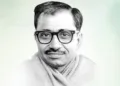
He pointed out the misuse of the term “Dharma” as synonymous with religion and stressed its deeper philosophical meaning. Quoting Deendayal Upadhyaya, he said foreign ideas must be adapted to Indian needs, and indigenous ideas must evolve with time.
Binay Kumar Singh, Director of the Dr. Syama Prasad Mookerjee Research Foundation, highlighted that the concept of Antyodaya (upliftment of the last person) draws inspiration from Ram Rajya. He also noted that Indian philosophy emphasizes ethical restraint even in war, rooted in the principle of Vasudhaiva Kutumbakam (the world is one family).
He concluded that India’s development model must go beyond economic strength to include social, cultural, and value-based progress.