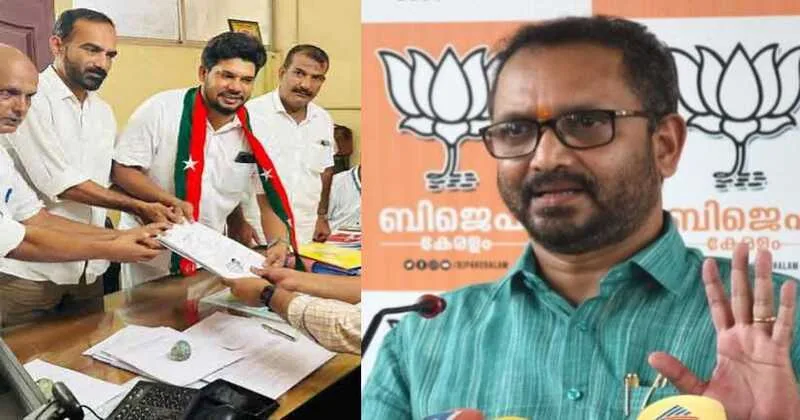
Kasaragod: Under pressure from religious organisations, the Muslim League, and the Congress, SDPI candidate K.M. Ashraf withdrew his nomination from the Collectorate in the Manjeswaram Assembly constituency in Kasaragod district. The SDPI is widely regarded as the political wing of the banned Popular Front of India (PFI). Soon after, he also resigned from the District Council, marking a significant political development in one of Kerala’s most closely watched constituencies.
K.M. Ashraf, whose name closely resembles that of UDF candidate A.K.M. Ashraf, had earlier been associated with the UDF. The SDPI had extended support to the UDF during the 2016 and 2021 Assembly elections. According to political sources, the Muslim League and leaders from Panakkad exerted pressure on the SDPI to withdraw its candidate. Subsequently, SDPI state leaders intervened, arriving in Manjeswaram on the morning of the decision. After holding internal discussions, the party chose to withdraw its nomination.
A high-stakes contest in Manjeswaram
Manjeswaram has emerged as a key battleground in Kerala politics, attracting intense attention due to its history of narrow electoral margins. In the previous elections, the BJP lost the constituency by a very small margin, making it a strategic target this time. Former BJP state president K. Surendran is contesting as the NDA candidate. The LDF has fielded CPI(M) district secretariat member K.R. Jayananda, while the UDF is represented by A.K.M. Ashraf of the Muslim League.
Earlier, there had been discussions within the LDF to field Shanavas Padur as the candidate. However, he was ultimately shifted to contest from the Kasaragod constituency. This decision was reportedly taken based on the assessment that Padur’s presence in Manjeswaram could create a favourable environment for the BJP.
Although the LDF does not traditionally hold strong influence in the constituency, the votes secured by its candidate are often decisive in determining the final outcome. The constituency has witnessed extremely close contests in the past. In the 2016 Assembly elections, K. Surendran lost by just 89 votes, leading to allegations of fake voting and subsequent legal disputes. In the 2021 elections, Muslim League candidate A.K.M. Ashraf won the seat by a margin of 745 votes. The NDA is now confident that Surendran can convert his previous near-misses into a victory this time, especially given the shifting political equations.
Surendran alleges UDF–SDPI nexus
Reacting to the withdrawal of the SDPI candidate, K. Surendran alleged that the UDF’s top leadership was behind the move. He further claimed that religious leadership without formal political affiliations had also intervened to ensure the withdrawal. According to Surendran, the development exposes an underlying relationship between the UDF and the SDPI. He criticised what he described as the UDF’s contradictory stance, accusing leaders who had publicly rejected SDPI support of now seeking its votes.
Surendran also challenged Opposition Leader V.D. Satheesan to clarify his position. He questioned whether Satheesan, who has repeatedly asserted a commitment to secularism, would openly state that he does not want SDPI support. Using strong rhetoric, Surendran suggested that political opportunism had replaced ideological consistency within the opposition.
He further expressed confidence that the BJP would receive support from sections of the Muslim community in this election. Emphasising the NDA’s development agenda, Surendran asserted that the alliance would remain firm and ultimately secure victory in Manjeswaram, regardless of opposition tactics. He also warned that voters would punish those engaging in what he termed “dirty politics,” adding that the electorate is closely observing the unfolding developments.
Allegations of communal alignments and political opportunism
The political discourse in Manjeswaram has also been shaped by broader allegations of communal alignments. Critics argue that both the Left and the Congress-led UDF are relying on religious organisations to strengthen their electoral prospects, rather than engaging in substantive political debate. The UDF has been accused of working with Jamaat-e-Islami, which had earlier announced its support for the alliance. Opposition Leader V.D. Satheesan had stated that Jamaat-e-Islami had moved away from its earlier advocacy of a theocratic state, a claim that further consolidated its ties with the Congress.
On the other hand, the LDF has faced criticism for aligning with organisations such as the SDPI and the PDP, led by Abdul Nasser Madani. The PDP has publicly declared its support for the LDF, adding another dimension to the evolving political alliances. Both fronts have been accused of attempting to mobilise voters by appealing to religious sentiments, particularly on contentious issues such as the Citizenship Amendment Act and triple talaq. Observers note that the UDF had previously benefited from such alignments during the Lok Sabha and local body elections. The CPI(M), in turn, is seen as attempting to counter this advantage through its own outreach strategies.
As the BJP and NDA intensify their campaign, claiming gains in multiple constituencies, both the LDF and UDF are alleged to be resorting to what critics describe as “last-resort tactics.” These include reviving long-standing allegations and engaging in mutual accusations of proximity to the BJP. In this highly polarised environment, both fronts are accused of attempting to consolidate the Muslim vote bank by portraying each other as indirectly aligned with the BJP. Such strategies, however, have also drawn criticism for spreading misinformation and diverting attention from governance and development issues.
With the campaign entering a crucial phase, Manjeswaram stands as a microcosm of Kerala’s larger political contest, marked by tight margins, shifting alliances, and intense ideological battles.