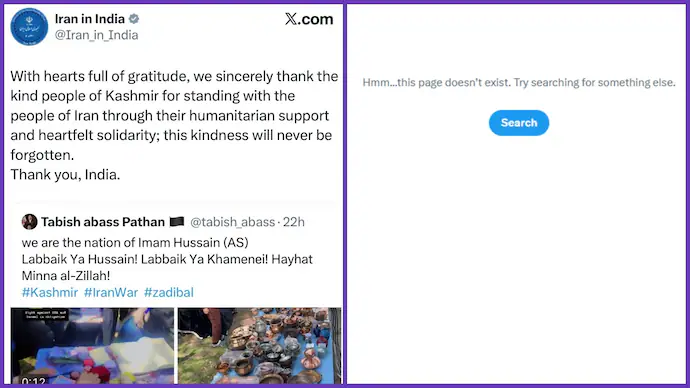
In a development that has raised eyebrows in diplomatic and public circles, the Iranian Embassy in New Delhi deleted a series of social media posts that had expressed gratitude to India and the “kind people of Kashmir” for humanitarian aid sent to Iran.
The posts, shared earlier this week through the embassy’s official handle “Iran in India” on X (formerly Twitter), showcased images and videos of relief material and donations collected from across India, including Jammu and Kashmir. However, these acknowledgements were later quietly removed without any official clarification.
The sudden deletion has led to widespread speculation about the reasons behind the move, particularly in the context of geopolitical sensitivities surrounding Kashmir.
Before being taken down, the embassy’s posts had highlighted a wave of humanitarian support extended by Indian citizens for Iranians affected by ongoing conflict linked to US-Israeli strikes.
The posts specifically mentioned contributions from Jammu and Kashmir, where people reportedly came together after Eid-ul-Fitr celebrations to organise donation drives. These efforts cut across community lines, reflecting a broader humanitarian response.
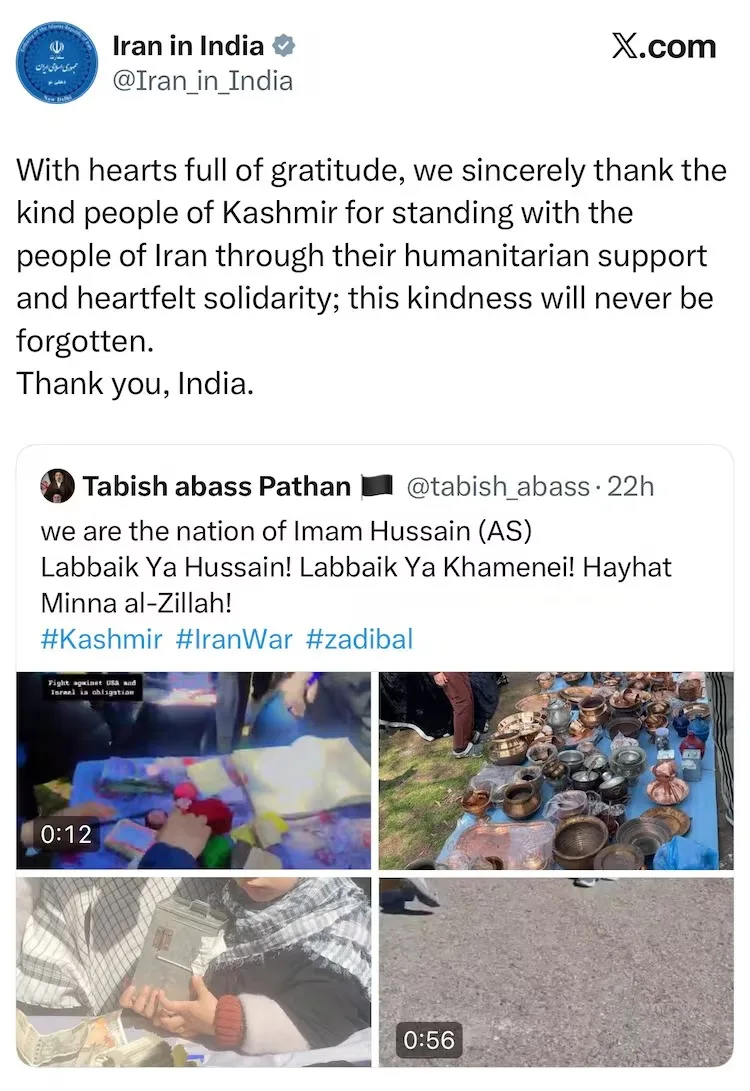
According to details shared by the embassy, donations included cash, gold and silver jewellery, livestock, and household items such as brass and copper utensils. Many individuals, particularly women, were said to have donated personal valuables as a gesture of solidarity.
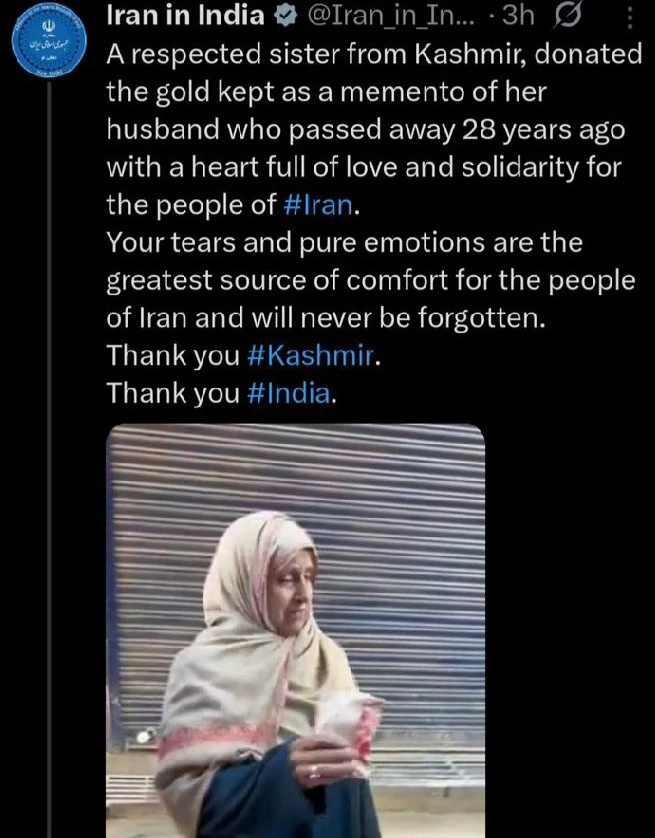
One of the most emotionally resonant examples cited by the embassy involved a widow who donated a gold memento she had preserved for 28 years in memory of her late husband. The post described her act as one of deep compassion and empathy, stating that such gestures would “never be forgotten.”
In a widely circulated message, the embassy had written: “With hearts full of gratitude, we sincerely thank the kind people of Kashmir for standing with the people of Iran… Thank you, India.” This message, too, was later deleted.
Edited reposts drop references to India and Kashmir
Interestingly, some of the deleted content reappeared in modified form. In these reposts, references to both India and Kashmir were removed, leaving only a generic expression of gratitude.
For instance, a video earlier captioned with detailed references to Kashmir and India was re-uploaded with a brief message: “We will never forget your kindness.”
We will never forget your kindness. pic.twitter.com/mLbk27DFKy
— Iran in India (@Iran_in_India) March 24, 2026
This selective editing has further intensified speculation that the deletions were not accidental but part of a conscious effort to alter the narrative.
The deletions appear to have coincided with a wave of online criticism, largely from Pakistan-based social media users. Several accounts reportedly objected to the embassy referring to Kashmir as part of India, calling it a “disputed territory.”
Some users demanded that Iran “correct” its position and even apologise for the wording used in the original posts. The coordinated nature of these responses has led observers to question whether online pressure influenced the embassy’s decision.
While there is no official confirmation linking the deletions to such reactions, the timing has fuelled speculation that diplomatic sensitivities and digital backlash may have played a role.
The move has also drawn reactions from Indian users, many of whom questioned why the embassy chose to delete posts acknowledging humanitarian aid.
Some voices on social media have called on the Ministry of External Affairs to take note of the development, arguing that such actions could undermine the goodwill generated by Indian citizens’ contributions.
Others have pointed out that humanitarian gestures should remain above political considerations, emphasising that the aid was extended in a spirit of solidarity rather than geopolitics.
India-Iran relations and the Kashmir sensitivity
India and Iran share longstanding diplomatic, cultural, and economic ties. Cooperation between the two countries spans sectors such as trade, energy, and regional connectivity.
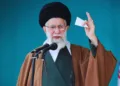
However, Kashmir has historically been a sensitive issue in bilateral relations. In 2019, following India’s decision to revoke the special status of Jammu and Kashmir, Iran’s Supreme Leader Ayatollah Ali Khamenei had expressed concern over the situation of Muslims in the region.
India had reacted strongly at the time, summoning the Iranian envoy and reiterating its position that Jammu and Kashmir is an integral part of India.
The latest episode, though relatively minor in diplomatic terms, once again highlights how references to Kashmir can quickly become contentious in international discourse.
What began as a story of compassion and cross-border solidarity has now turned into a subject of diplomatic speculation. The quiet deletion of posts has raised more questions than answers, particularly about the influence of online pressure on official communication.
At its core, the episode highlights the delicate interplay between humanitarian efforts and geopolitical sensitivities. While the aid extended by Indian citizens, including those in Jammu and Kashmir, remains a significant gesture, the controversy surrounding its acknowledgement highlight the complexities of modern diplomacy.