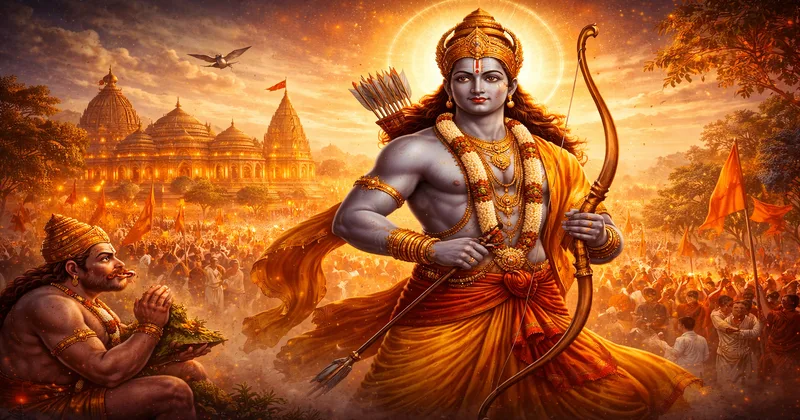
The global Sanatani community had long cherished the sacred aspiration of witnessing a grand, divine, and magnificent temple at the birthplace of Bhagwan Shri Ram in Ayodhya. After centuries of penance, sacrifice, and relentless struggle, that resolve has finally been fulfilled. Not only the nation, but the entire world has borne witness to this momentous phase of India’s cultural renaissance. This event is not merely the construction of a temple; it represents the re-establishment of faith, perseverance, and the continuity of India’s civilizational ethos. Today, millions of devotees from across the country and the world visit Ayodhya daily to seek the darshan of Ram Lalla and experience a profound sense of spiritual fulfilment. Following the consecration of the deity, not only Ayodhya but also its surrounding towns have undergone a remarkable transformation. Ayodhya today stands as a symbol of India’s resurgence and as a proud bearer of its spiritual and civilizational legacy.
Those who once questioned the very existence of Bhagwan Shri Ram, dismissing Him as a mythical figure and making unwarranted assertions, now appear to have significantly altered their stance following the construction of the Shri Ram Temple and the consecration of Ram Lalla. So marked is this shift that many among them, perhaps apprehensive of being relegated to the margins of history, have reversed their positions and begun to align themselves with the very ideals they once contested. Even those individuals and communities who had approached the courts to obstruct the construction of the Shri Ram Temple are today, albeit cautiously, acknowledging that had the path to temple construction been paved through dialogue and mutual understanding, it would have been more conducive to social harmony.
This transformation is not merely of individuals; it reflects a broader shift in the direction of time itself and signals the rising global resonance of Sanatan thought. It stands as a living affirmation of the eternal principle that “truth ultimately prevails.” Furthermore, even those influenced by colonial and ideological frameworks – often shaped by Marxist and Macaulayan thought – are now, to some extent, beginning to recognise and appreciate the dignity and depth of Shri Ram and the philosophy of Ramatva. There should remain no doubt that Shri Ram embodies the very essence of India’s identity, its civilizational self, and its dharmic consciousness. In essence, the character of Shri Ram is so pure, expansive, generous and elevating that it inevitably draws all into its sphere of influence. Ram is not merely an object of faith, but a timeless civilizational worldview – one that inspires individuals to rise above the self and live for society and the greater collective. His life offers a profound understanding of duty and righteousness, of dharma and adharma. He weaves humanity into the fabric of moral restraint and higher ideals. His life and legacy continue to inspire, engage, and be reinterpreted across ages, finding ever-renewed expression in the hearts and works of saints, scholars, writers, and spiritual exponents.
It is a universally accepted truth that Ram is the consciousness of Bharat, the soul of Bharat, and its vital life force. He is the living and manifest embodiment of dharma. It would be more appropriate to say that Ram himself is dharma. As has been said, “Ramo Vigrahavan Dharmah.” In simple terms, whatever is noble, beautiful, meaningful, exemplary, and worthy of reflection in human life exists within Ram or the essence of Ram. This is why he is called Maryada Purushottam. This is a distinction that has perhaps not been accorded to any other deity or incarnation. It establishes him at the highest pinnacle of ideals.
In our social and national life today, if there is anything most needed, it is dignified and disciplined conduct. Ram is a character who sets ideals in every role, such as that of a son, brother, husband, friend, king, and forest dweller (Vanvasi). He establishes a standard of conduct in both personal and public life that transcends time, place, and circumstance, and teaches every individual, society, and nation the values of humility, restraint, patience, and discipline. In every situation, the principles of dharma and proper conduct can be learned from Shri Ram. It is indeed ironic that in the land of Maryada Purushottam, we often witness conduct that lacks dignity and restraint. In particular, when individuals in positions of responsibility display disorderly, unrestrained, and arrogant behaviour, make irresponsible remarks, and engage in unethical actions, this leads to the erosion of social and public decorum. Whether one belongs to the ruling side or the opposition, whether ordinary or distinguished, all citizens are expected to uphold dignified conduct. The future of any free and awakened nation lies in the fulfilment of duties and in disciplined and principled behaviour. Power often gives rise to authoritarian tendencies, and from such tendencies emerge ego and arbitrariness. Yet Ram remained untouched by ego. Throughout his life, he embodied truth, character, compassion, and humility, and this remains the highest inspiration of his character.
Though a king, Ram was a profound upholder of democratic values; yet his conception of democracy was not confined to the arithmetic of majority (Bahumat), but was rooted in the spirit of consensus and collective harmony (SarvaMat). He did not believe in the politics of division; rather, he was a unifier – one who brought people together, never one who fractured society. Within his moral and social order, all found equal place – whether so-called upper or lower, privileged or marginalised, forest-dwellers (Vanvasi), hill communities (Girivasi), or urban citizens. Ram transcends the boundaries of caste and class. His sense of kinship extends across all beings – humans, vanaras, tribal communities, animals, and even those regarded as adversaries. Whether it was Nishadraj or Sugriva, Shabari or Jatayu, Ram embraced all with equal warmth, mingled with them with genuine affection, and carried them along in his journey.
Those whom contemporary politics often categorises and fragments into identities – tribal, Dalit, deprived, backwards, or forward – and at times reduces to mere vote banks, were embraced by Ram in a spirit of deep friendship and dignity. His approach was to alleviate the suffering of every section of society and bind them together in a thread of unity. He never treated people as means, but always as ends worthy of respect. He excluded none; he accepted all with sincerity and openness. In his vision, none were dispensable – everyone was worthy; none were outsiders – everyone belonged. Ram stands as a seeker and sustainer of unity.
The very purpose of his life was to bring together virtuous forces and establish a fearless and just social order. The eradication of evil (Durjan) and the elevation of the righteous (Sajjan Shakti) formed the core of his resolve. His ability to organise and unite people was extraordinary and unparalleled – an example that remains relevant, valid, and worthy of emulation in every age. It is worth reflecting that when he departed from Ayodhya for the forest, he was accompanied by only two individuals; yet upon his return, he was followed by the affection and blessings of an entire society. Indeed, anyone who came into his fold became his own. It is no coincidence that he left Ayodhya as a crown prince, but returned as Maryada Purushottam – the supreme exemplar of righteousness – an eternal ideal who will continue to guide humanity towards harmony, justice, and compassion for ages to come.
In Ram’s conception of governance, there is the humility to learn even from an adversary, along with a deep sense of responsibility to address, with sincerity and satisfaction, the concerns raised by even the last person in society (the Dhobi). For this reason, Ram belongs to all and resides in all. He is as much the embodiment of the formless (Nirguna) as he is of the manifest (Saguna). He belongs as much to Tulsidas as to Kabir, Nanak, and Raidas. He is not confined to one community; he is as much revered within Hindu traditions as he is respected across Buddhist, Jain, and Sikh thought. In essence, Ram serves as a unifying thread across the diverse spiritual traditions of Bharat. The scope of his compassion extends beyond human society to encompass animals, birds, and all living beings. Such is the vastness of his empathy. He is all-pervading (Sarvavyapi), all-embracing (SarvaSaparshi), and universally accessible (SarvaGrahi).
In essence, within Ram’s ideal state, the highest measure of civic virtue is the excellence of one’s conduct – not identity, division, or numerical considerations of caste. He stands as a living embodiment of a culture rooted in harmony and integration. His vision of social cohesion is not confined to slogans or declarations; it finds expression in lived conduct and everyday interactions. There is no place in his framework for political maneuvering that seeks to exploit caste divisions or foment social discord for the sake of power, nor for self-serving pursuits driven by short-term gains. Ram brings together even opposing poles and divergent ideas. His entire life is a unique and profound example of reconciling contradictions. He is not a proponent of conflict, but a pioneer of dialogue and resolution.
Ram is not merely a hero of the Sanatan tradition, but its great and universal exemplar. His greatness is not confined within the geographical boundaries of a nation; it transcends them and resonates across the world. It is no coincidence that wherever followers of the Sanatan tradition have travelled, they have carried the name of Ram with them. Even when separated from their homeland, the significance, value, and spiritual meaning of Ram’s name have remained alive in their lives and memories. This singular connection has helped them remain rooted in their faith, culture, and civilizational identity. The truth is that Ram is synonymous with Sanatan, and Sanatan with Ram. In the remembrance of His name and the celebration of His glory, countless devotees find a deep sense of purpose and fulfilment in life.
Across the world, millions draw upon his ideals to interpret and understand the diverse dimensions of life – its contexts, challenges, circumstances, and experiences. He serves as the highest moral touchstone in the conscious and subconscious processes of human decision-making, guiding individuals beyond doubt and inner conflict. He inspires a vision that rises above narrowness and limitation, fostering a deeper sense of values and clarity. In the sacred flow of Ram’s name, all traces of envy, hatred, ego, alienation, and division dissolve. For those who truly understand and revere Ram, the entire world becomes one family, imbued with the spirit of “Siyarammay sab jag jani.” The narrative of Ram is itself global in its reach. While the story of Ram has been composed in numerous Indian languages, it has also found expression in many cultures and languages across the world. Beyond India, traces of the Ramayana tradition can be found in Nepal, Laos, Cambodia, Malaysia, Indonesia, Bali, Java, Sumatra, Thailand, the Philippines, Vietnam, Bangladesh, Tibet, Bhutan, Sri Lanka, China, Mongolia, Japan, Korea, Suriname, Mauritius, Iraq, Syria, Honduras in the United States, Egypt, Turkey, and several other regions. Thus, Ram is universal – timeless, global, and all-embracing. In an age when the world is grappling with conflicts, divisions, and a crisis of values, the ideals of Ram and the philosophy of Ramatva offer meaningful guidance not only for Bharat but for all of humanity.