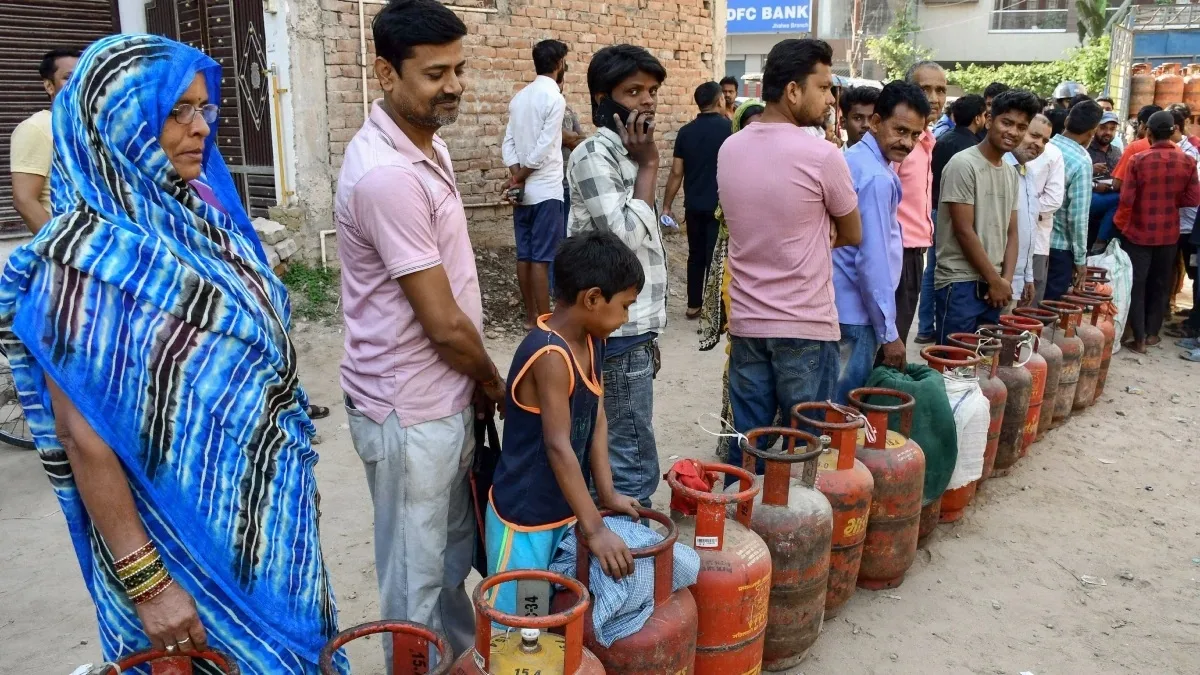
In recent days, visuals of long queues at fuel stations, from Hyderabad to Ahmedabad and Indore, have triggered widespread concern among citizens. Social media has been flooded with claims of an impending fuel shortage, pushing people to rush to petrol pumps, often filling tanks unnecessarily or even storing fuel in containers.
But officials insist that the panic is misplaced.
The Ministry of Petroleum and Natural Gas has categorically stated that there is no nationwide shortage of petrol, diesel, or LPG. Supplies remain stable, refineries are operating at high capacity, and distribution networks are functioning normally.
What India is witnessing, reports say, is not a supply crisis but a crisis of perception.
How rumours triggered real-world chaos
The panic appears to have been sparked by viral social media messages linking the ongoing tensions in West Asia, particularly concerns around the Strait of Hormuz to India’s fuel supply.
These messages, often accompanied by misleading visuals of ‘No Stock’ boards, created a sense of urgency. In many cases, the images were either outdated or taken out of context, but their impact was immediate and widespread.
Within hours, petrol pumps in multiple cities began witnessing unprecedented crowds.
In Hyderabad, areas like Jubilee Hills, Banjara Hills, and Ameerpet saw serpentine queues, with traffic disruptions reported across key junctions. Police had to step in, using public announcement systems to calm anxious motorists.
Similarly, in Gujarat, cities like Ahmedabad and Mehsana saw fuel demand surge to 8-10 times normal levels. In one instance, nearly 3,500 litres of diesel were sold within just two hours, fuel that would typically last an entire day or more.
When demand becomes the problem
The irony of the situation lies in the fact that the shortage people feared began to appear only after panic buying intensified.
According to estimates, fuel sales in several regions surged to 2.5 to 3 times normal levels, leading to temporary stock exhaustion at retail outlets. These were not supply failures but the result of sudden, abnormal demand spikes.
As officials pointed out, fuel supply chains are designed to meet predictable consumption patterns. When demand multiplies overnight, even a robust system can face short-term stress.
This is why some petrol pumps briefly displayed ‘No Stock’ signs, not because fuel was unavailable, but because it had been sold out faster than it could be replenished.
Ground reports show panic across states
The ripple effect of rumours was visible across multiple states.
In Ujjain, despite sufficient stock, 40,000 litres of diesel and 16,000 litres of petrol pumps ran dry temporarily due to overwhelming demand. Similar scenes were reported in Dewas, Ratlam, and Shajapur.
In Agra and parts of rural Uttar Pradesh, late-night crowds gathered at fuel stations, with people rushing to top up tanks as a precaution. In some cases, pumps had to shut temporarily to manage the rush.
In Bikaner, panic buying flared up briefly before subsiding once authorities intervened and reassured the public.
One of the most striking incidents was reported from Balaghat in Madhya Pradesh, where people queued up late at night carrying bottles and cans to store fuel. The scene reflected not a shortage, but a deep-seated anxiety fuelled by misinformation.
While panic buying was the primary driver, some localised issues added to the confusion.
In Solapur, for instance, a shortage of LPG auto gas led to long queues of auto-rickshaws stretching over a kilometre. However, this was due to limited infrastructure, only one operational pump not a broader fuel shortage.
Similarly, temporary disruptions caused by dealer-payment issues or logistical delays were misinterpreted as signs of a larger crisis.
Reports caution that such localised challenges, when amplified through social media, can create a false narrative of nationwide scarcity.
Government steps in
Amid growing concern, the government has taken multiple steps to address both the perception and the reality of the situation.
Officials from the Ministry have reiterated that adequate fuel stocks are available across the country. They have urged citizens not to engage in panic buying and to rely only on verified information.
“Petrol pumps across the country remain fully functional, though panic buying triggered by rumours led to unusually high sales in some areas,” a senior official was quoted as saying in the media.
The government has also intensified monitoring and enforcement. Over 3,400 raids have been conducted to curb hoarding and black marketing, resulting in 642 FIRs and 155 arrests.
Additionally, efforts are being made to boost supply resilience, including increasing LPG production and expanding PNG connections to reduce dependence on cylinders.
The Petroleum and Natural Gas Regulatory Board is also overseeing infrastructure expansion to ensure smoother distribution in the long term.
Role of social media: A double-edged sword
The current situation highlights the powerful and often dangerous role of social media in shaping public behaviour.
Platforms that enable rapid information sharing can also become breeding grounds for misinformation. In this case, unverified claims and sensational posts triggered real-world consequences, from traffic snarls to temporary supply disruptions.
Many have described social media as a “double-edged sword” capable of informing, but also misleading.
The speed at which rumours spread often outpaces official clarifications, making it difficult to control panic once it sets in.
Panic buying is not a new phenomenon. It has been observed during crises ranging from natural disasters to pandemics. But its impact on essential commodities like fuel can be particularly disruptive.
When consumers rush to stock up beyond their immediate needs, it creates artificial demand. This, in turn, leads to:
1. Temporary stock depletion at retail outlets
2. Increased pressure on supply chains
3. Inconvenience for genuine users, including emergency services
4. Potential price fluctuations in extreme cases
In essence, panic buying can create the very shortage it seeks to avoid.
Reports emphasise that fuel supply systems are designed to function efficiently under normal conditions. Sudden spikes in demand disrupt this balance, leading to short-term challenges that could otherwise be avoided.
Energy security and the global context
While the current panic is largely unfounded, it is not entirely disconnected from global realities.
The ongoing tensions in West Asia, particularly around key shipping routes like the Strait of Hormuz, do have the potential to impact global energy markets. India, being a major importer of crude oil and LPG, remains sensitive to such developments.
However, officials have clarified that India has sufficient buffer stocks and diversified supply sources to manage short-term disruptions.
The government has also set up expert groups to monitor the situation and respond proactively to any emerging challenges.
At its core, the current situation is a reminder of the importance of responsible consumption and informed decision-making.
Authorities have repeatedly urged citizens to: Avoid panic buying, rely on official sources for information, use fuel judiciously and refrain from spreading unverified claims.
“Citizens need not queue at petrol pumps, as fuel will be available whenever required,” officials were reported as saying, emphasising that the system is robust enough to meet demand, provided it remains rational.
The scenes unfolding across Indian cities are not just about fuel, they are about trust, information, and collective behaviour.
In an age where a single viral message can influence thousands, managing perception becomes as important as managing supply.
India is not facing a fuel shortage. But the fear of one, amplified by misinformation and human instinct, has momentarily disrupted normalcy.
The lesson is clear: in times of uncertainty, calm and clarity are as essential as fuel itself.