From a nation where women walked miles for water to one where 15.72 crore rural homes have taps, this is the success story of Jal Jeevan Mission and India’s broader water revolution.
For generations, the sight of women carrying heavy pots of water on their heads before sunrise was a common view in rural India. It was simply a life at that time. It was what women were made to do. In thousands of villages across Uttar Pradesh, Rajasthan, Bihar, and Jharkhand, a daughter’s morning began not with school but with the long walk to the nearest well, pond or handpump, which is sometimes two kilometres away or more. This daily ritual consumed time, health and dignity; it had been done so long that no one could remember.
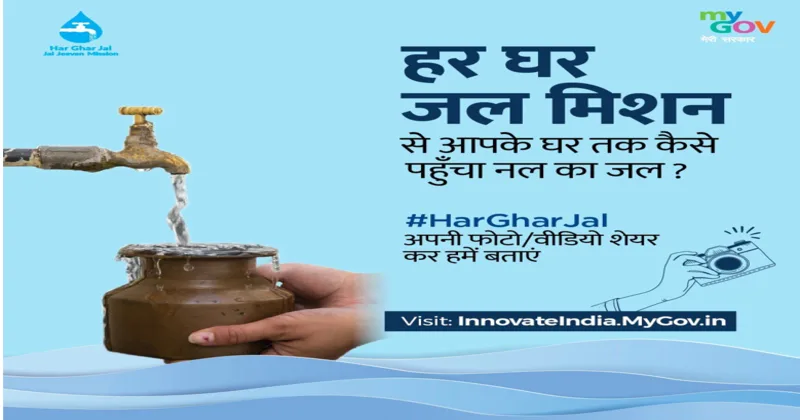
On August 15, 2019, Prime Minister Narendra Modi stood at the Red Fort and announced that this would change. The Jal Jeevan Mission- Har Ghar Jal, was born with one promise, which was to provide a functional tap water connection in every rural home in India. At the time of the announcement, only 3.23 crore rural households, roughly 16.7 per cent of all households, had a tap connection. The government is slowly justifying what was being promised. It must have happened, since it is one of the most remarkable stories in the history of public administration in independent India.
What the Mission Is and What It Set Out to Do
The Jal Jeevan Mission is implemented by the Department of Drinking Water and Sanitation under the Ministry of Jal Shakti, in partnership with every state and union territory. Water, being a state subject under the Constitution, means the primary responsibility for building and running piped water schemes rests with state governments. The central government’s role is to supplement these efforts with financial and technical support. The total central outlay approved for the Mission is Rs 2,08,652 crore, the single largest investment ever made in rural drinking water infrastructure in this country.
The goal is not just to lay pipes. It is to ensure that every rural household receives water at a minimum service level of 55 litres per capita per day of prescribed quality under BIS:10500 standards on a regular and long-term basis. This distinction between a connection that exists on paper and one that actually delivers clean water reliably is through design, and it shapes every aspect of how the programme is monitored, evaluated and improved.
The progress made between August 2019 and today is possible because of the government’s honest measures. As of October 2025, more than 15.72 crore rural households across India now receive clean drinking water through household taps, representing over 81 per cent of India’s approximately 19.36 crore rural households. In six years, 12.48 crore additional homes were connected. In the seven decades between Independence and 2019, India had managed to connect 3.23 crore rural homes. The Mission connected nearly four times that number in six years.
Eleven states and union territories, including Goa, Haryana, Gujarat, Arunachal Pradesh and Telangana, have achieved 100 per cent household tap water connectivity. Tap water has reached all households, schools and Anganwadi centres in 192 districts. Full coverage has been achieved in 1,912 blocks, 1,25,185 Gram Panchayats and 2,66,273 villages. Tap water supply has been ensured in 9,23,297 schools and 9,66,876 Anganwadi centres across the country.
What This Means for Ordinary Citizens
The real story of the Jal Jeevan Mission is written in the changed routines of crores of Indian families. The World Health Organisation has calculated that when tap water reaches every rural household in India, the country will collectively save more than 5.5 crore hours every single day that were previously consumed in fetching water. Three-quarters of those saved hours belong to women. That is time that can now go to work, to school, to rest, to business, to simply being present in a family without the shadow of a daily chore that should have been solved decades ago.
The health implications are equally profound. WHO estimates that ensuring safe drinking water for all Indian households could prevent nearly 4 lakh deaths from diarrhoea diseases annually, saving approximately 1.4 crore Disability Adjusted Life Years (DALYs). Nobel laureate Professor Michael Kremer’s research concludes that safe water coverage could reduce mortality among children under five by nearly 30 per cent, potentially saving 1,36,000 young lives every year. These are not aspirational projections. They are the measured, peer-reviewed consequences of what tap and clean water at home actually do for a family’s survival chances.
The economic dimension is no less significant. IIM Bangalore, working with the International Labour Organisation, has estimated that the Mission will generate 59.9 lakh person-years of direct employment during its capital expenditure phase, along with 2.2 crore person-years of indirect employment. Its operation and maintenance phase is projected to generate a further 13.3 lakh person-years of direct employment. Water infrastructure is not just welfare. It is economic activity, rural jobs and community livelihoods.
The Technology Behind the Tap
What makes the Jal Jeevan Mission different from earlier rural water programmes is not just scale but architecture. The Mission has built a digital backbone that tracks every connection, village and complaint in real time. The Integrated Management Information System (IMIS), with its portal and mobile app, operates simultaneously at the Panchayat, district, state, and national levels. Every asset created under the Mission is geo-tagged through the Sujalam Bharat App. Pipeline data is uploaded on the PM Gati Shakti portal. Beneficiaries are linked through Aadhaar seeding, creating a multi-layered verification system that ensures the numbers on the dashboard correspond to real households receiving real water. IoT-based sensors installed across villages, including in high-altitude and hard-to-reach terrain, replace manual oversight with automated, real-time monitoring of water services. These devices track flow, quality and supply continuity, flagging gaps before they become crises. In December 2025, the Department launched Jal Seva Aankalan, under which Village Water and Sanitation Committees conduct village-level assessments. Data is presented at the Gram Sabha, digitally submitted by the Panchayat Secretary via the JJM-IMIS Dashboard, and then reviewed by district and state authorities to identify service gaps and develop improvement plans. This is governance that closes the loop from the ground up.
Water quality has its own institutional infrastructure. During 2025–26, a network of 2,843 laboratories tested 38.78 lakh water samples across 4,49,961 villages. And in a genuinely innovative step toward community ownership, 24.80 lakh rural women have been trained to test water quality using Field Testing Kits in more than 5 lakh villages. These women are not just beneficiaries. They are frontline monitors of the system that serves them.
Protecting the Source: The Conservation Ecosystem
The architects of India’s water policy understood why the Jal Jeevan Mission sits within a much broader ecosystem of water security initiatives. Among these is the Jal Shakti Abhiyan: Catch the Rain, which has now completed six annual editions since its launch in 2019. The campaign’s guiding principle, ‘Catch the Rain, Where It Falls, When It Falls’, is deceptively simple and deeply practical. India receives abundant monsoon rainfall but loses most of it to runoff because the infrastructure to capture it is lacking. Building that infrastructure at scale and with community participation is what the campaign focuses on.
The 6th edition launched on March 22, 2025 (World Water Day) with the theme ‘Jal Sanchay Jan Bhagidari: Jan Jagrukta Ki Or’ focuses on 148 districts identified by the Central Ground Water Board as water-stressed and emphasises grassroots engagement, inter-sectoral convergence and community financing. Since the campaigns launch, more than 75 lakh traditional water bodies and tanks have been renovated, and approximately one crore water conservation and rainwater harvesting structures have been created across the country. The current edition (2025–26) mentions about 1,51,800 traditional water bodies renovated, 2,78,086 reuse and recharge structures built over 10.47 lakh hectares of watershed development, and an astounding 4.6 crore intensive afforestation activities logged across states. India’s first-ever census of water bodies has enlisted 24.24 lakh water bodies for conservation.
Mapping What Lies Beneath: NAQUIM and Groundwater Science
Sustainable rural water supply ultimately depends on knowing what water is underground, where it is, how much there is, and how quickly it is being depleted. India’s answer to this challenge is the National Aquifer Mapping and Management programme, NAQUIM, which began in 2012 and, by March 2023, had mapped approximately 25.15 lakh square kilometres of aquifer area across the country. Those maps and management plans have been shared with all state governments, giving planners a scientific foundation for managing groundwater rather than simply extracting it.
NAQUIM 2.0, launched in 2023, goes deeper. It focuses on village-level studies in priority areas, which are water-stressed regions, urban agglomerations, coastal zones, springs, industrial and mining areas, and regions with poor groundwater quality. So far, 144 studies covering about 77,157 square kilometres have been taken up or completed. The programme also promotes micro-irrigation and crop diversification, reducing farmers’ overreliance on groundwater in already-stressed areas. This is science in the service of livelihoods, and it matters because no tap can survive a dry aquifer.
Villages That Show the Way
Behind the national aggregates are local stories of genuine transformation. In Maharashtra’s Mhapan village, a women’s self-help group has taken over management of the tap water scheme entirely, achieving 100 per cent bill collection and earning Rs 1.70 lakh, making it financially self-sustaining. In Assam’s Borbori village, piped water and hygiene campaigns eliminated waterborne illness, with reported cases dropping from 27 in 2022–23 to zero. In Rajasthan’s Bothara village, the implementation of check dams and infiltration trenches raised the water table by 70 feet, increasing water storage by over 11 per cent. In Nagaland’s Wokha district, communities are protecting drinking water sources through recharge pits and afforestation, ensuring the tap has water to draw from for years to come.
These are not curated exceptions. They are examples of what happens when infrastructure meets community ownership, which is precisely the model the Mission has been designed to encourage. West Bengal’s Jal Mitra app has tracked over 13.70 crore community water activities across 22,111 villages and supported the creation of 4,522 Jal Bachao Committees. Community participation is not a footnote to the Mission; it is its operating system.
Government Commitment Delivered Through a Tap
There is a phrase that Prime Minister Modi has used repeatedly in the context of the “Jal Jeevan Mission is a ease of living”. It is worth pausing on those words. Easy living is not a luxury. It means a mother who does not leave home before sunrise to fetch water. It means a child who does not go to school is already tired from the morning walk to the well. It means a family that does not lose a child to diarrhoea from a contaminated pond. It means a village that does not watch its daughter’s futures drain away in the time spent on a task that should have been automated out of existence a generation ago.
The Jal Jeevan Mission, the Jal Shakti Abhiyan, the NAQUIM programme, and the Jal Seva Aankalan initiative, taken together, form the most comprehensive, coordinated, and science-backed approach to water security that India has ever attempted. The numbers are verification enough in six years, from 3.23 crore connections to 15.72 crore, from 16.71 per cent coverage to over 81 per cent, with Rs 2.08 lakh crore invested and crores of lives visibly changed. Rajasthan alone has recorded over 1.55 crore intensive afforestation activities in a single campaign year. Over 1.97 crore water-related works have been taken up nationwide under JSA-CTR. These projects are on the ground, according to the government’s report.
Self-sufficient Bharat must be built on the foundation of its villages. The Jal Jeevan Mission is not a government scheme. It is the fulfilment of a promise that independent India made to its poorest citizens and, for too long, could not keep because of politics. The tap has finally arrived under NDA led government under the Prime Minister’s leadership. The work now is to make sure it never runs dry.