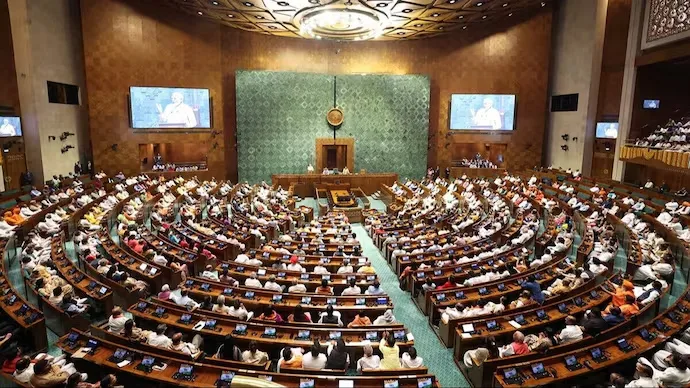
The proposal to expand the strength of the Lok Sabha from its current 543 seats to nearly 816 marks one of the most consequential structural changes in India’s parliamentary history. While the immediate trigger for this expansion lies in the implementation of the women’s reservation law, envisaging 33 per cent seats for women, the implications extend far beyond gender representation. At its core, the move fundamentally reshapes how political power is distributed among states.
At first glance, the idea appears straightforward: increase the total number of seats while retaining the existing proportional share of each state. This ensures that no state loses its current representation in percentage terms. However, beneath this seemingly neutral approach lies a deeper transformation. By increasing the absolute number of seats, the proposal amplifies the political weight of already dominant states, making their influence even more decisive in government formation.
Same Proportion, Greater Influence
The government’s approach of proportional expansion ensures continuity while introducing scale. In theory, every state benefits equally, as their relative share remains unchanged. However, in practice, larger states stand to gain disproportionately in terms of political clout.
Consider states like Uttar Pradesh, Maharashtra, and West Bengal. These states already command significant representation in the Lok Sabha. Under the proposed expansion, their seat counts could rise dramatically, Uttar Pradesh from 80 to around 120, Maharashtra from 48 to 72, and West Bengal from 42 to approximately 63. While their percentage share remains stable, the sheer increase in numbers enhances their bargaining power in coalition politics.
This phenomenon can be described as “numerical amplification.” The influence of these states does not just grow incrementally; it expands in a way that makes them even more central to national politics. Political parties, particularly national ones, will find it increasingly difficult to ignore these regions, as electoral success in these states could determine the fate of governments at the Centre.
Hindi Heartland: Consolidating dominance
The most significant gains in absolute terms are likely to be seen in the Hindi-speaking belt, often referred to as the political heartland of India. States such as Bihar, Madhya Pradesh, and Rajasthan are projected to witness substantial increases in their seat counts.
This expansion further consolidates the dominance of the Hindi belt in parliamentary arithmetic. Even without altering proportional representation, the rise in seat numbers strengthens the region’s already significant role in shaping national outcomes. Historically, electoral trends in these states have often determined the composition of governments in New Delhi. With more seats at stake, their importance is only set to increase.
This has long-term implications for policy priorities as well. Governments may increasingly align their agendas with the socio-political dynamics of these states, given their enhanced electoral significance.
While southern states such as Tamil Nadu, Karnataka, Kerala, Andhra Pradesh, and Telangana will also see an increase in their seat counts, the development has triggered underlying concerns.
The apprehension is not about the immediate expansion, but about what lies ahead. Southern states have historically performed better on population control indicators. If future delimitation exercises are conducted based on updated population data, these states fear a relative decline in their share of seats compared to the more populous northern states.
Thus, while the current proposal maintains the status quo in proportional terms, it indirectly intensifies the long-standing “North vs South” debate. Leaders from southern states have already begun voicing concerns that such reforms could eventually tilt the balance of power further in favour of the Hindi belt.
Coalition politics and the rising majority mark
One of the most immediate consequences of expanding the Lok Sabha is the increase in the majority mark. Currently, a party or coalition requires 272 seats to form a government. With the House expanding to 816 members, this threshold would rise to around 408.
This shift has profound implications for coalition politics. Forming a government will require either a stronger single-party mandate or broader alliances. Regional parties may gain leverage in coalition negotiations, but only if they command significant seat shares within their respective states.
At the same time, national parties will need to recalibrate their electoral strategies. Winning big in a few key states may become even more critical, as larger states contribute a higher number of seats. This could lead to more concentrated campaign efforts and resource allocation in electorally significant regions.
States like Odisha, Jharkhand, and those in the Northeast, including Assam, will also see an increase in their representation. However, these gains are relatively modest compared to those of larger states.
For smaller states and Union Territories, the expansion offers incremental improvements in representation but does not significantly alter their position in national politics. Their influence will continue to depend on strategic alliances rather than sheer numerical strength.
Why the Government chose proportional expansion
The decision to adopt a proportional expansion model appears to be driven by both political pragmatism and administrative necessity. By retaining the existing distribution of seats, the government avoids immediate resistance from states that might otherwise lose representation in a full-scale delimitation exercise.
Moreover, this approach facilitates the implementation of the women’s reservation law without reducing the number of seats currently held by male representatives. By adding new seats instead of redistributing existing ones, the government sidesteps potential political backlash.
At a broader level, the move can also be seen as a transitional step. It allows the system to expand and adapt gradually, buying time before a more contentious delimitation exercise based on updated census data is undertaken.
While the proposed expansion to 816 seats does not immediately redraw India’s political map, it sets the stage for more profound changes in the future. The real transformation is likely to occur when delimitation is eventually carried out based on updated population figures.
At that stage, the balance of power among states could shift more dramatically, potentially altering the federal equilibrium. The current proposal, therefore, serves as both a reform and a precursor—a way to prepare the system for larger structural changes ahead.
The expansion of the Lok Sabha represents a unique moment in India’s democratic evolution. By increasing representation without altering proportional shares, it maintains continuity while introducing significant change.
However, the impact of this change cannot be measured solely in percentages. In absolute terms, the rise in seat numbers amplifies the influence of larger states, reshapes coalition dynamics, and intensifies existing regional debates.
As India moves towards a larger and more representative Parliament, the question is not just about how many seats each state gets, but how this expansion will redefine power, representation, and governance in the years to come.