
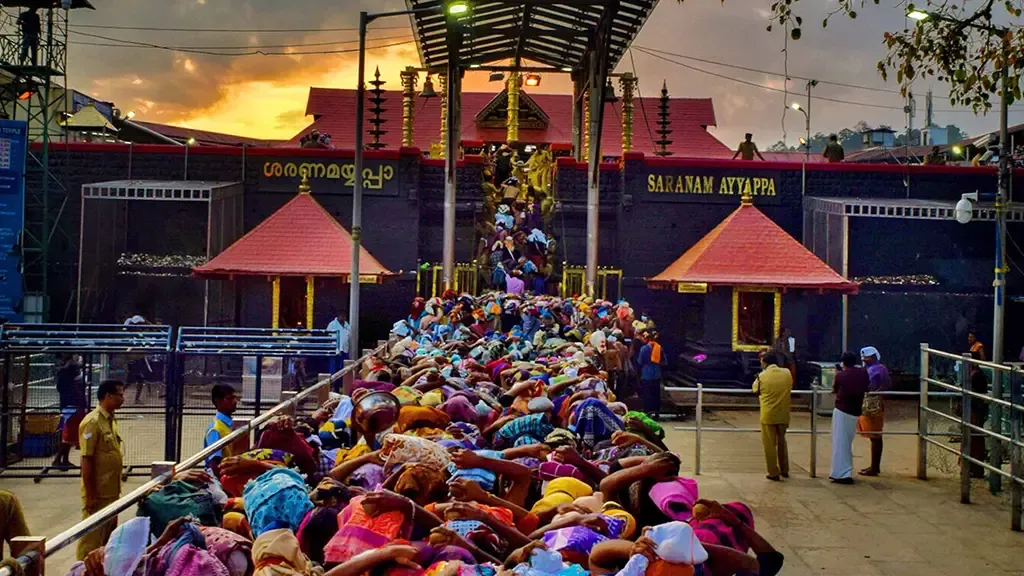
The Tiruvitamcoor Devaswom Board, in a fresh affidavit submitted ahead of March 23 before the Supreme Court, has taken a clear U-turn from its earlier stand of permitting all women to enter the temple, contrary to the tradition of restricting women between 10 and 50 from entering the temple. It states that there is no gender bias in Sabarimala and that the only restriction is for young women aged between 10 and 50, adding that the practice should continue as it belongs to a peculiar sort of temple.
The affidavit further says that the Devaswom Board enjoys the power to take decisions and to implement those decisions in religious matters. Article 26(b) authorises the management of the temple belonging to a peculiar sort to take its own decisions regarding the conduct of the temple and implement those decisions. There are more than 1,000 Ayyappa temples in the state. But Sabarimala, the forest temple, is the only temple with Naishtika Brahmachari Ayyappa as the presiding deity.
The affidavit suggests that a commission should set up that comprise religious scholars, experts and social reformers. The matter shall be decided by them, not just by judicial review. Since the issue pertains to faith, a detailed study of all aspects is essential before taking a final decision.
It is too early to forget the way the Devaswom Board took the initiative, with the support of the police force, to take ‘undesirable’ young women to the temple in 2018 and 2019. Those women were in police uniform. The Board was acting as a loyal stooge of the CPM-led Left Democratic Front (LDF) and Chief Minister Pinarayi Vijayan to break and demolish the faith and divinity of the Sabarimala temple.
There is no ambiguity in the change of policy of the Devaswom Board. It is quite simple. CPM, LDF and the Chief Minister are afraid of a Hindu backlash in the Assembly elections scheduled for next month. So, they found a sop to keep the Ayyappa devotees in good humour. They might have asked the Devaswom Board to take such a step. Obviously, the Devaswom Board has no other alternative than to comply.
Now, the elections are a few days away. The ruling LDF is changing its old stand. It recommends that there should be a commission to study the issue. Since it is a deviation from the earlier stand of ‘facilitating young women’s Sabarimala entry at any cost’, the latest stand can be construed as a nod to the traditional restriction on women aged 10–50. In other words, Communist leaders agree with the traditions of the Sabarimala temple.
This change of stand vindicates the positions taken by pro-Hindu organisations. If the government had taken this stand eight years ago, there would have been no police action and no devotee’s death due to CPM attacks against devotees. Thousands of cases registered against devotees could have been avoided. Thousands of youths would not have lost their jobs and the opportunity to go abroad for employment.
This change highlights a clear contradiction in the Communists’ approach. They claim to be atheists, yet their actions have mostly targeted Hindu rituals and traditions. Now, with this shift, it appears they have been forced to rethink their stand due to power politics and the pressures of a democratic system.
It raises an important question: were their earlier actions based on principle or political convenience? Critics argue that the Communists’ approach has been selective—strong interference in Hindu practices, with little or no interference in Islamic and Christian rituals—a classic vote-bank politics devised and designed by them.