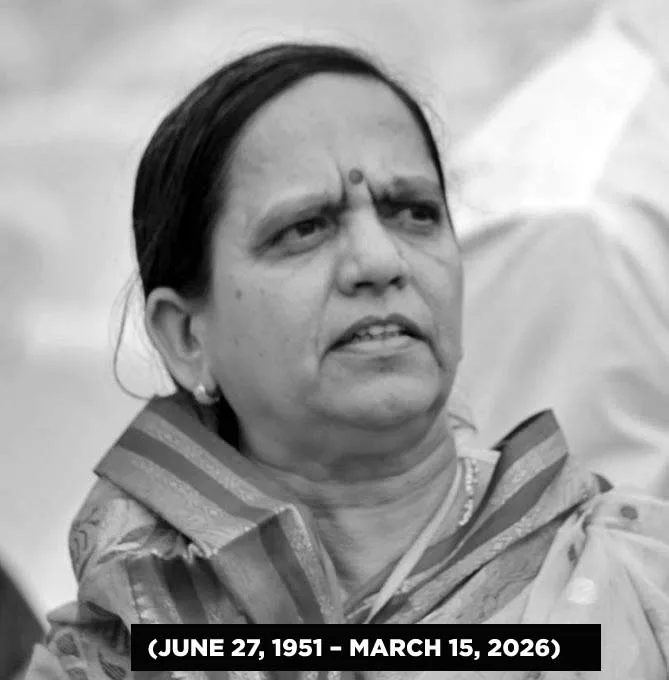
Rekha Tai Raje holds the distinct honour of being the very first Pracharika (full-time dedicated worker) in the 90-year history of the Rashtra Sevika Samiti, a woman who thoughtfully and resolutely dedicated her entire life to the nation through her body, speech, and mind.
Around 50 to 55 years ago, the social climate was entirely unfavourable for young women to leave their homes, embrace a life of austerity, and devote themselves to national and social service. As an alternative, some women chose to remain unmarried at home, managing their own livelihoods while prioritising the expansion of the Samiti’s work. The late Sindhutai Phatak had set an ideal of a dedicated life by starting the Samiti’s work in Northern Bharat after a specific tragedy. However, Rekha Tai was the first person to successfully convince the Samiti’s leadership to make the favourable decision of allowing her to become a full-time Pracharika.
Her arduous path became a perpetual source of inspiration for countless other Karyakartas (volunteers). A great tradition of women dedicating their lives, be it for a short period or their entire lifetimes, began with her. Rekha Tai’s rare, unique, and highly significant contribution continues to inspire both the organisation and society at large.
Courage in the Face of Adversity
Born in 1951, she embraced the vow of a Pracharika’s life during the turbulent times of the Emergency, and upheld it with all her might until 1:30 PM on March 15, 2026. Tireless and unceasing.
She was never ordinary. She constantly faced challenging situations and had a special affinity for extraordinary, bold endeavours. Long before the term ‘Love Jihad’ was even known, she was rescuing young women trapped in the web of religious conversions and exploitation. Showing them and their children a path to a respectable, cultured life, and successfully rehabilitating them, were among the many daring feats she performed, demonstrating a fearless manifestation of Nari Shakti (women’s power).
She did this in highly sensitive areas like Jammu & Kashmir. Despite facing severe adversity, neglect, and insults, she pressed on, driven by the unwavering belief that “protecting Hindutva is my ultimate duty.” In an era where even the grassroots Karyakartas lacked widespread awareness about Love Jihad and support was scarce, she overcame every obstacle to keep her mission alive.
Healing Wounds in Jammu, Kashmir, and Punjab
Her journey in Jammu & Kashmir began around 1984–85, precisely when terrorism in the region had reached its peak. Massacres of Hindus were rampant, and arson and looting were widespread. The mass exodus of Kashmiri Pandits had begun, and their rehabilitation was an urgent necessity. During this time, the Samiti, led by Pracharikas like the late Sindhutai Phatak and Rekha Tai Raje, made an immense contribution. Rekha Tai was at the forefront of uniting local women Karyakartas, travelling from village to village to boost morale, and providing necessary aid. The “Aditi” hostel was established in Jammu for the daughters of those who had sacrificed their lives to terrorism. Today, this institution is well-regarded, and Rekha Tai had a lion’s share in its foundation, enduring untold hardships and opposition along the way.
Punjab was another highly sensitive region. During the fierce Khalistan movement, Rekha Tai played a crucial role in the efforts to keep Hindu unity intact. While Delhi remained her base for a long time, her primary responsibilities lay in Punjab and J&K. Coordinating between Jammu, Punjab, Delhi, and the Karyakartas there, she built various frameworks for constructive work.
Later, a hostel was set up in Jalandhar for girls from families traumatised by terrorism in Punjab. Following the Kargil War, another hostel was established in Jalandhar for girls from Ladakh, and subsequently, one in Patiala. Rekha Tai’s role in all these endeavours was invaluable. She extensively toured Punjab to ensure emotional integration and the expansion of the Samiti’s work, not just then, but many times over the years.
When she took on the responsibility of Uttar Kshetra Pracharika (Northern Region), her travels expanded to Haryana and Himachal Pradesh. She focused specifically on establishing contact in border areas, understanding local problems, and striving to resolve them. She had an exceptional network and deep knowledge of the patriots residing in these border regions.
A Life Forged in the Fire of Duty
Born in Pune, Rekha Tai first connected with a Samiti Shakha (branch) in Nashik. There, she met Vandaniya Mavashi Kelkar. Deeply influenced by her personality, she decided to place the Samiti at the forefront of her life. Shortly after moving to her home in Kanpur, she began managing her education and Samiti work simultaneously, aggressively expanding the Shakhas. Her home was closely tied to the Sangh, and there she developed a close rapport with Mananiya Ashok Singhal. With his encouragement and guidance, she turned her resolve to work as a Samiti Pracharika into reality.
She completed her MA in Sociology, BEd, and MEd, and began teaching. In her early years, Eastern and Western Uttar Pradesh were her areas of operation.
While she was still studying, the Emergency was imposed on the country, strangling democracy. Rekha Tai was at the absolute forefront of the Satyagrahis, despite being the youngest! She was sentenced to three and a half months in prison. To instill fear in her, she was deliberately kept with mentally unstable and criminal women. In one astonishing incident, despite having no medical knowledge, she had to deliver a pregnant woman’s baby in jail! She weathered many such intense experiences during those three and a half months.
The Capital and Beyond
In 1984, Delhi became her center. There, under the guidance of the late Sindhutai Phatak, she began her work with the “Samarth Shiksha Samiti” and travelled across the Northern Region.
In the next phase of her life, she took on the responsibilities of Akhil Bharatiya Sah-Sharirik Pramukh and later Sah Karyavahika (Joint General Secretary). This initiated her nationwide travels. Her greatest strengths were her exceptional communication skills and her ability to mould workers through simple, relatable methods.
As Delhi is the nation’s capital and a hub of activity, Karyakartas from across the country would come to Rekha Tai with their problems, hoping for a solution. Using her tremendous networking and communication skills, she would successfully resolve them.
For instance, Minakshi Tai, a Tamil woman, had a son who was imprisoned in a Chinese jail due to a misunderstanding. Hearing Rekha Tai’s name, Minakshi Tai came to her office. Rekha Tai listened, organised a protest outside the Chinese Embassy, and utilised her contacts to ensure the boy received justice. He eventually returned safely from the Chinese prison! Countless such memories surround Rekha Tai. Another incident I witnessed personally occurred during the Samiti’s Akhil Bharatiya Prerana Shibir in 2016. Just days before the camp, Demonetisation was suddenly announced. A mountain of logistical issues arose. Yet, applying all her energy and resourcefulness, Rekha Tai arranged everything within mere hours. It was as if no crisis had occurred at all.
A Lasting Legacy
It is impossible to adequately describe Rekha Tai as a Karyakarti. She never pampered herself, always prioritising duty. I recall an incident in Delhi: in the blistering heat, she had to travel to Gujarat for a Samiti training camp. She had a severe leg injury and could barely walk. She had no reserved ticket. Despite this, she limped into an unreserved train compartment and made it to the camp! Everyone who knew her holds similar memories.
I met Rekha Tai when I was still a schoolgirl, at a training camp. Her smiling face instantly captivated me, and hearing about her daring work made me admire her immensely. Our meetings increased, and she made it a point to visit my home. Whenever I went to Delhi, we would have long, informal chats. It has been my lifelong experience that discussing any organisational issue with her always yielded a solution.
One amusing memory stands out. I must have been in the 12th grade, visiting Delhi for four or five days. Rekha Tai knew the massive map of Delhi entirely by heart. She travelled everywhere on a simple two-wheeler. Over those days, I rode pillion as she gave me a grand tour of Delhi. I vividly remember noticing that at every traffic signal, amidst a sea of male riders, she was often the only woman driving a two-wheeler! In that regard too, she was exceptionally rare.
Rekha Tai’s achievements are colossal. They cannot be contained within the margins of an article. Despite doing monumental, courageous work and building an army of Karyakartas, she remained hundreds of miles away from the allure of stages, garlands, and microphones. Seeing people who get inflated egos over minor achievements always makes me remember Rekha Tai, who stayed entirely away from the limelight despite her immense deeds. How can a person exist with absolutely no personal desires or ambitions? But that was exactly who
Rekha Tai was. For the last five or six years, she was besieged by various illnesses. Seeing her condition would churn my stomach, but she accepted this inevitable change with effortless grace. Her face remained calm, composed, and smiling.
A “God-rare” (Dev-Durlabh) Karyakarta is the hallmark of the Sangh and Samiti’s work. In this brilliant constellation, Rekha Tai was a shining, radiant star. It breaks my heart to append the word “Late” before her name. A humble, final tribute to the deeply inspiring Rekha Tai!