In the history of the subcontinent, the three-day session of the All India Muslim League on March 22, 23 and 24, 1940, at Lahore was a watershed moment. At this session, the idea of Pakistan as a separate nation carved out of India took concrete shape. The main resolution, which was moved, adopted and passed at this session, was drafted by Zafarullah Khan, later Foreign Minister of Pakistan. It is an irony that men like Zafarullah, an Ahmadiya, have no place in today’s Pakistan, as the Ahmadiyas are considered non-Muslims, heretics in fact.
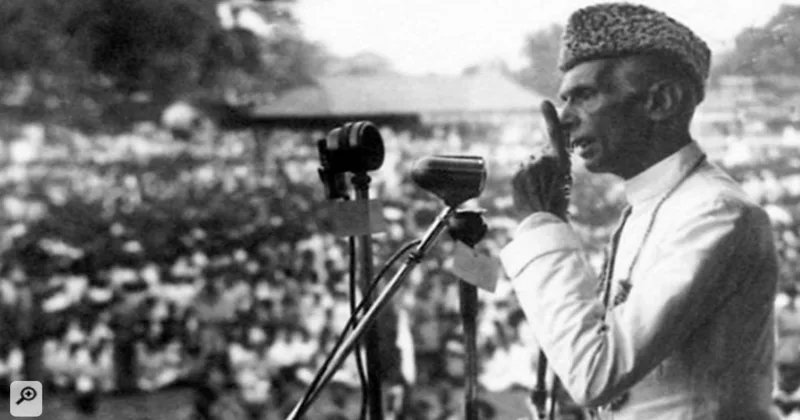
At that time, in March 1940, it was also not disclosed to those present at the session presided over by Mohammad Ali Jinnah that the draft was the handiwork of an Ahmadiya. During the session at Iqbal Park, Lahore. The welcome speech was delivered by the chairman of the reception committee, Sir Shah Nawaz Khan. The session was then taken over by Muhammad Ali Jinnah, who spoke in favour of creating two independent nations. Jinnah had started speaking against Hindus and Muslims co-existing in one nation.
Jinnah’s Speech
In his speech on March 22, Jinnah asserted that Hindus and Muslims could not live together peacefully. He argued that the differences between the two were so great that living under one central government, which governed both under one law, would be dangerous. His argument was that Muslims and Hindus belonged to two disparate civilisations, based on conflicting ideas.
Hindus and Muslims belonged to two different nations as they followed different scriptures and derived inspiration from different histories. Jinnah warned that clubbing Muslims in a country dominated by Hindus would lead to destruction. As such, parting ways to create two major dominions based on religion was an honourable way of resolving matters.
Liaquat Ali Khan first finished presenting his annual report, and the then Chief Minister of undivided Bengal, A. K. Fazl ul Huq, moved the resolution in the general session. This resolution came to be known as the ‘Lahore Resolution’ and later as the ‘Pakistan resolution’ as well. The resolution, drafted by Zafarullah, received the support of prominent Muslims such as Mohammad Abdul Ghafoor Hazarvi, Maulana Zafar Ali Khan, Qazi Esa, and Sir Abdullah Haroon.
Independent Nations
The resolution stated that no constitutional plan would be accepted by the Muslims until geographical units were separately demarcated as independent states. It also stated that Muslims living in the Eastern and North Western zones of British India should be allowed to form an independent state with autonomous and sovereign constituent units. The resolution rejected the proposal for a ‘United India,’ which opposed the division of India.
It recommended the creation of a separate nation-state for Muslims and added that the new state should comprise regions such as the North-West Frontier Province, Punjab, Bengal, Assam, Sindh, and Baluchistan. The resolution, which is sometimes referred to as the ‘Pakistan Resolution’, holds great significance in Pakistan’s history. In 1941, the resolution was made a part of the constitution, framed by ‘All India Muslim League.’
On March 22, 1940, Jinnah delivered his presidential address to the Muslim League’s open session at Lahore. He said that Hinduism and Islam ‘… are not religions in the strict sense of the word, but are, in fact, different and distinct social orders, and it is a dream that Hindus and Muslims can ever evolve a common nationality. The Hindus and Muslims belong to two different religions, philosophies, social customs and literature … and indeed they belong to two different civilisations which are based mainly on conflicting ideas and conceptions.
Interestingly, the 1940 Lahore Resolution, later called the Pakistan Resolution, did not mention the word “Pakistan” at all. Though this resolution became the core of the demand for the creation of Pakistan, it effectively sought parting of ways with the Hindus, not freedom from the British colonial power.
Ahmadiya Influence
Jinnah had returned to India in October 1935, and it is said that, in some quarters, Abdur Rahim Dard, an Ahmadiya missionary in London, motivated him to do so. The word Pakistan (literal meaning Land of the Pure) was first used in a four-page leaflet entitled ‘Now or Never’, published in January 1933 and signed by Rehmat Ali and three other students in Cambridge. According to Rehmat Ali, Pakistan was an acronym composed of Punjab, Afghania (North West Frontier Province, now known as Khyber Pakhtunkhwa), Kashmir, Sindh and Balochistan.
Rehmat Ali had met Jinnah in 1934, some time after he had authored his Pakistan pamphlet. However, Jinnah was at that time under the influence of Mahatma Gandhi and saw himself as an Indian nationalist. It has been reported that Jinnah did not show much enthusiasm or inclination towards Rehmat Ali, whom he just saw as a restless young man.
According to the well-known Pakistani author Ishtiaq Ahmed, the idea of a separate state for Muslims was born in the Viceroy’s office. It was Asghar Sodai, a poet from Sialkot, who in 1943 coined the slogan ‘Pakistan ka na’ara kya (What is the slogan of Pakistan?), La ilaha ilallah’. This later became ‘Pakistan ka matlab kya’. This became a popular slogan as it talked of Islam as the nucleus of Pakistan.
Pakistan’s Lawyer
It is said that Jinnah was the ‘lawyer’ for the case of Pakistan which he argued and won. However, he was neither a visionary nor a strategic thinker to chart out the course of the nation. Zafarullah, who authored the Lahore Resolution, was a visionary who had worked out the idea of Pakistan. Being an Ahmadiya, Khan’s role, however, was kept secret lest it lead to hatred and opposition within the Muslim League ranks.
Years later, another crucial resolution of the Muslim League was adopted in Bombay in July 1946. This resolution withdrew acceptance of the Cabinet Mission plan and called on Muslims to observe 16 August 1946 as Direct Action Day. In his concluding remarks, following the adoption of the resolution, Jinnah stated: We have taken a most historic decision. Never before in the whole life-history of the Muslim League did we do anything except by constitutional methods and constitutional talks.
The Intelligence Bureau defined ‘Direct Action’ as using violence to achieve the goals/agenda of the Muslim League. Direct Action could lead to bloodshed, butchery, slaughter of Hindus of East/West Bengal and Sindh. Several authors have vividly recorded the violence in Calcutta that left over 4,000 dead and 15,000 wounded. It required retaliation by Hindus who were organised by a butcher and Gandhiji’s fast to control the situation after days of rioting.
Oilfields in West Asia
The British had, as early as May 1946, recognised the immense potential of the oilfields found in the West Asian countries and named them “wells of power’’. A war rages on in the region, in 2026 now, initiated by US-Israel combine on February 28 when targeted bombing killed Iran’s Supreme Leader Ayotallah Khemenei. It should be clear to the world why taking control of energy sources, be it oilfields or natural gas, is uppermost in the minds of the Western powers.
In May 1946, Field Marshal Auchinleck said that partition would not serve British interests in the Indian Ocean, as Pakistan would be a weak state, and stronger India (post-1947) would move to the Soviet Union. He was thus a votary of a united India at that juncture. However, a year later, he revised his views and pressed for division of India, after having decided that a united India would be too strong to bother about the British and to act as a lackey.
The British moulded the Muslim League and Jinnah to counter the Indian nationalists at every turn. In the ultimate analysis, Jinnah and the Muslim League got Pakistan on a platter. They did not have to struggle against the British for India’s independence. After all, Pakistan was the creation of one clever man, Jinnah; the difference between a slick political trick and a mass movement was apparent in the contrast between Karachi and New Delhi, an author writes.
Hatred for India
Hatred towards India was fundamental to the creation of Pakistan, and as such, its politicians believe that this hatred must continue for its very existence. While arguing for the creation of Pakistan in Muslim-majority provinces, which formed the nucleus of the new nation state, Jinnah always said that it was not possible for the Muslims to live under Hindu domination.
This argument led to the birth of a counterargument too, as by the same logic, it was not possible for Hindus, Sikhs and even Christians to live under Muslims either. The underlying hatred that the Muslim League, headed by Jinnah, promoted continues to date, and its embers have singed Hindus, Ahmadiyas, Shias, Sikhs and Christians, though not necessarily in the same order. The ill treatment of Ahmadiyas, even men like Zafarullah and Pakistan’s only Nobel laureate, Abdus Salam, is thus a given and considered fairly normal in Pakistan. This hatred has forced this minuscule community to live in perpetual fear and face indignities in Pakistan today.
`Islam in danger’ was a coinage of Jinnah’s Muslim League and continues to be a headache worldwide, even in Islamic countries like Saudi Arabia and Iran. The definition of `Muslim’ also varies in different contexts, and then it leads to discussions on who is more Muslim!