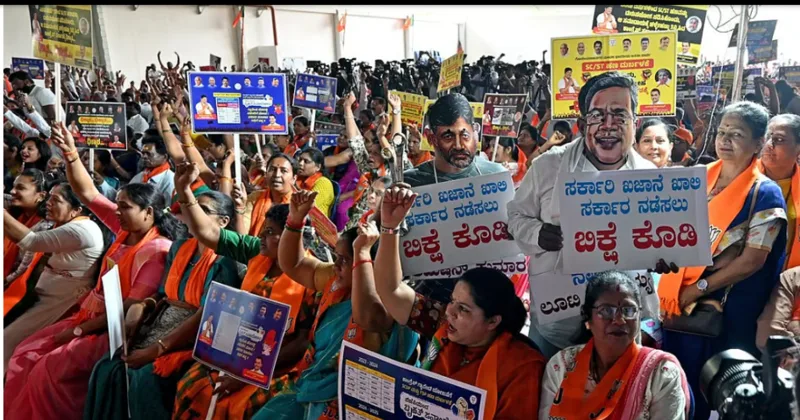
Bengaluru: The Karnataka government is facing sharp criticism after a significant portion of funds earmarked for the welfare of Scheduled Castes (SCSP) and Scheduled Tribes (STSP) was diverted towards implementing its flagship ‘guarantee’ schemes. The move has triggered widespread outrage among opposition parties, Dalit leaders, and social activists, who have accused the government of undermining the very purpose of these dedicated welfare funds.
According to the 2026–27 state budget presented by Chief Minister Siddaramaiah, a total of Rs 44,632 crore has been allocated under SCSP and STSP combined. However, out of this, a staggering Rs 14,198.93 crore has been earmarked for the implementation of five major guarantee schemes—Griha Lakshmi scheme, Yuva Nidhi scheme, Shakti scheme, Griha Jyoti scheme, and Anna Bhagya scheme.
Violation of welfare intent?
Critics argue that SCSP and STSP funds are constitutionally and legally intended for the targeted development of Scheduled Castes and Scheduled Tribes, focusing on education, employment, housing, and social upliftment. Diverting these funds for broad-based schemes that benefit the general population, they say, dilutes their impact and deprives marginalised communities of dedicated support.
The controversy is particularly significant as Dalit ministers and MLAs had reportedly urged the government during pre-budget consultations not to utilise these funds for guarantee schemes. Despite these appeals, the allocation has increased compared to previous years—Rs 14,282.68 crore in 2024–25 and Rs 13,433.84 crore in 2025–26—indicating a continuing trend.
Where the funds are going
Budget documents reveal that major portions of SCSP-STSP funds are being channelled into schemes that are not exclusively targeted at SC/ST communities:
Under the Women and Child Development Department, Rs 8,296.32 crore has been allocated for direct cash transfers under the Griha Lakshmi scheme.
The Transport Department has earmarked Rs 1,537 crore for the Shakti scheme, offering free bus travel for women.
The Energy Department has allocated Rs 2,591.61 crore for the Griha Jyoti scheme, providing free electricity.
The Food Department has set aside Rs 1,612 crore for Anna Bhagya cash transfers.
The Skill Development Department has allocated Rs 162 crore for Yuva Nidhi.
Opposition leaders argue that these allocations are calculated based on population proportions rather than actual beneficiaries, raising serious questions about transparency and accountability.
Political backlash intensifies
The opposition has slammed the government, calling the move “a betrayal of social justice.” Leaders have accused the ruling dispensation of prioritising political populism over genuine welfare, alleging that funds meant for the most disadvantaged sections are being used to sustain vote-centric schemes.
The issue was also raised in the Assembly, with members questioning the legality and ethics of such allocations. Critics maintain that this approach not only violates the spirit of welfare budgeting but also sets a dangerous precedent.
Hefty salary of Rs 6 lakh !
Adding to the controversy are revelations about the expenditure on the Guarantee Scheme Implementation Authority. The chairman reportedly receives a monthly salary of Rs 5.98 lakh, while each vice-chairman draws Rs 4.44 lakh—figures significantly higher than the salary of Rs 2.25 lakhs of the state government’s Chief Secretary. This has further fuelled criticism that the government is spending heavily on administrative structures while diverting funds from core welfare objectives.
Need for course correction
Social activists and policy experts have called for an immediate review of the allocations, urging the government to ensure that SCSP and STSP funds are used strictly for targeted community development. They warn that continued diversion could hamper long-term progress in education, employment, and social equity among SC/ST populations.