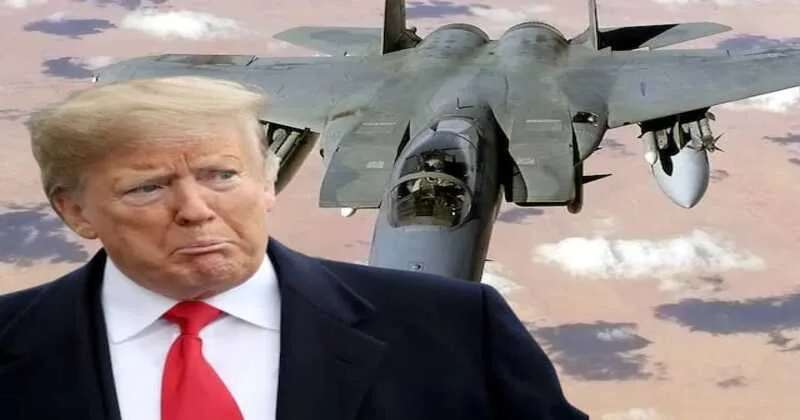
Tehran/Washington: In a fresh escalation of the ongoing conflict between Iran and the United States, the Iranian military on Sunday claimed to have shot down an “enemy” F-15 fighter jet near the country’s southern coast, close to the strategically vital Hormuz Island. According to the Iranian state-affiliated Fars News Agency, the aircraft was targeted using ground-to-air missile systems operated by Iran’s air defence forces.
If confirmed, the incident would mark yet another significant development in a conflict that has already witnessed multiple aerial confrontations. Iranian officials have suggested that at least half a dozen American aircraft have been struck or downed since hostilities intensified, though these claims remain disputed by Washington.
Iranian media also circulated a video purportedly showing the moment its air defence systems locked onto the F-15. However, neither the United States nor its regional allies have confirmed any such loss. Notably, F-15 fighter jets are not only deployed by the US but are also part of the air fleets of several West Asian countries, including Saudi Arabia, Israel, and Qatar, raising further uncertainty over the aircraft’s identity.
The latest claim follows closely on the heels of another controversial assertion by Iran, that it had successfully struck a US F-35 Lightning II, one of the most advanced fifth-generation fighter jets in operation. A CNN report, citing US defence officials, confirmed that an F-35 had made an emergency landing during the conflict, with the pilot ejecting safely. However, no confirmation was provided that the aircraft had been hit by Iranian fire, and an investigation into the incident is ongoing.
Repeated incidents raise questions over air safety
The reported downing of the F-15 marks the fourth such incident involving the aircraft within just four weeks of intensified conflict in West Asia. Earlier, on March 1, three F-15E “Strike Eagle” jets were mistakenly shot down by Kuwaiti air defence systems during active operations. The US Central Command (CENTCOM) later confirmed that the aircraft were brought down in “friendly fire” incidents, underscoring the risks posed by the crowded and volatile airspace in the region. In another incident, a US KC-135 refuelling aircraft crashed following what the military described as an “unspecified incident” involving two aircraft in friendly airspace. These developments have highlighted growing concerns about coordination failures and operational hazards amid escalating military engagements.
Iran has also claimed responsibility for targeting an Israeli F-16 fighter jet over central Israel using surface-to-air missiles, though Israeli authorities have not confirmed any such loss.
US rejects Iranian claims as war of words intensifies
The United States has categorically denied Iran’s claims regarding the downing of its aircraft. In a statement posted on X, the US Central Command rejected the assertions made by Iran’s Islamic Revolutionary Guard Corps (IRGC), stating that American forces have conducted more than 8,000 combat sorties under “Operation Epic Fury” without losing aircraft to Iranian fire. Meanwhile, the conflict has taken on a sharper rhetorical edge. US President Donald Trump issued a stern warning to Tehran, threatening to “obliterate” Iran’s power infrastructure if it failed to reopen the Strait of Hormuz within 48 hours, a crucial global oil transit chokepoint.
Iran responded with its own warnings, indicating that it would target US-linked infrastructure in the Gulf region, including energy installations and desalination plants, if Washington followed through on its threat. Adding to the tension, Iran’s parliamentary leadership warned that financial entities supporting the US military could also be considered legitimate targets, extending the conflict narrative into economic domains.
The current escalation comes after reports of US-Israeli strikes on Iranian nuclear facilities, followed by Iranian missile attacks targeting Israeli locations, including the southern cities of Dimona and Arad. Israeli authorities acknowledged that some missiles had penetrated their air defence systems.
The intensifying conflict has begun to ripple through global markets. While oil prices showed signs of stabilisation on Monday, analysts warn that further attacks on critical infrastructure could trigger sharp increases. Meanwhile, US stock markets reflected growing investor anxiety, with major indices ending the previous week on a downward trend, signalling broader economic uncertainty tied to the prolonged conflict.
Iran clarifies Hormuz stance
Amid rising tensions, Iran has clarified that the Strait of Hormuz has not been fully closed and that global shipping traffic continues to move through the vital waterway. Iranian authorities stated that restrictions were imposed only as a defensive measure, targeting vessels linked to “enemy” forces, while allowing passage to those complying with its directives. Tehran maintained that the United States and Israel would not be permitted access under current conditions, attributing the escalation to their actions.
At the same time, Iran pointed to growing international involvement in the crisis, noting that the G7 has expressed support for Gulf countries. In a significant diplomatic development, the French President announced that negotiations have begun, raising cautious hopes for de-escalation even as military tensions persist in the region.