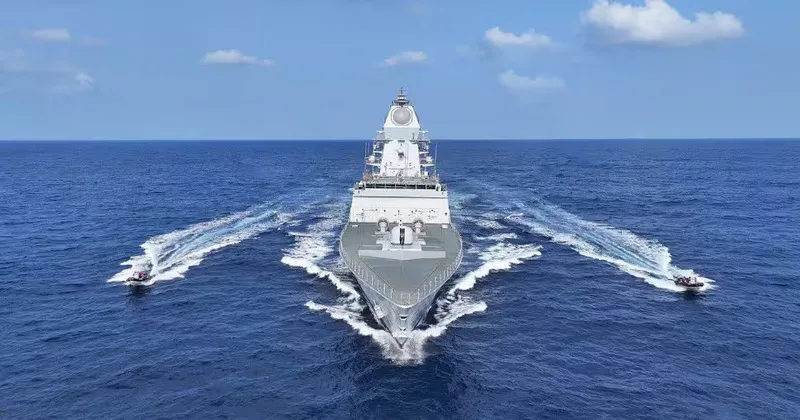
The saga of the Indian defence ecosystem is earmarked with Atmanirbharata(self-reliance) and the vision to accelerate an incredible kinetic leap in crafting the indigenous defence industrial hub. As a testament to this motto of the Indian defence paradigm, the Indian Navy is set to commission warship INS Taragiri on April 3. As per the official sources, the ceremony will be presided over by Defence Minister Rajnath Singh.
INS Taragiri is part of the Project 17A of the Indian Navy. It is the ambitious project of the Navy that aims to build seven advanced guided-missile stealth frigates. The warships constructed under the project will be embedded with more than 75 per cent of indigenous elements, thus marking a major leap in the defence indigenisation path of the country. INS Taragiri is the fourth warship under Project 17A or among the Nilgiri class frigates.
The warship represents state-of-the-art features in terms of smart designing, stellar technical capabilities and overarching operational effectiveness to defend national security. INS Taragiri thus reflects the growing indigenous naval potential of India and the remarkable advancement of the defence industries in terms of seeking self-reliance in the domain of warship design and manufacturing. INS Taragiri is also the third stealth frigate constructed by Mazagon Dock Shipbuilding Ltd.(MDL), Mumbai.
The highlight of INS Taragiri is, it comprises more than 75 per cent of indigenous elements thus reflects the stellar effectiveness and growth of the domestic industrial ecosystem of India. More than 200 Micro, Small and Medium Enterprises(MSMEs) have been involved in the construction of the warship. This shows the massive capabilities of the small-scale industries of India and their contribution in the path of seeking self-reliance/Atmanirbharata in the defence sector. Involving MSMEs in the manufacturing of a state-of-the-art warship also mirrors the inclusive nature of India’s growth story that provides employment, skill development and nation-building opportunities to lakhs of people.
Advanced and cutting-edge features of INS Taragiri
- The state-of-the-art design of the stealth frigate marks a generational leap in the warship design and manufacturing domain of India. Thus, the sleeker form renders greater operational efficiency for the warship.
- Cutting-edge construction reduces the cross-section of radar that will indeed help to operate with lethal stealth and utmost efficiency.
- INS Taragiri has high speed and high endurance. Its versatile, thus aids in multidimensional maritime operations.
- Driven by Combined Diesel or Gas(CODOG) propulsion plant.
- The warship is capable of launching supersonic surface-to-surface missiles, medium range surface-to-air missiles and also specialised anti-submarine warfare suite. These missiles and other weapons have been seamlessly integrated into the warship via the state-of-the-art Combat Management System(CMS) that helps the crew to respond to threats with split second precision.
- The warship is capable of launching BrahMos ship-to-ship missile system. BrahMos is called as the “game-changer” and saviour during Operation Sindoor. INS Taragiri being equipped to carry such a missile, truly elevates the role of India as a credible and self-sufficient global maritime power.
- INS Taragiri is popularly dubbed as the “hunter of the sea” due to its incredible operational capabilities in defending maritime security. However, it is also capable of assisting in humanitarian crises and disaster relief. Thus, INS Taragiri has a very flexible profile from combat to humanitarian aid, making it a boon to the Indian Navy.
- The combat suite of INS Taragiri includes MFSTAR, a 76 mm Super Rapid Gun, a combination of 30 mm and 12.7 mm close-in weapon systems.
- For underwater threats, INS Taragiri has an exclusive set of anti-submarine rockets and torpedoes.
As the maritime corridors across the geopolitical chessboard become high-stake zones of contention, state-of-the-art warships with overarching indigenous technology is indeed a boon to secure strategic autonomy and defend national security during unforeseen contingencies. In this direction, INS Taragiri scripts a pivotal milestone in the defence indigenisation and national security paradigm of India.