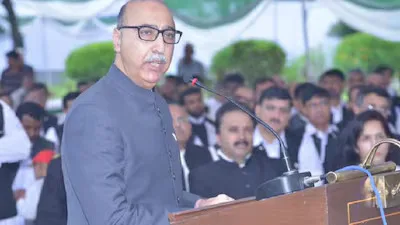
In a deeply concerning development, former Pakistan High Commissioner to India Abdul Basit has come under scrutiny after a video clip surfaced in which he appeared to advocate military retaliation against Indian cities if Pakistan were attacked by Western powers such as the United States or Israel.
Basit, who served as Islamabad’s top diplomat in New Delhi between 2014 and 2017, was seen describing India as the “default” target in the event of a broader geopolitical conflict. His remarks have not only gone viral on social media but have also triggered alarm within strategic and intelligence circles.
“What route do you think will be good for us? India”
During the broadcast, Basit posed a rhetorical question, stating, “What route do you think will be good for us? India.” He further suggested that even if Pakistan were unable to directly strike distant adversaries like the US, it should “never give up” on targeting Indian cities.
By explicitly naming Mumbai and New Delhi, the former envoy invoked painful memories of past terror incidents, including the 2008 Mumbai attacks. Analysts say such statements risk legitimising the idea of targeting civilian populations as a strategic fallback.
Top intelligence sources quoted in media believe that Basit’s comments may not be merely spontaneous. Instead, they are being viewed as part of a broader, “tutored narrative” reflecting deeper thinking within Pakistan’s security establishment.
According to these assessments, Basit, given his diplomatic background, is unlikely to make such statements without alignment with prevailing institutional views. His remarks are being interpreted as indicative of a mindset where India is positioned as a convenient and immediate target during crises involving other global powers.
Strategic vacuum or deliberate signalling?
Reports argue that the comments highlight a troubling strategic gap. The inability to directly engage distant adversaries, they say, appears to be redirected toward India, effectively making it a default theatre for retaliation.
Basit’s assertion that there would be “no other option” but to strike India in such a scenario has been viewed as both provocative and destabilising. It also attempts to link India to conflicts in which it may have no direct involvement, thereby risking unnecessary escalation in South Asia.
As a former High Commissioner tasked with maintaining diplomatic ties, Basit’s shift from dialogue to aggressive rhetoric has raised serious questions about the evolving discourse within Pakistan’s elite circles.
For Indian agencies, the remarks offer insight into what is increasingly being described as a “hybrid threat environment” where rhetoric, psychological messaging, and indirect threats play a significant role alongside conventional military posturing.
The use of prominent figures to articulate such views is seen as part of a broader pattern aimed at shaping both domestic opinion and international narratives. It also reinforces long-standing concerns that India remains central to Pakistan’s geopolitical calculus, even in conflicts involving other nations.
As the video continues to circulate, it has not only sparked debate but also served as a reminder of the fragile security dynamics in South Asia, where words, even hypothetical ones, can carry significant geopolitical consequences.
A track record against terrorism
India’s security establishment has, over the years, consistently demonstrated its resolve to dismantle terror networks emanating from across the border. From intelligence-led operations to strategic military responses, New Delhi has made it clear that attempts to target its cities or people will not go unanswered. Incidents such as the 2016 Uri attack were followed by calibrated responses like the 2016 Indian surgical strikes, signalling a shift in India’s counter-terror doctrine from restraint to proactive deterrence.
This approach was further reinforced after the 2019 Pulwama attack, when India carried out the Balakot airstrike deep inside Pakistani territory, targeting terror infrastructure. These actions show India’s willingness to cross conventional thresholds to neutralise threats and hold perpetrators accountable, even beyond its borders.
Under Prime Minister Narendra Modi, the government has repeatedly asserted a zero-tolerance policy towards terrorism. Any threat, rhetorical or real, against India’s sovereignty or civilian population will be dealt with firmly. The current doctrine combines military preparedness, diplomatic pressure, and global outreach to isolate terror-supporting networks.
Reports point out that such provocative statements from figures like Abdul Basit are unlikely to alter India’s strategic posture. Instead, they reinforce the need for continued vigilance and readiness. India’s counter-terror grid, strengthened through intelligence coordination and technological upgrades, is designed to pre-empt and neutralise threats before they materialise.
Going forward, the message from New Delhi remains unambiguous: any attempt to target India, whether through proxy warfare or direct provocation, will invite decisive consequences. With a clear political mandate and an assertive security doctrine, India has positioned itself to not only counter such threats but to deter them altogether, ensuring that hostile rhetoric does not translate into action.