For generations of Indians, the railway clock has shaped daily life. From early-morning commuters and long-distance travellers to pilgrims heading for sacred cities, millions depend on trains that run on schedule. When trains are delayed, the impact on travellers extends far beyond the station platform, affecting businesses, family commitments, tourism, and even logistics. In recent years, Indian Railways has addressed this long-standing challenge with renewed seriousness. With technological upgrades, modern train sets, and large-scale infrastructure reforms, the railway system is steadily moving toward a more reliable future.
Punctuality in Indian Railways is calculated in a specific way. Instead of measuring every intermediate halt, the system primarily focuses on whether a train reaches its final destination within the permissible delayed window. This method is known as terminating punctuality, reflecting the overall reliability of the journey from start to finish.
In the financial year 2025-26 (upto February 2026), the railway network has recorded an overall punctuality of more than 77 per cent, with several divisions performing even better. Some divisions have crossed 90% punctuality, while others fall in the 80-90% range. These numbers are technical, but they represent a significant operational improvement in one of the world’s largest railway networks.
Complexity of Railway Network
It is important to appreciate the magnitude of the Indian Railways network. Every day, almost 25,000 trains run on the network. These include passenger trains, suburban trains, freight trains and special trains. These trains operate over thousands of kilometres of rail routes connecting metropolitan cities, towns, industrial centres, and rural areas.
It is important to understand that such a large network of trains needs to operate in a coordinated fashion. For instance, passenger trains run on the same routes as freight trains. In some cases, the trains run almost at full capacity. This means that even a small delay on one train can cause significant problems for multiple trains. There are a number of factors that can affect train schedules. These include weather conditions, technical problems, maintenance problems and even operational problems.
Digital Tools Bringing Real-Time Control
One of the most important developments in recent years has been the use of digital technology, which allows railway authorities to monitor train movements in real time.
A number of operational systems have been put in place to handle train traffic. Systems such as the Integrated Coaching Management System, the Control Office Application, and the National Train Enquiry System enable the continuous flow of information on train movements across the country. These systems enable controllers to monitor delays and quickly adjust the timetable.
Another significant technological advancement has been the implementation of Real-Time Train Information System (RTIS) devices on trains. The RTIS devices, which are based on GPS technology, enable the train’s location to be transmitted to the central control system. This enables the train timetable to be recorded automatically, not just manually.
Other technologies, such as Remote Monitoring and Management of Locomotives and Trains (REMMLOT) and data loggers linked to the signalling system, enable more accurate data collection on train operation. This result marks a shift from reactive management to a more proactive system in which railway authorities can anticipate problems and respond quickly.
Modern Trains Changing the Game
Digital monitoring has enhanced operational efficiency; the train services themselves have also undergone major changes. Another major change has been the replacement of the older ICF coaches with the newer LHB coaches, which are not only lighter, safer, and faster but also allow higher speeds. Indian Railways has been focusing on manufacturing LHB coaches since 2018, and over 50,000 have been manufactured.
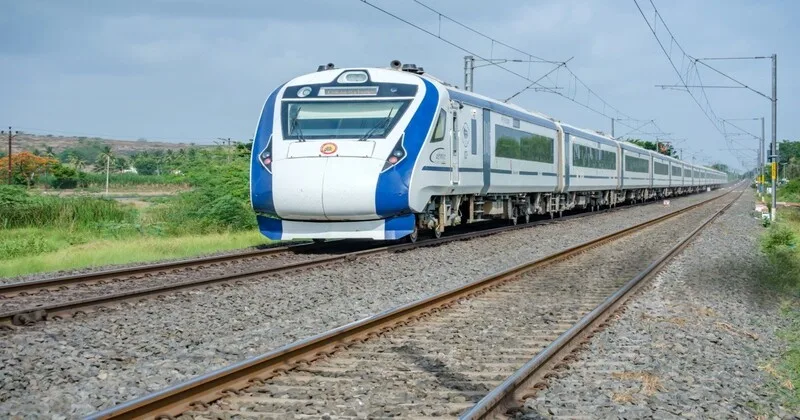
The LHB coaches are more stable and have better braking systems, and since they can accelerate faster, the trains can adhere to the timetable and avoid delays at stations. India has also introduced new train sets such as Vande Bharat, Amrit Bharat, and Namo Bharat, which are the next generation of train services with faster speeds and on-board technology.
Rapid acceleration, compatibility with modern signalling systems, and enhanced operational capabilities enable passengers to reach their destinations with arrival times closer to the scheduled times. For passengers, these trains are the harbinger of India’s new railway system.
Scientific Scheduling for Better Efficiency
Another significant area of reform is thus happening behind the scenes: train timetabling. Indian Railways has been working with professionals from academic institutions such as IIT Mumbai to develop simulation models that analyse traffic patterns on the rail network. These simulation models enable planners to optimise train routes and schedules based on the analysis results.
One of the most significant results of this initiative is the implementation of integrated maintenance blocks. These blocks enable regular maintenance work on the rail tracks without disrupting train services. This is achieved by planning maintenance work systematically, enabling the rail system to strike a balance between operational efficiency and maintenance.
Scientific timetabling also enables trains to run in an organised manner rather than competing randomly for track space. This enhances track usage and prevents cascading delays.
Dealing with the Winter Fog
In northern India, winter fog has long been a challenge for train operations. This is because reduced visibility can significantly slow trains, leading to delays along the entire route.
To address this problem, Indian Railways has launched Fog-Safe Devices for locomotive pilots. These GPS devices provide information about upcoming signals, speed restrictions and other critical landmarks right inside the locomotive cab. Even if the visibility outside is poor, the pilot gets the right information about the track conditions ahead.
Over 30,000 of these devices have already been installed on the railway network. Special signalling systems have also been provided in some routes to enable the safe movement of trains during fog. Also, the training programs for locomotive pilots have been developed to train them to run trains safely even in adverse weather conditions.
Expanding Tracks to Reduce Congestion
Technology by itself will not be able to address the issue of punctuality unless the railway infrastructure continues to expand. Over the last decade, Indian Railways has accelerated the construction of new lines and the doubling of existing ones. Earlier, the average rate of expansion of new lines was approximately 4.2 kilometres a day. Currently, the rate has risen to approximately 8.6 kilometres a day, reflecting efforts to enhance railway infrastructure.
At present, over 430 railway projects, amounting to over 36,000 kilometres of railway lines, are being developed in the country. These include new railway lines, doubling of existing lines and gauge conversion projects.
One of the most significant developments is the development of Dedicated Freight Corridors. These corridors will have separate freight lines, thereby allowing the existing lines to be used for passenger trains. With freight trains moving to Dedicated Freight Corridors, passenger trains are expected to operate with fewer delays.
Transition in Punctuality and Administration
It must be admitted that, while progress has been made, railway punctuality is still a work in progress. It takes constant coordination and planning to ensure that trains run on time over such a vast network. The occasional hitch, such as a technical snag, emergency chain pulling or unexpected obstacles on the track, might cause delays. The high passenger load on popular routes means that the system is operating at high pressure. The overall trend is unmistakable. Indian Railways is slowly but surely moving towards a technology-driven, modernised railway system.
For the millions of railway passengers, on-time trains are more than just a practical necessity; they are an assurance that the system works. A reliable railway network is a guarantee for economic growth, tourism and national connectivity. As digital monitoring systems improve, new trains replace outdated ones and infrastructure development nears completion, Indian Railways is slowly overcoming one of its biggest challenges. The change may not occur overnight, but the progress is evident. From better operational data to faster trains and more intelligent scheduling, the rail network is gradually becoming more efficient.