
From Movement to Monopoly: Rise of dynastic control in DMK
June 5, 2026
  • Read Ecopy
  • Circulation
  • Advertise
  • Careers
  • About Us
  • Contact Us
Android AppiPhone AppArattai
Organiser
  • ‌
  • Bharat
    • Assam
    • Bihar
    • Chhattisgarh
    • Jharkhand
    • Maharashtra
    • View All States
  • World
    • Asia
    • Europe
    • North America
    • South America
    • Africa
    • Australia
  • Editorial
  • International
  • Opinion
  • RSS @ 100
  • More
    • Op Sindoor
    • Analysis
    • Sports
    • Defence
    • Politics
    • Business
    • Economy
    • Culture
    • Special Report
    • Sci & Tech
    • Entertainment
    • G20
    • Azadi Ka Amrit Mahotsav
    • Vocal4Local
    • Web Stories
    • Education
    • Employment
    • Books
    • Interviews
    • Travel
    • Law
    • Health
    • Obituary
  • Subscribe
    • Subscribe Print Edition
    • Subscribe Ecopy
    • Read Ecopy
  • ‌
  • Bharat
    • Assam
    • Bihar
    • Chhattisgarh
    • Jharkhand
    • Maharashtra
    • View All States
  • World
    • Asia
    • Europe
    • North America
    • South America
    • Africa
    • Australia
  • Editorial
  • International
  • Opinion
  • RSS @ 100
  • More
    • Op Sindoor
    • Analysis
    • Sports
    • Defence
    • Politics
    • Business
    • Economy
    • Culture
    • Special Report
    • Sci & Tech
    • Entertainment
    • G20
    • Azadi Ka Amrit Mahotsav
    • Vocal4Local
    • Web Stories
    • Education
    • Employment
    • Books
    • Interviews
    • Travel
    • Law
    • Health
    • Obituary
  • Subscribe
    • Subscribe Print Edition
    • Subscribe Ecopy
    • Read Ecopy
Organiser
  • Home
  • Bharat
  • World
  • Operation Sindoor
  • Editorial
  • Analysis
  • Opinion
  • Culture
  • Defence
  • International Edition
  • RSS @ 100
  • Magazine
  • Read Ecopy
Home Politics

From Movement to Monopoly: The rise of dynastic control in Tamil Nadu’s DMK

As Tamil Nadu approaches another electoral cycle, the issue is not merely about one party or one family. It is about the kind of democracy the people wish to strengthen. Should political leadership remain concentrated within a closed circle, or should it open itself to broader participation? Should the future of governance be shaped by inheritance or by merit?

Siddhartha DaveSiddhartha Dave
Mar 21, 2026, 09:30 pm IST
in Politics, Bharat, Analysis, Opinion, Tamil Nadu
Follow on Google News
FacebookTwitterWhatsAppTelegramEmail

Dynastic politics has long stood as one of the most troubling contradictions within Bharat’s democratic framework. While the nation takes pride in electoral vibrancy, several major political formations—from the Congress to the Samajwadi Party and the Trinamool Congress—have increasingly come to revolve around familial authority. In such systems, leadership is not contested; it is transferred. Authority is not earned; it is inherited. The consequences are visible in weakened internal democracy, suppression of alternative leadership and a gradual alienation of the ordinary karyakarta.

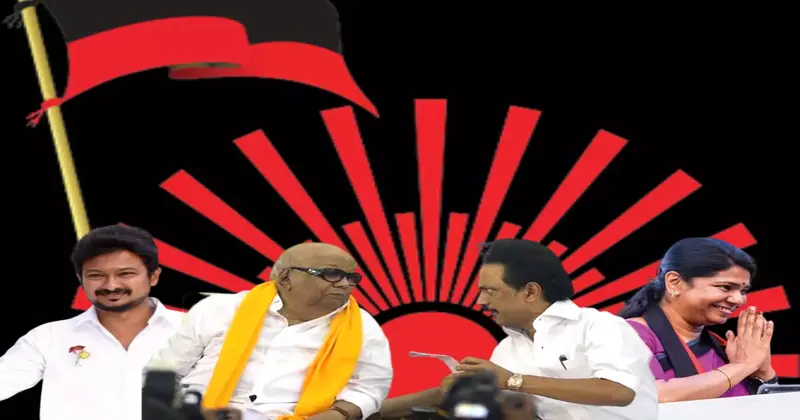
It is, however, in Tamil Nadu under the Dravida Munnetra Kazhagam(DMK) that this phenomenon finds one of its most elaborate and institutionalised expressions. The attached image is not merely a family tree—it is a political map. At its centre stands M. Karunanidhi, a towering figure whose legacy has come to define not just a party but an entire ecosystem of power. Surrounding him is an intricate web of relatives, many of whom have occupied or continue to occupy influential political, administrative and economic positions.

Karunanidhi’s immediate family itself reflects this consolidation. His sons have been central to Tamil Nadu’s political landscape. M.K. Stalin, his son, rose through the ranks to become the Chief Minister of Tamil Nadu and the current face of the DMK. Another son, M.K. Alagiri, wielded significant influence in southern Tamil Nadu and served as a Union Minister. Yet another son, M.K. Tamilarasu, has been associated with business interests linked to the family’s broader influence.

The next generation further deepens this concentration of power. Udhayanidhi Stalin, son of M.K. Stalin, has transitioned from cinema into politics and now holds a ministerial position, marking the continuation of dynastic succession. Dayanidhi Maran, Karunanidhi’s grand-nephew, has served as a Union Minister and remains a prominent political figure. His brother, Kalanithi Maran, while not directly in electoral politics, controls one of the largest media networks in the country, Sun TV, which has historically been seen as closely aligned with DMK interests—highlighting the overlap between political power and media influence.

Kanimozhi Karunanidhi, Karunanidhi’s daughter, is another key figure, serving as a Member of Parliament and playing a prominent role in shaping the party’s cultural and political narrative. The extended family includes several other individuals who, while not always in the limelight, are part of the broader network of influence—occupying roles in party structures, business enterprises, or allied institutions. Even more striking is the presence of multiple layers of relatives—sons, daughters, nephews, grand-nephews and in-laws—who are connected to positions of authority.

The image reflects names such as Durai Dayanidhi, Arulnidhi and others who are linked either to political roles or to industries like media, cinema and business, sectors that significantly shape public opinion and economic power in Tamil Nadu. The presence of spouses and extended family members in this network further underscores how influence is not confined to formal political positions but extends into a broader ecosystem of control.

This concentration of power within one family raises critical concerns about the health of democracy within the party and by extension, within the state. When leadership positions are repeatedly occupied by members of a single family, it creates a perception—if not a reality—that political power is being monopolised. For party workers who have dedicated decades of service, the message is clear: the highest offices may remain perpetually out of reach.

Such a structure also risks blurring the line between public service and private interest. When political authority, media control and economic influence intersect within a single familial network, it can create an environment where accountability becomes diffused. Decisions may be influenced not solely by public welfare but by the imperative to sustain a consolidated power structure.

Also Read: Tunis anti-terror arrests cast shadow on Gaza Flotilla, spotlight turns on Greta Thunberg and funding links

For the people of Tamil Nadu, this has deeper implications. The state, known for its high literacy, industrial growth and cultural vibrancy, has a population that is aspirational and increasingly aware. Yet, the persistence of dynastic politics risks limiting the emergence of new leadership that can bring fresh ideas and perspectives. It can create a political culture where loyalty to a family supersedes commitment to governance and public welfare.

As Tamil Nadu approaches another electoral cycle, the issue is not merely about one party or one family. It is about the kind of democracy the people wish to strengthen. Should political leadership remain concentrated within a closed circle, or should it open itself to broader participation? Should the future of governance be shaped by inheritance or by merit?

The image serves as a powerful visual reminder of the stakes involved. It is not just a depiction of relationships; it is a representation of how deeply entrenched dynastic politics can become when left unchallenged. For a state with the intellectual and cultural legacy of Tamil Nadu, the moment calls for introspection.

The coming election, therefore, is more than a political contest—it is an opportunity to reaffirm the principles of democratic openness, accountability and equal opportunity. Tamil Nadu’s electorate has the agency to decide whether its political future will continue to be shaped by a single extended family or whether it will embrace a more inclusive and merit-based path forward.

Topics: Family politicsTamil Nadu elections 2026DMKTamil NaduDemocracydynasty politics
Siddhartha Dave
Siddhartha Dave
Siddhartha Dave is an alumnus of the United Nations University in Tokyo and a former Lok Sabha Research Fellow. He writes on foreign affairs and national security. [Read more]
ShareTweetSendShareSend
✮ Subscribe Organiser YouTube Channel. ✮
✮ Join Organiser's WhatsApp channel for Nationalist views beyond the news. ✮
Previous News

Karnataka: 24 sedition in 3 years; Zero conviction & dismissed for lack of evidence, raises national security concern

Next News

Karnataka: Rs 20 crore splurged on foreign tours; Missing reports expose governance failure

Related News

MK Stalin with Sonai Gandhi; MK Stalin with Rahul Gandhi (File Photos) (Left to Right)

Tamil Nadu: DMK says no to INDIA Alliance meet in Delhi, blames Congress for political backstabbing

Representative Image

From DMK to TVK Government: Did crimes against women and children end in Tamil Nadu?

Tamil Nadu Governor Rajendra Vishwanath Arlekar

Tamil Nadu Governor calls Thiruvalluvar a ‘sanatani’; says his wisdom matters more than saffron or white robes

A huge crowd of Sanatanis, along with the Hindu Munnani Karyakartas, gathered to
protest near Coimbatore Power House in Sivananda Colony on May 15

Sanatan Dharma and Politics in Tamil Nadu: Eradicating the eternal

Beyond the Thucydides Trap: Why the rise of India differs fundamentally from China

Tamil Nadu CM Joseph Vijay with PM Narendra Modi at Delhi on May 27

Tamil Nadu: CM Joseph meets PM Modi, thanks him for Aanaimangalam copper plates, raises Vande Mataram, fishermen issues

Load More

Latest News

Hindu victim in the case who was trapped by Islamist senior

After TCS, Wipro, Pune insurance employee accuses Mohammad Sadiq of harassment; Arrested by police

AAP’s New Front? CJP Emerges as Congress’s Biggest Narrative Challenger

Congress Protests, CJP Trends: AAP harvests through CJP on ground tilled by Congress

The Maharashtra SIT chargesheet in the TCS Nashik case alleges that a woman employee was encouraged to stop visiting temples and was introduced to Islamic teachings through videos of religious preachers.

‘Allah is with us, stop going to mandir’: Chargesheet exposes new details in TCS Nashik Corporate Jihad probe

Congress Era of paper leaks (This is an AI generated image)

Congress era and the recurring challenge of paper leaks: A look back at 2004-2014; Were resignations asked then?

World Environment Day: A green future demands more than planting trees

RSS Sarsanghchalak Dr Mohan Bhagwat

The time of Bharat has arrived; we need to expedite our preparation: Dr Bhagwat at RSS Karyakarta Vikas Varg 2

Padma Bhushan awardee and noted industrialist Kumar Mangalam Birla Kumar Mangalam Birla addressing the Samapana Samaroh (Valedictory Function) of the Rashtriya Swayamsevak Sangh Karyakarta Vikas Varg – Dwitiya at Nagpur, on June 4, 2026

“RSS always stood by the society and nation”, Kumar Mangalam Birla at RSS Karyakarta Vikas Varg 2 in Nagpur

Arunachal Pradesh seals all 15 illegal Mosques; Bandh called off by APIYO

MK Stalin with Sonai Gandhi; MK Stalin with Rahul Gandhi (File Photos) (Left to Right)

Tamil Nadu: DMK says no to INDIA Alliance meet in Delhi, blames Congress for political backstabbing

Union Finance Minister Nirmala Sitharaman

Karnataka: All-Women team powers Yadgir’s groundnut revolution; Nirmala Sitharaman inaugurates NABARD Unit

Load More
  • Privacy
  • Terms
  • Cookie Policy
  • Refund and Cancellation
  • Delivery and Shipping

© Bharat Prakashan (Delhi) Limited.
Tech-enabled by Ananthapuri Technologies

  • Home
  • Search Organiser
  • Bharat
    • Assam
    • Bihar
    • Chhattisgarh
    • Jharkhand
    • Maharashtra
    • View All States
  • World
    • Asia
    • Africa
    • North America
    • South America
    • Europe
    • Australia
  • Editorial
  • Operation Sindoor
  • Opinion
  • Analysis
  • Defence
  • Culture
  • Sports
  • Business
  • RSS @ 100
  • Entertainment
  • More ..
    • Sci & Tech
    • Vocal4Local
    • Special Report
    • Education
    • Employment
    • Books
    • Interviews
    • Travel
    • Health
    • Politics
    • Law
    • Economy
    • Obituary
  • Subscribe Magazine
  • Read Ecopy
  • Advertise
  • Circulation
  • Careers
  • About Us
  • Contact Us
  • Policies & Terms
    • Privacy Policy
    • Cookie Policy
    • Refund and Cancellation
    • Terms of Use

© Bharat Prakashan (Delhi) Limited.
Tech-enabled by Ananthapuri Technologies