TN deportation of 33 Bangladeshis exposes larger network
July 3, 2026
  • Read Ecopy
  • Circulation
  • Advertise
  • Careers
  • About Us
  • Contact Us
Android AppiPhone AppArattai
Organiser
  • ‌
  • Bharat
    • Assam
    • Bihar
    • Chhattisgarh
    • Jharkhand
    • Maharashtra
    • View All States
  • World
    • Asia
    • Europe
    • North America
    • South America
    • Africa
    • Australia
  • Editorial
  • International
  • Opinion
  • RSS @ 100
  • More
    • Op Sindoor
    • Analysis
    • Sports
    • Defence
    • Politics
    • Business
    • Economy
    • Culture
    • Special Report
    • Sci & Tech
    • Entertainment
    • G20
    • Azadi Ka Amrit Mahotsav
    • Vocal4Local
    • Web Stories
    • Education
    • Employment
    • Books
    • Interviews
    • Travel
    • Law
    • Health
    • Obituary
  • Subscribe
    • Subscribe Print Edition
    • Subscribe Ecopy
    • Read Ecopy
  • ‌
  • Bharat
    • Assam
    • Bihar
    • Chhattisgarh
    • Jharkhand
    • Maharashtra
    • View All States
  • World
    • Asia
    • Europe
    • North America
    • South America
    • Africa
    • Australia
  • Editorial
  • International
  • Opinion
  • RSS @ 100
  • More
    • Op Sindoor
    • Analysis
    • Sports
    • Defence
    • Politics
    • Business
    • Economy
    • Culture
    • Special Report
    • Sci & Tech
    • Entertainment
    • G20
    • Azadi Ka Amrit Mahotsav
    • Vocal4Local
    • Web Stories
    • Education
    • Employment
    • Books
    • Interviews
    • Travel
    • Law
    • Health
    • Obituary
  • Subscribe
    • Subscribe Print Edition
    • Subscribe Ecopy
    • Read Ecopy
Organiser
  • Home
  • Bharat
  • World
  • Operation Sindoor
  • Editorial
  • Analysis
  • Opinion
  • Culture
  • Defence
  • International Edition
  • RSS @ 100
  • Magazine
  • Read Ecopy
Home Politics

Tamil Nadu deports 33 Bangladeshis, questions raised over DMK’s silence on ecosystem

The deportation of 33 illegal Bangladeshi infiltrators in Tamil Nadu is being seen as a positive step, but questions remain over a larger, well-established network that continues to enable illegal entry, settlement, and documentation across the state.

TS VenkatesanTS Venkatesan
Mar 21, 2026, 08:00 pm IST
in Politics, Bharat, Tamil Nadu
Follow on Google News
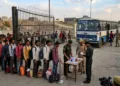
Deporting illgal Bangladeshi by Tamil Nadu police (Image courtesy: ANI)

Deporting illgal Bangladeshi by Tamil Nadu police (Image courtesy: ANI)

FacebookTwitterWhatsAppTelegramEmail

The recent deportation of 33 Bangladeshi nationals by Tamil Nadu police, along with the further processing to deport such individuals under police escort via the Tiruchi–Howrah Superfast Express on March 20, is being projected as a decisive administrative action by the DMK government and CM Stalin ahead of the State Assembly polls.

But when placed against the larger backdrop, it begins to resemble a familiar pattern, a carefully staged act that creates the illusion of enforcement among the people while concealing a far deeper and more entrenched ecosystem linked to illegal Bangladeshi settlements in the state.

On the surface, the deportation move appears aligned with directives from the Supreme Court and the Central government, mandating the identification and deportation of illegal immigrants.

Tamil Nadu has even constituted a special task force, and detention centres are operational in Tiruchi, Cheyyar, and Attur near Salem.

However, this isolated action does little to address the scale of the issue. The reality, as widely acknowledged yet rarely confronted, is that thousands of illegal Bangladeshi infiltrators continue to reside across Tamil Nadu.

#WATCH | Tamil Nadu | A total of 33 Bangladeshi nationals who were lodged in the special refugee camp at Attur in Salem district were deported from Tiruchirappalli.

According to officials, the individuals had been detained in connection with various cases and for residing in… pic.twitter.com/3cVMnDQgi9

— ANI (@ANI) March 20, 2026

It has been rightly argued that, over time, under Dravidian Parties Particularly during DMK rule, Tamil Nadu has carefully evolved into a critical transit and settlement hub, facilitating movement from Bangladesh to West Bengal then into southern regions, including Coimbatore and even neighbouring Kerala.

Critics argue that this movement is not random; however, it is sustained by a well-developed radical Islamic network from the point of origin to transportation, employment, and eventual settlement by a mosque-controlled ecosystem in the state.

It is alleged that industries in districts like Tiruppur and Coimbatore provide easy access to work in hosiery units, construction, and agriculture, where they can work and focus on a change of demography, with all political support, particularly from the DMK and its allies.

Over time, this illegal integration is reinforced by the acquisition of identity documents, Aadhaar cards, voter IDs, ration cards, and, in some cases, even passports, through the connivance of local Muslim leaders and DMK allies or organised Islamic jamaat networks.

The deportation of 33 individuals is amplified, but the larger eco-system that enables illegal entry and long-term settlement remains unquestioned.

The question arises: is this a genuine attempt at enforcement, or a tactical move to momentarily deflect scrutiny ahead of the Tamil Nadu Assembly elections scheduled in April 2026?

Allegations persist that parties such as the DMK and its allies maintain a transactional relationship with these populations, viewing them as potential vote banks. From Panchayat to Parliamentary elections, the incentive is to regularise and retain them to remain in political power.

At the same time, a contrasting narrative is often highlighted: the DMK and its allies show a perceived hostility towards Hindi-speaking North Indian migrant workers, while migrants from Bangladesh and Myanmar are treated with relative accommodation.

Historical data further complicates the narrative. Arrests of Bangladeshi nationals have been recurring: 11 detained in Annur, Coimbatore in January; 13 more from Coimbatore and Dindigul soon after; 18 sentenced a month prior; 19 imprisoned in Sikkarayapuram last year; 31 arrested by ATS in Tiruppur; 26 detained near Palladam; and as many as 98 apprehended in Tiruppur alone for lack of valid documents.

#Tamilnadu: 26 Bangladeshis arrested at Tiruppur The State Police raided their houses at Palladam. It was found that the Bangladeshis were working as labourers with fake Aadhaar IDs. pic.twitter.com/abc7zUbG0y

— Oxomiya Jiyori 🇮🇳 (@SouleFacts) June 19, 2025

These numbers indicate not an isolated issue, but a carefully drafted design. Despite arrests in small numbers, the core network remains intact. Each round of arrests is followed by silence, allowing the cycle to continue without media attention.

31 illegal Bangladeshis arrested in Tirupur, Tamil Nadu. All were working in textile units.

Employing low-cost labor without proper verification can jeopardize our national security.

In last few months, many illegal Bangladeshis have been consistently apprehended in Tamil Nadu. pic.twitter.com/hxNZ8yelWH

— Anshul Saxena (@AskAnshul) January 14, 2025

The timing of the recent deportation, ahead of Tamil Nadu’s Assembly elections, adds another layer to the debate.

It suggests that these actions may not be only for security, but also to send a political message—showing that the government is protecting national interests while not disturbing the vote-based system behind it.

The deportation of 33 illegal Bangladeshi infiltrators is a welcome step. But it should not be seen as enough. It is only a small part of a bigger issue, where such visible actions can hide the real problem instead of solving it. The real challenge lies in dismantling the networks, exposing the individuals behind them, and punishing them.


Topics: DMKTamil NaduBangladeshi infiltratorscoimbatoreillegal immigrationDeportationAssembly Elections 2026infiltration network
ShareTweetSendShareSend
✮ Subscribe Organiser YouTube Channel. ✮
✮ Join Organiser's WhatsApp channel for Nationalist views beyond the news. ✮
Previous News

Freedom of Religion Bill 2026: Renewing the legacy of Dilip Singh Judev

Next News

Ex-bureaucrats & judges debunk biased USCIRF report; Hail India’s religious freedom & role of RSS in nation-building

Related News

Tamil Nadu CM Joseph Vijay (File Photo)

Tamil Nadu: TVK alleges DMK bid to poach its MLAs; DMK counters with horse-trading complaint against CM Joseph Vijay

Tamil Nadu govt challenges High Court cow slaughter ban in Supreme Court; BJP slams CM Joseph Vijay

BJP Minority Morcha National Secretary Vellore Syed Ibrahim

Tamil Nadu: TVK Minister pushes for higher Muslim quota; BJP leader Ibrahim says it violates Islamic tenets

Image Courtesy-Hindu Munnani

Tamil Nadu: Hindu Munnani hails temple land retrieval in Erode, raises HR&CE accountability issues

Tamil Nadu: Poster portraying Shivaji Maharaj at the feet of Tipu removed after protests by Hindus

Arrested Bangladeshi nationals: Mohammed Woola, Mohammed Mafdi Hassan and Mohammed Hassan Ali

Keralam: Three more Bangladeshis arrested in Kozhikode; IB probes fake Aadhaar, SIM links

Load More

Latest News

80 Years of Organiser: Celebrating 8 decades as Voice of the Nation; VP Radhakrishnan to join in commemorative event

Tamil Nadu: Madras HC allows temple entry to American woman, says Hindutva cannot be judged by name or nationality

Tamil Nadu CM Joseph Vijay (File Photo)

Tamil Nadu: TVK alleges DMK bid to poach its MLAs; DMK counters with horse-trading complaint against CM Joseph Vijay

Odisha Govt to provide error-free textbooks to students, rejects claim of 1,678 mistakes

Odisha government to provide error-free textbooks to students, rejects claim of 1,678 mistakes

US-Iran Conflict: Beyond the battlefield

Japan’s Domestic Transformation: The silent revolution behind its strategic rise

A section of the vast procession paying homage to Dr Syama Prasad Mookerjee

Dr Shyama Prasad Mookerjee: Exposing the mystery surrounding his death

India-Pak reconciliation appeal in an open letter by a section of Indians draws fire amid cross-border terror concerns

By enabling direct yen-rupee settlements, India and Japan are laying the foundation for a more efficient, resilient and strategically integrated economic partnership

Beyond De-Dollarisation: What India-Japan’s Yen-Rupee trade framework really means

(Left) J&K LG Manoj Sinha performing puja (Right) LG Manoj Sinha flags off the bus carrying pilgrims for the Amarnath Yatra

Amarnath Yatra 2026: LG Manoj Sinha flags off first batch of pilgrims amid tight security

Load More
  • Privacy
  • Terms
  • Cookie Policy
  • Refund and Cancellation
  • Delivery and Shipping

© Bharat Prakashan (Delhi) Limited.
Tech-enabled by Ananthapuri Technologies

  • Home
  • Search Organiser
  • Bharat
    • Assam
    • Bihar
    • Chhattisgarh
    • Jharkhand
    • Maharashtra
    • View All States
  • World
    • Asia
    • Africa
    • North America
    • South America
    • Europe
    • Australia
  • Editorial
  • Operation Sindoor
  • Opinion
  • Analysis
  • Defence
  • Culture
  • Sports
  • Business
  • RSS @ 100
  • Entertainment
  • More ..
    • Sci & Tech
    • Vocal4Local
    • Special Report
    • Education
    • Employment
    • Books
    • Interviews
    • Travel
    • Health
    • Politics
    • Law
    • Economy
    • Obituary
  • Subscribe Magazine
  • Read Ecopy
  • Advertise
  • Circulation
  • Careers
  • About Us
  • Contact Us
  • Policies & Terms
    • Privacy Policy
    • Cookie Policy
    • Refund and Cancellation
    • Terms of Use

© Bharat Prakashan (Delhi) Limited.
Tech-enabled by Ananthapuri Technologies