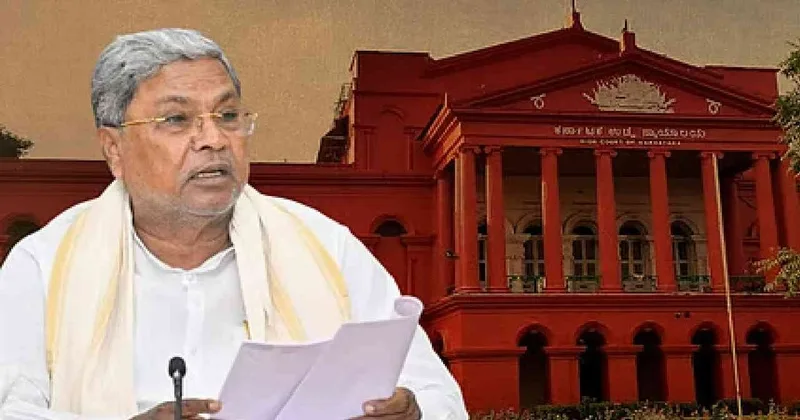
BENGALURU: The Karnataka High Court has delivered a strong indictment of the functioning of the Chief Minister’s Office (CMO), placing the spotlight firmly on alleged interference in transfers and postings under the Congress-led government headed by Siddaramaiah.
In a sharply worded order, a Division Bench comprising Justice D K Singh and Justice T M Nadaf made it clear that the Chief Minister should not be engaging in routine administrative matters such as transfers of government employees. The court underlined that such вмешательство not only undermines institutional processes but also raises serious concerns over transparency and governance.
CM Has Better And More Important Work To Perform Than Interfering With The Transfers Says High Court#TV9Kannada #CMSiddaramaiah #HighCourt #RecommendationsLetterForTransfter #HealthDepartment #ExciseDepartment #HealthOfficerTransferredToExciseDept #BJP… pic.twitter.com/sSEvKtNAQz
— TV9 Kannada (@tv9kannada) March 19, 2026
The Bench categorically directed that requests for transfers and postings should not be entertained directly by the CMO and must be handled strictly at the level of concerned departments. It emphasised that the highest executive office in the state has “more important work” than involving itself in such day-to-day administrative decisions.
The matter arose from an intra-court appeal challenging an earlier order of a Single Judge, who had already flagged a disturbing pattern of interference. The Single Judge had observed that letters, approvals, and recommendations issued from the CMO were effectively overriding decisions taken by departmental authorities, particularly in the transfer of Group ‘B’ and ‘C’.
One of the instances highlighted involved an Assistant Manager who allegedly secured a mutual transfer through approval from the CMO, bypassing the established process within the Karnataka Power Transmission Corporation Limited (KPTCL). The court noted that such instances create doubt over whether due procedure is being followed or if parallel systems are being allowed to function.
More significantly, the Single Judge had raised suspicion that certain individuals within the CMO could be “mechanically issuing” such approvals without proper scrutiny. This observation, now reinforced by the Division Bench, points to possible systemic lapses within the highest administrative office of the state.
The state government attempted to defend itself by submitting an affidavit through the Chief Secretary, claiming that communications from the CMO were merely recommendatory in nature. However, the court appeared unconvinced, stressing that even recommendations from such a high office carry undue influence and can distort the decision-making process.
The Bench reiterated that transfers and postings must be governed strictly by laid-down guidelines and handled exclusively by competent authorities within departments. Any deviation, it warned, could erode fairness, breed favouritism, and damage the morale of government employees.
Importantly, the court directed that a copy of the order be placed before the Chief Minister for “necessary directions,” effectively asking him to ensure that the CMO refrains from вмешательство in such matters going forward.
The ruling has triggered a political storm, with the BJP accusing the Congress government of running a “transfer racket” and using postings as instruments of patronage. Opposition leaders argue that the High Court’s observations validate long-standing allegations of backdoor influence, lobbying, and misuse of authority in administrative decisions.
The controversy also raises broader questions about governance standards and accountability. Frequent вмешательство in transfers has often been criticised for disrupting administrative continuity and enabling corruption, with employees allegedly seeking political backing for favourable postings.
With the High Court stepping in and issuing clear directions, pressure is mounting on the Siddaramaiah government to bring transparency and discipline to the transfer process. Whether the CMO will comply fully with the court’s observations or face further scrutiny remains to be seen.