Time is not merely the discipline of clock hands; it is the living reflection of cosmic motion. From the moment humanity first looked up at the sky, it began deciphering the mystery of time through the Sun’s journey, the phases of the Moon, and the silent procession of the stars. This contemplation gradually evolved into systems of calendrical reckoning. While the modern world recognises the Gregorian calendar as a universal standard for civil timekeeping — largely shaped by administrative needs and historical adjustments — the Bharatiya Panchang represents a far deeper endeavour: it seeks to understand time not as a sequence of dates, but as a harmonious orchestration of celestial rhythms grounded in scientific precision.
The Panchang is a multi-dimensional science of time. Whereas conventional calendars typically provide only the date and day of the week, the Bharatiya Panchang is structured upon five fundamental elements — Tithi (lunar day), Vara (weekday), Nakshatra (lunar mansion), Yoga (a specific angular relationship of the Sun and Moon), and Karana (half of a Tithi). These five components give the Panchang its name — Pancha (five) + Anga (limbs). It is not a mere list of dates; it is a living astronomical document based on meticulous calculations of the relative positions of the Sun and Moon, the division of the ecliptic into stellar sectors, planetary alignments, and subtle temporal divisions.
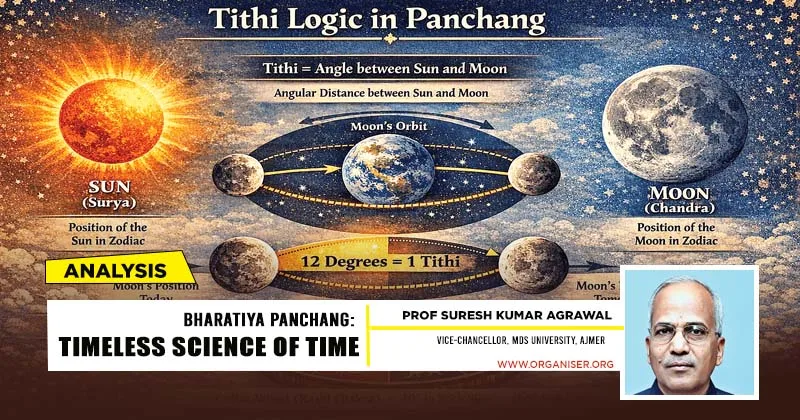
In classical Bharatiya astronomy, the celestial sphere is divided into 27 Nakshatras. The Moon completes one orbit around the Earth in approximately 27.3 days, and this motion forms the basis for the division of the ecliptic into 27 equal segments. Each Nakshatra spans 13°20′ of arc — an impressive demonstration of mathematical exactitude. The Tithi is determined by the angular distance between the Sun and the Moon. When both share the same longitude, it is Amavasya (New Moon); when they are separated by 180°, it is Purnima (Full Moon). The full 360° circle is divided into 30 equal parts, each of 12°, and each such segment constitutes one Tithi.
The Yoga is derived from the combined longitudes of the Sun and the Moon, resulting in 27 Yogas. The Karana is half of a Tithi. The interval from one sunrise to the next is known as Vara, or the weekday, based fundamentally on the Earth’s rotation.
Science Behind Hindu Timekeeping
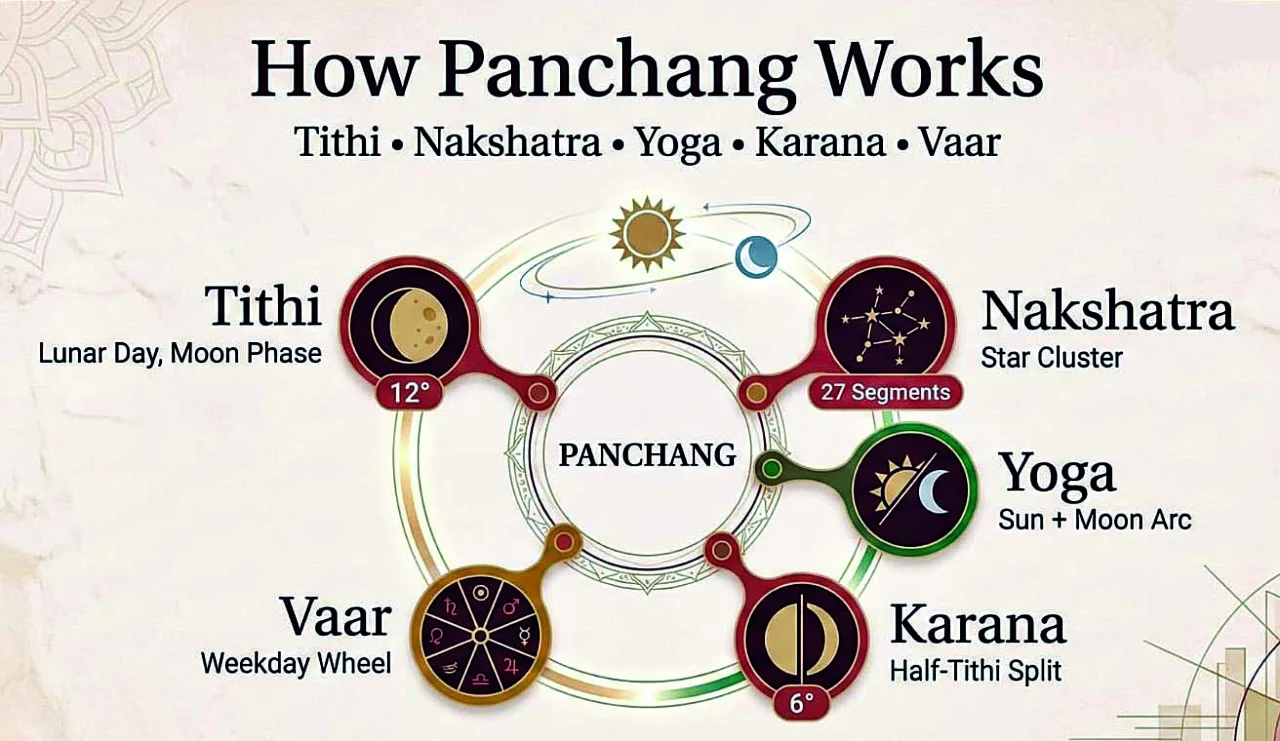
The word Panchang comes from Sanskrit. Pancha means five and Anga means limbs. It is called so because it is made of five main parts. The modern calendar follows only the Sun but the Panchang follows both the Sun and the Moon. It works as both a calendar and an astrological guide. It shows good and bad timings and auspicious days.
The Five Elements of Panchang
Tithi
A Tithi is the distance between the Sun and the Moon measured in steps of 12°. There are 30 Tithis in a lunar month. They are split into Shukla Paksha and Krishna Paksha. Each Tithi has its own meaning. For example Ekadashi is sacred for fasting and prayer
Nakshatra
The sky is divided into 27 star groups called Nakshatras. The position of the moon in a Nakshatra affects mood, events and outcomes. Pushya Nakshatra is considered lucky for new beginnings while others are less favorable
Yoga
Yoga is formed by adding the longitudes of the Sun and Moon. There are 27 Yogas in total. Some are good like Siddha and Amrita. Others such as Vyatipata and Vaidhriti are avoided
Karana
A Karana is half of a Tithi. So each Tithi has two Karanas. There are 11 types in total. Some, like Bava and Balava are good for work. Vishti or Bhadra is usually avoided.
Vaar
Each weekday is ruled by a planet. Sunday is ruled by the Sun. Monday by the Moon. Tuesday by Mars, and so on. The ruling planet shapes the energy of the day. For example, Thursday is linked to Lord Vishnu and wisdom, while Saturday is tied to discipline
The seven-day week itself rests upon a scientific foundation. In the Bharatiya tradition, time reckoning recognises nine planetary entities — Surya (Sun), Chandra (Moon), Mangal (Mars), Budha (Mercury), Guru (Jupiter), Shukra (Venus), Shani (Saturn), and the shadow planets Rahu and Ketu. Since Rahu and Ketu are considered shadow nodes rather than luminous bodies, the seven visible celestial bodies form the basis of the seven-day week. The combined cycle of day and night is termed Ahoratra, divided into 24 Horas. The very word “Hora” is derived from the union of Aho (day) and Ratri (night). The naming of weekdays follows the planetary order of Horas: the first Hora of a day determines its name. Thus, Sunday, Monday, Tuesday, and the rest are not merely cultural conventions but outcomes of astronomical sequencing.
The structure of twelve months in a year is equally scientific. The Earth revolves around the Sun in approximately 365.25 days, while the Moon completes about twelve revolutions around the Earth within that period. Hence, the twelve-month system emerges from observable celestial cycles. In the Bharatiya framework, the solar year is based on the Sun’s motion, and the lunar year on the Moon’s motion. The lunar year comprises approximately 354 days—about eleven days shorter than the solar year. To harmonise this discrepancy, an Adhika Masa (intercalary month) is added approximately every three years. This represents a remarkable scientific solution to astronomical divergence.
The naming of months is also rooted in stellar observation. Each month derives its name from the Nakshatra in which the Full Moon occurs. Thus, Chaitra is associated with Chitra; Vaishakha with Vishakha; Jyeshtha with Jyeshtha; Shravan with Shravana; Ashwin with Ashwini; Kartika with Krittika; Margashirsha with Mrigashira; Pausha with Pushya; Magha with Magha; and Phalguna with Purva Phalguni. These names are not commemorations of kings or historical events; they arise from astronomical realities.
Classical Indian literature often records events alongside precise planetary configurations. In the Valmiki Ramayan, the birth of Bhagwan Ram is described as occurring on Chaitra Shukla Navami under the Punarvasu Nakshatra with Cancer rising. Similarly, the Ramcharitmanas mentions Navami Tithi, Abhijit Muhurta, and the midday hour. Such references illustrate that chronological reckoning in the Bharatiya tradition was deeply anchored in astronomical observation.
By contrast, the Gregorian calendar evolved through successive historical reforms. Romulus is credited with devising a ten-month, 304-day year. Numa Pompilius later added January and February. In 46 BCE, Julius Caesar introduced a 365-day year along with the leap-year correction. Finally, in 1582, Pope Gregory XIII refined the system by removing ten days to produce the modern Gregorian calendar. Evidently, this calendar is the outcome of historical and administrative adjustments, whereas the Bharatiya Panchang represents a continuous astronomical tradition.
The Bharatiya system is dynamic — its Tithis may lengthen or shorten in accordance with actual celestial motion. The Gregorian calendar, in contrast, is fixed for administrative uniformity. The Panchang is not merely a cultural instrument; it is a scientific mirror of cosmic rhythm. The week is structured according to planetary order; the Tithi is determined by the Sun-Moon angular relationship; the month is aligned with stellar positions; and the year is harmonised through solar-lunar coordination.
In our contemporary world, while global synchronisation necessitates the use of the Gregorian calendar, it is equally essential to understand and reestablish the rational foundations of our own scientific heritage — the Bharatiya Panchang.
The Bharatiya vision of time teaches us that time is not merely a date inscribed on paper. It is the living dialogue between humanity and the cosmos — a profound expression of harmony between nature’s eternal movements and human consciousness.