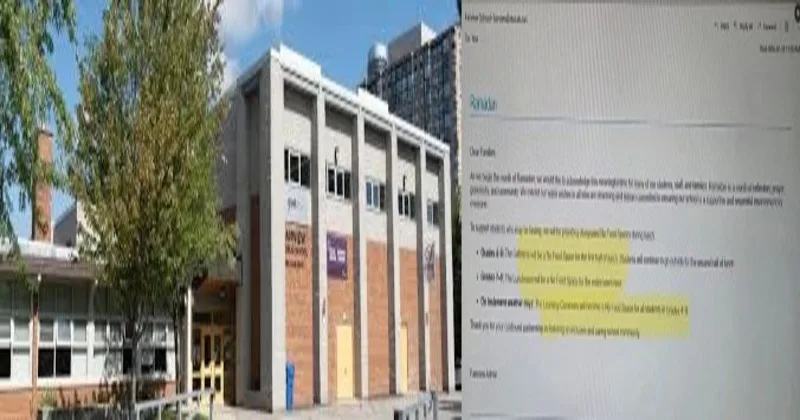
A school in Canada has been stuck in a major controversy as it has erected “no food zones” in the premises in order to respect the religious sentiments of the Muslim students during the month of Ramzan. However, displaying the board of “no food zone” within the school campus has denied access to certain areas in the school to the students of other communities. This reflects hurting the rights and freedom of a certain group of students in order to accommodate with the practices of other students. This is clearly against the principle of inclusivity that has to be followed in the academic setup, said observers.
Putting a “no food zone” board in the school cafeteria to support the Muslim students who are fasting during the month of Ramzan was considered by the school as a move to promote inclusivity and accommodate religious sentiments. However, the move has erupted into wide controversy and criticism. This has spiked questions such as how far educational institutions can go in the path of respecting religious sentiments. Isn’t there a thin line of difference between accommodating religious sentiments and ensuring equality, uniformity and inclusivity?
A Canadian school has sparked outrage after it designated 'No Food' zones at certain times inside its cafeteria in order to be inclusive to Muslim children who are fasting for Ramadan.
Lunch areas at Fairview School in Calgary have been named 'food free' to support students… pic.twitter.com/M1N1Onz94N
— Tommy Robinson 🇬🇧 (@TRobinsonNewEra) March 16, 2026
The controversy erupted when the Fairview school in Canada sent email to the students asserting about the special arrangements made during the month of Ramzan. The email reads that parts of the school cafeteria will be declared as “no food zone” during the lunch hour. In this direction, students in Grades 4 to 6 were barred from eating in certain areas during the first half of lunch, while those in Grades 7 to 9 faced stricter rules, with eating banned in their lunchroom for the entire hour-long break. The school administration defended the decision by claiming that it was taken to support the students who are fasting and to build an “inclusive and caring school community”.
The decision by the school authorities created further anger among the students and parents as the email did not clearly state where the students from the other community apart from Muslims could eat. This led to frustration and confusion among the students and parents. Critics argued that the new rules adopted to accommodate the religious practices of Muslim students was indeed unfair. It adversely impacted those who were not fasting rather than supporting or making alternative arrangements for those who were fasting.
“The true common sense solution would have been for the fasting students to avoid the cafeteria area”, said a critic on social media. Some comments were even more harsh. “Whoever made that rule should be fired”, one user posted, while another added, “If my kid isn’t allowed to eat at school, I’d be looking for another school”, illustrating the anger among the parents. Despite the school authorities defending the decision as it was necessary to accommodate the religious practices of certain communities, parents, students and social media have severely criticised the move as non-inclusive. The school must understand the thin line of difference. Respecting religious sentiments of certain sections should not rupture the principles of inclusivity and uniformity that has to be followed in the school premises.