
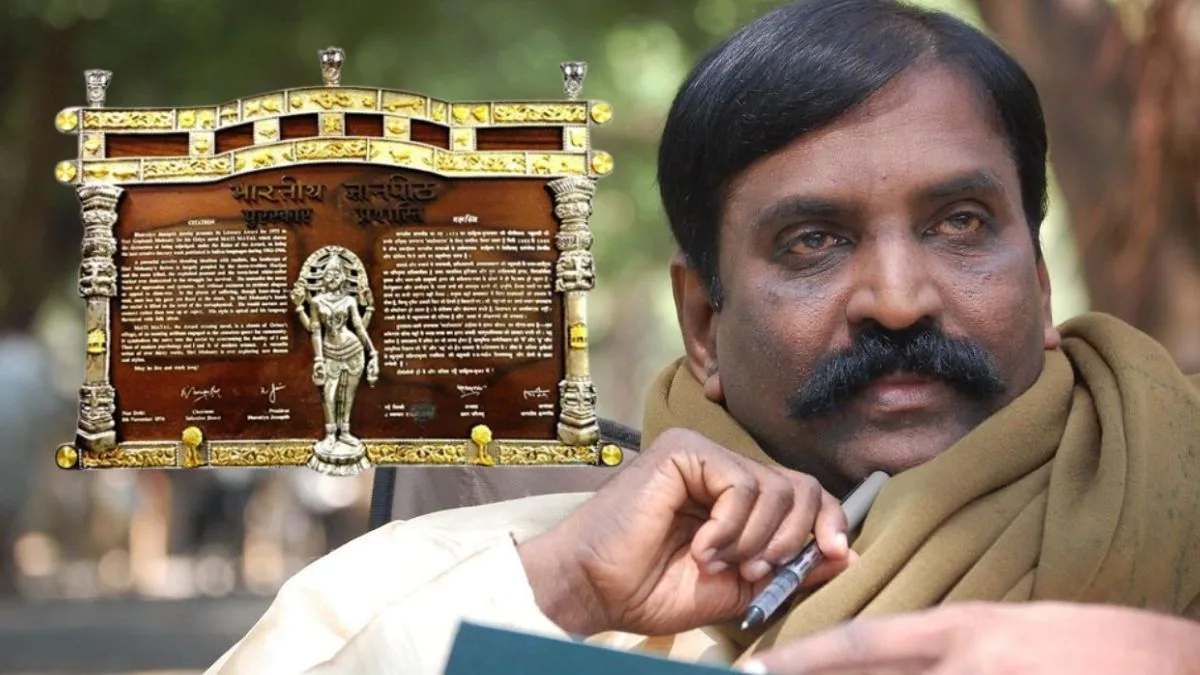
Dravidian model poet Vairamuthu, long seen as closely aligned with the Dravida Munnetra Kazhagam (DMK), is back in the spotlight—this time not just for the sexual harassment allegations levelled against him by multiple women or the controversies over his remarks on Hindu deities, but for being conferred the Jnanpith Award. The development has triggered sharp reactions and renewed scrutiny, particularly given that the award includes a bronze replica of Saraswati, the Hindu goddess of knowledge and wisdom, adding a layer of irony that has not gone unnoticed.
On March 13, Vairamuthu was named for the Jnanpith Award—an honour often mistaken for a state or government award. But is it really a government honour, or is it conferred by a private trust? Absolutely, it isn’t a state honour. The award is conferred by a trust.
Bharatiya Jnanpith – State Honour or Private?
The Jnanpith Award was conceived by the Bharatiya Jnanpith, a private research and cultural institution founded in 1944 by industrialist Sahu Shanti Prasad Jain. In 1961, the organisation proposed creating a prestigious national-level literary award to recognise the best works in Indian languages.
The idea was further developed through consultations with leading literary figures such as Kaka Kalelkar, Harivansh Rai Bachchan, and Ramdhari Singh Dinkar, and received encouragement from then President Dr. Rajendra Prasad.
In 1962, the proposal was discussed widely among literary bodies, and a final framework was prepared after consultations with around 300 writers across India. The award selection process formally began in 1963, with a committee of eminent scholars overseeing it.
Overall, the Jnanpith Award emerged as a privately instituted literary honour of national prestige, shaped by prominent intellectuals and supported in spirit—but not administered—by the state.
Any statutory or government-mandated process governing award?
There is no statutory or government-mandated process governing how these bodies are constituted; members are appointed internally by the organisation.
For each Indian language, Bharatiya Jnanpith sets up a Language Advisory Committee (LAC) comprising writers, critics, scholars, and academics from that language’s literary community. These committees assess authors and recommend names based on their lifetime literary contributions.
The final decision is taken by the Jnanpith Selection Board, which is also appointed by Bharatiya Jnanpith. The board usually includes senior writers and sometimes past award winners. It reviews all the recommended names and then selects the person who will receive the award.
However, the award has been formally presented by the President of India in a ceremony on different occasions.
DMK Stooge Poet, Multiple Sexual Harassment Case Against Vairamuthu
Singers like Chinmayi Sripada, Bhuvana Seshan, has come out exposing DMK puppet poet-lyricist Vairamuthu both during #MeToo campaign and after.
During the #MeToo movement in 2018, singer Chinmayi Sripada publicly accused Vairamuthu of sexual harassment, alleging that he behaved inappropriately during an overseas incident and made suggestive advances. She stated that she was asked to “cooperate,” which she interpreted as misconduct, and went on to share her experience on social media.
Chinmayi also amplified and supported several other women who came forward with similar allegations against him, bringing wider attention to the issue in the Tamil film industry. She positioned herself as a vocal advocate for accountability, while also claiming that she faced professional backlash after speaking out. Vairamuthu, however, denied the allegations and maintained that they were baseless.
she had filed a complaint with the DGP and the NCW. She said apart from her, her husband and mother too had submitted written complaints and said it was the police’s fault if they did not file an FIR.
Another Tamil Singer Bhuvana Seshan alleged that Vairamuthu harassed her early in her career and used his influence to pressure her, including suggesting that he had the power to “make or break” her in the industry. She said his behaviour made her uncomfortable and eventually led her to step away from pursuing playback singing.
Bhuvana also highlighted that around 17 women had made allegations against him, but only a few came forward publicly due to fear and stigma. She stated that many women hesitate to speak out because they believe no action will be taken, and said she shared her story so that young singers would not face similar experiences.
Vairamuthu’s Controversial remarks on Hindu Gods and Hindus
Vairamuthu has faced repeated controversy over his remarks on Hindu beliefs and figures. In 2018, he triggered widespread protests after referring to Andal as part of the devadasi tradition while citing a scholarly source, which many Hindu groups found derogatory. He claimed that the 7th-century mystic poet Andal was a Devadasi who lived and died at the Srirangam Temple.
A police complaint was filed, following which Vairamuthu issued a clarification. More recently, his remarks interpreting Lord Ram in a literary context—suggesting Ram “lost his mind” after separation from Sita—sparked a political row, with critics calling it offensive to religious sentiments. Over the years, several of his statements on Hindu themes have drawn backlash from religious groups and political leaders.
In July 2024, Vairamuthu mocked Hindu practices in a poem under the garb of condoling the Hathras stampede tragedy.
ONV Award Row: Honour Conferred, Decision Later Reconsidered
In 2021, a similar controversy erupted when the ONV Cultural Academy in Kerala announced Vairamuthu for their literary prize. Following a massive public outcry and protests from the literary community, the academy was forced to stay and reconsider the decision. Critics are now asking why the Jnanpith Selection Board has not shown similar ethical scrutiny.