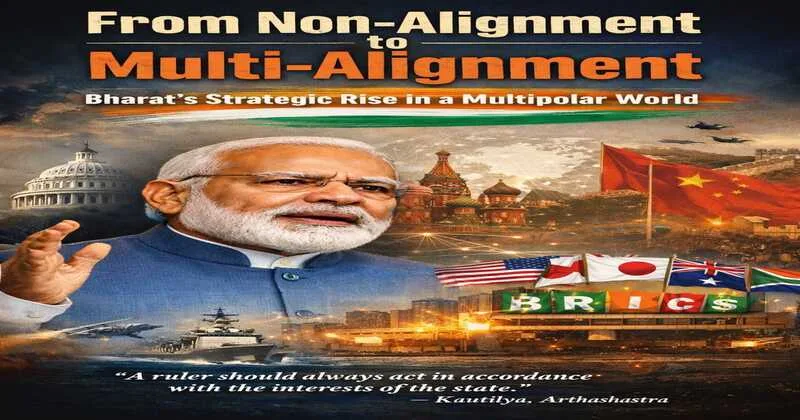
The world is entering a new era of geopolitical competition where rigid alliances are giving way to flexible partnerships. In this emerging multipolar order, Bharat is redefining its diplomatic posture by moving beyond the legacy of non-alignment, towards a more confident strategy of multi-alignment. For much of the Cold War, global diplomacy revolved around rigid alliances. Nations were broadly expected to align either with the Western bloc led by the United States or with the Soviet camp dominated by the Soviet Union. At that historical juncture, India chose a different course. Through the Non‑Aligned Movement, it attempted to preserve strategic autonomy and avoided being drawn into the ideological rivalries of the Cold War.
The geopolitical landscape of the twenty-first century, however, is far more complex. Power is diffused across multiple regions, economic interdependence shapes political choices and technological competition increasingly define global influence. In this environment, the rigid neutrality of the Cold War era has gradually evolved into something more pragmatic. Over the past decade, India’s foreign policy under Prime Minister Narendra Modi has taken on a new character, one that many analysts describe as a transition from non-alignment to multi-alignment. Rather than binding India to any ideological bloc, this approach places national interest, strategic autonomy and issue-based partnerships at the centre of diplomacy.
At the heart of this strategy lies a timeless principle of statecraft: nations do not have permanent friends or permanent enemies. They have permanent interests. India’s diplomatic conduct in recent years reflects this realism. While New Delhi has significantly deepened strategic cooperation with the United States and other Western partners, it has simultaneously preserved long-standing ties with Russia, expanded engagement across West Asia and remained active in multilateral forums seeking to rebalance global governance. The result is not neutrality but strategic balance.
Strategic autonomy in practice
This shift became increasingly visible after 2014, when the PM Modi government began recalibrating India’s external engagement to match its growing economic and strategic stature. Today, India is the world’s fifth-largest economy and an increasingly significant security actor in the Indo-Pacific. Accordingly, its diplomatic posture has moved beyond maintaining distance from major powers. Instead, India now engages actively with multiple partners while preserving its independence of judgment. Energy security offers a clear illustration. Following the outbreak of the Russia‑Ukraine War, Western countries imposed extensive sanctions on Russia and urged partners to reduce economic ties with Moscow. India faced considerable diplomatic pressure to follow suit.
New Delhi adopted a different path. Guided by economic realism, India increased its purchases of discounted Russian crude oil. This helped stabilise domestic markets and shield Indian consumers from global energy volatility. For a country of more than 1.4 billion people, energy security could not be subordinated to geopolitical signalling. Indian policymakers made it clear that partnerships would continue, but decisions would ultimately be guided by national interest.
Diversifying defence partnerships
India’s defence policy reflects a similar logic of diversification rather than dependence. Russia has historically been a key supplier of military hardware to India and continues to account for a substantial portion of its defence inventory. Despite expanding defence cooperation with the United States, France and Israel, India has not abandoned its long-standing strategic ties with Moscow. The acquisition of the S‑400 Triumf illustrates this approach.
Despite concerns in Washington about possible sanctions under the CAATSA, India proceeded with the purchase, arguing that its national security environment demanded robust air-defence capabilities. Such decisions underline India’s broader objective: to build a diversified defence ecosystem while strengthening domestic military production under the vision of strategic self-reliance.
Multi-alignment in global institutions
India’s participation in international institutions also reflects this balanced strategy. New Delhi remains an active member of BRICS, where emerging economies seek greater influence in global financial governance. At the same time, India plays a leading role in the G20. India’s presidency of the G20 in 2023 demonstrated its growing diplomatic weight. Despite deep divisions among major powers over the Ukraine conflict, New Delhi succeeded in securing a consensus declaration at the summit, an achievement widely recognised as an example of India’s ability to bridge geopolitical divides.
The Indo-Pacific dimension
China’s rise and its increasingly assertive posture along the Himalayan frontier and across regional waters have also reshaped India’s strategic outlook. In response, India has strengthened cooperation through the Quadrilateral Security Dialogue, a strategic platform that includes the United States, Japan and Australia. The Quad focuses on maritime security, supply-chain resilience, emerging technologies and humanitarian cooperation. Significantly, India continues to emphasise that the Quad is not a military alliance. This careful positioning allows New Delhi to enhance regional cooperation while retaining diplomatic flexibility.
West Asia: A model of balanced diplomacy
India’s relations in West Asia offer another example of this multi-vector diplomacy. Over the past decade, strategic cooperation with Israel has expanded significantly, particularly in defence technology, agriculture and innovation. At the same time, India continues to support a two-state solution to the Israel-Palestine question and has maintained its traditional engagement with the Palestinian leadership.
Parallel to this, economic ties with the Gulf have deepened. Partnerships with the United Arab Emirates and Saudi Arabia have expanded across energy, infrastructure investment and financial connectivity.
The large Indian diaspora in the Gulf further strengthens these relationships and reinforces India’s cultural and economic presence across the region.
India as a balancing power
Taken together, these developments suggest that India is positioning itself as a balancing power in an emerging multipolar world. Rather than aligning firmly with any single bloc, it is cultivating relationships across diverse centres of influence while shaping outcomes through diplomacy, trade and technological cooperation. International observers increasingly recognise India as a pivotal state in a fragmented global order. Decisions taken in New Delhi today influence debates on trade, supply chains, climate policy and security architecture far beyond South Asia. In such a competitive environment, diplomatic flexibility becomes a strategic asset.
Towards an independent pole in global politics
India’s evolving foreign policy reflects a larger ambition. The country is no longer content to remain on the margins of global decision-making. Instead, it seeks to shape the international agenda in ways consistent with its civilisational values and national interests. Claims that India has tilted decisively toward any single power therefore miss the larger transformation underway. The more accurate description is this: India has embraced a confident and multidimensional diplomatic framework under the PM Modi government.
The emerging Modi Doctrine seeks to position India not merely as a participant in global politics, but as an independent pole in the emerging world order. If this trajectory continues, the defining feature of India’s diplomacy will not be rigid alignment, but the ability to engage multiple powers while steadily advancing the national interest of Bharat.
India’s foreign policy is therefore undergoing a profound transition. The country that once practiced cautious non-alignment is now exercising confident multi-alignment rooted in civilisational self-belief. In a world increasingly shaped by strategic rivalries and shifting power equations, Bharat is rediscovering an ancient principle of statecraft, engage with all, align with none and act always in the national interest. If the current trajectory continues, the coming decades may well witness the emergence of India not merely as a regional power but as a decisive pole in the evolving global order.