The ripple effects of the escalating tensions in West Asia are now being felt far beyond the immediate geopolitical battlefield. What began as a conflict thousands of kilometres away has slowly begun to influence everyday life across Bharat, particularly through concerns surrounding energy supplies. Reports of disruptions in LPG supply chains, coupled with rising cylinder prices, have triggered anxiety among households that depend heavily on cooking gas for their daily meals.
In several cities, families have begun to ration their LPG usage, carefully planning when and how the stove is lit. For many middle-class and lower-income households already struggling with inflation and rising food prices, the possibility of delayed cylinder deliveries or higher costs has added a new layer of stress to the daily routine of preparing meals. Restaurants, small eateries and hostels too have started reassessing their menus and operational expenses, with some considering cutting down on fuel-intensive dishes or adjusting prices to cope with the uncertainty.
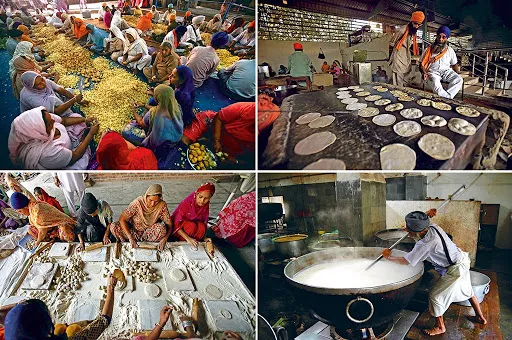
However, a contrasting scene unfolds in the vast kitchens of temples, gurudwaras and charitable institutions across the country. In these sacred spaces, where cooking is not merely a necessity but an act of seva, annadanam and collective service, the giant cauldrons continue to simmer as usual. Meals are still being prepared in enormous quantities to feed devotees, pilgrims and the needy. Despite the broader concerns surrounding LPG availability, the rhythm of these kitchens remains steady, ensuring that the age-old tradition of offering food as a form of devotion and compassion continues uninterrupted.
Steam kitchens feeding millions
One of the largest examples is the network run by the Akshaya Patra Foundation, which operates one of the world’s biggest mid-day meal programmes.
The organisation feeds more than 2.35 million schoolchildren every day across India through a network of 78 large kitchens. Surprisingly, only six of these kitchens depend on LPG, while the majority run on alternative energy systems.
Speaking about the situation, Sri Bharatarshabha Dasa, National President and Trustee of the foundation, told media that the programme remains fully protected despite the current LPG concerns.
He said the organisation’s centralised kitchens are largely steam-based, where boilers generate steam using electricity or briquettes made from agricultural waste. Some kitchens also run on piped natural gas (PNG), drastically reducing their dependence on LPG cylinders.
In cities like Bengaluru, the scale is remarkable. Two Akshaya Patra kitchens alone prepare meals for 1,15,918 children across 759 schools every day. Instead of LPG, they primarily use briquettes sourced from local farmers, which fuel massive steam cookers capable of preparing food at an industrial scale.
Another reason the programme remains insulated from disruption is planning. Petroleum companies including GAIL and BW LPG supply LPG to the foundation’s kitchens through CSR programmes, often delivering gas a month in advance, ensuring adequate reserves.
Solar power at Tirumala’s kitchens
At the sacred hill shrine of Tirumala Tirupati Devasthanams in Andhra Pradesh, where lakhs of devotees visit every week, the temple’s famed annadanam service continues without disruption.
At the Vengamamba Annaprasada Kendra, the temple serves free meals daily to one lakh to 1.5 lakh devotees. Despite concerns about LPG supply, officials say the service will continue without interruption.
The kitchen relies on a solar steam cooking system, one of the largest of its kind, along with modern equipment that prepares rice, pongal, curd rice, dal and sambar for devotees.
Officials also confirmed that the temple maintains a major agreement with Indian Oil Corporation to supply gas for the annadanam programme. If required, alternative systems such as biogas and induction stoves can support operations.
Further strengthening the infrastructure, another state-of-the-art kitchen and dining complex is currently being constructed in Tirumala at a cost of Rs 120 crore with support from Reliance Industries.
Shirdi temple’s solar cooking system
In Maharashtra, the kitchen of the Shirdi Sai Baba Temple, one of the country’s largest temple food services has been quietly relying on renewable energy for years.
The temple’s prasadalaya feeds between 35,000 and 50,000 devotees daily. Ordinarily, the kitchen consumes around 1.5 to 2 tonnes of LPG each day.
However, a solar cooking system installed in 2009 significantly reduces that consumption. The solar setup prepares staples such as rice and dal and helps save nearly 200 kilograms of LPG every day.
During festival rushes like Ram Navami or during times of fuel uncertainty, this renewable system plays a crucial role in keeping the sacred food service running smoothly.
Golden temple langar continues nonstop
Perhaps the most powerful example of resilience is the langar at the Golden Temple.
The community kitchen at the Sikh shrine, officially known as Sri Harmandir Sahib operates 24 hours a day, serving free meals to thousands of devotees and visitors from across the world.
Bhagwant Singh Dhangera, Manager of Sri Darbar Sahib, said the temple management ensures that the langar never stops.
Around 1,300 units of gas are supplied daily through pipeline connections, while an additional 25–30 LPG cylinders are maintained as emergency reserves.
He emphasised that the langar represents much more than food.
“Langar is not just a kitchen but a symbol of service, equality and brotherhood.”
The temple management also remains in constant touch with gas agencies to ensure uninterrupted supply so that the sacred service continues without disruption.
Dharmasthala’s LPG-free kitchen
In Karnataka’s Dharmasthala Sri Manjunatheshwara Temple, the kitchen has hardly felt the impact of the LPG shortage at all.
Temple authorities say their kitchen does not rely on LPG cylinders. Instead, they use steam boilers, with diesel as backup fuel if required.
As a result, the daily meals served to devotees continue exactly as before, with rice, sambar and other traditional dishes prepared without any change in menu.
However, not every religious institution has been equally insulated from the shortage.
Several temples under Karnataka’s state-run Muzrai department have begun adjusting their food programmes due to LPG constraints.
At the Kukke Subramanya Temple, the prasada menu has been simplified. Instead of fuel-intensive dishes like pongal, devotees are now offered Avalakki-Mosaru (poha with curd) and other items that require less cooking fuel.
Similarly, the Banashankari Temple has suspended its rice-based morning and afternoon meal programmes after its LPG stock dropped to just four cylinders.
Temple authorities said they may have to stop prasada distribution entirely if supplies do not improve soon.
Meanwhile, the Sri Chamundeshwari Temple has decided to continue its free afternoon meals for two more weeks, after which the situation will be reassessed.
The Male Mahadeshwara Temple is also continuing operations using existing LPG stock while monitoring supply conditions.
Community kitchens turn to traditional fuels
Outside temple complexes, charitable trusts across India are also adapting.
In Gujarat, organisations such as the Bolbala Charitable Trust in Rajkot have started using wood-fired stoves to continue feeding the needy. Trustees say that dishes like khichdi, curry and rotla can be easily prepared using traditional stoves.
Similarly, the Jalaram Charitable Trust in Virpur has begun cooking some dishes using wood as LPG supply becomes irregular.
At the Bagdana Bapa Sitaram Temple in Gujarat, food has always been cooked using dry cotton wood, making the kitchen naturally immune to LPG shortages.
Another example is Salangpur Dham, where a high-tech kitchen prepares meals without relying on electricity or gas, instead using a specialised oil-based cooking system.
Taken together, these sacred kitchens reveal a remarkable truth about India’s deeply rooted food traditions and the resilience built into them over centuries. In a country where cooking is not merely a household activity but also a sacred duty connected to faith, charity and community service, many of the largest food programmes have evolved systems that can withstand disruptions.
While most households across the country depend heavily on LPG cylinders for their everyday cooking needs, several of India’s biggest community kitchens that serve devotees and the needy have gradually built diversified energy systems over the years.
As a result, many of these kitchens rely on a combination of steam boilers, solar-powered cooking systems, briquettes made from agricultural waste, piped natural gas networks, biogas plants and traditional wood-fired stoves. This mix of technologies and fuels has created a resilient framework that allows them to continue operating even during energy uncertainties.
Therefore, even as concerns about LPG availability ripple through ordinary households and commercial kitchens, the massive kitchens of temples, gurudwaras and charitable institutions continue to cook, serve and sustain millions of people every day. In these spaces, food is prepared not only to fill stomachs but also as an offering of faith and service.