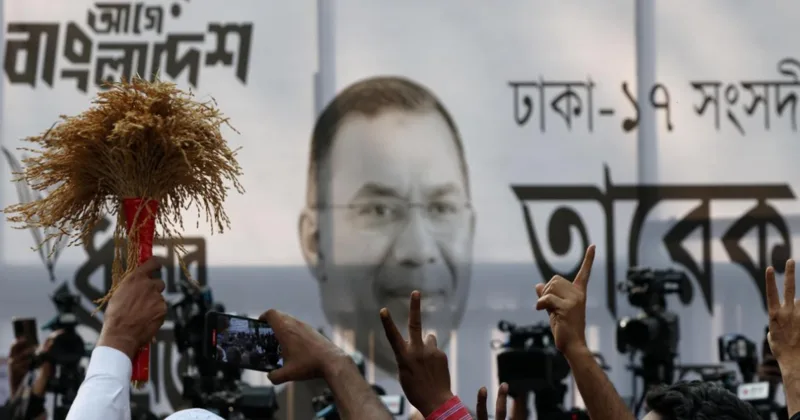
Given the nature of the majority of media outlets the world over and their pattern of eulogizing, or at least insinuating, to please whoever is in power, it is hardly surprising that a newspaper in Bangladesh today sees in the victory of the Bangladesh Nationalist Party in the country’s parliamentary election, held on February 12 last month, the nation’s “admirable capacity to restore trust in democracy.” It is being stressed in a section of the media that Tarique Rahman, the new Bangladesh Prime Minister, has already promised to build an inclusive nation, and he can be expected to deliver the needful.
One finds there is little substance in such eulogies or insinuations. The nature of the new political leadership in the country is purely dynastic. The eldest son of former Bangladeshi Prime Minister Khaled Zia and dictator Zia-ur Rahman, Premier Rahman, returned to Bangladesh only at the end of last year. For the previous 17 years, he had been living in exile in the United Kingdom. During the BNP regime, led by his mother from 2001 to 2006, Rahman was allegedly involved in various acts of corruption. In 2007, he was jailed during the then-ongoing anti-corruption drive in the country.
One thinks it would be naïve to assume that such a dynasty could advance the cause of democracy in the country. It may be borne in mind that the recent parliamentary election in Bangladesh was a total fraud against democracy. The electoral process adopted by the then dispensation kept the Awami League, arguably the most popular party in the nation, out of bounds.
One thinks there is little room for pluralism, which constitutes the soul of democracy, in Bangladesh’s new parliament. According to official estimates, in the February elections, the BNP won 209 seats in the Jatiya Sangsad. The Jamaat polled approximately 2.41 crore votes (some 31.7 pr cent) and won 68 seats. The radical Jamaat-e-Islami coalition today has about 74 seats in the House. It constitutes the largest Opposition in the country. It is absolutely against the spirit of pluralism and democracy.
Besides, the Jamaat has long been under the influence of Pakistan’s Inter-Service Intelligence (ISI). In the last couple of years, it has also been influenced by the United States. As such, this coalition is highly likely to use its presence in the current Bangla parliament to advance the interests of the forces that remotely control them.
One would suggest that New Delhi would be better advised to remain ever cautious about developments in Bangladesh under the leadership of Rahman. India’s scriptural commandments on statecraft clearly dictate its government to back only such governments abroad as are pro-people.
The prospects for such a democracy are bleak in Bangladesh today. Indications are that Premier Rahman may focus on an agenda of vengeance against former Prime Minister Hasina, during whose regime he was jailed. Rahman is inclined to pursue the policy of the interim Yunus government towards Hasina. It is well documented that since the fall of the Hasina government in August 2024, a policy of political repression has been underway against her party and affiliated wings.
Besides, the Rahman government seems to be the least bothered about the need to protect all its citizens, including the minorities, one of the key functions of any democratic set-up . There are still reports of premeditated killings of Hindus by armed individuals.