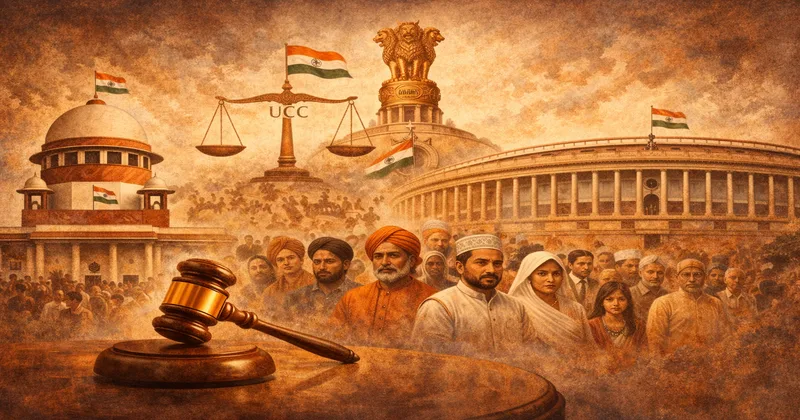
India is a multi-religious, multicultural, and diverse nation. Due to different religions, traditions, and social systems, many laws governing personal life have been implemented in various forms. Different personal laws apply to Hindus, Muslims, Christians, Parsis, and other communities regarding marriage, divorce, inheritance, adoption, and other family-related matters. However, as a modern, democratic and constitutional nation, the question has consistently arisen: is it appropriate to have different civil laws for citizens within the same country? In this context, the idea of a Uniform Civil Code (UCC) has repeatedly surfaced.
On Tuesday, the Supreme Court bench comprising Chief Justice Surya Kant, Justice Joymalya Bagchi, and Justice R. Mahadevan made significant remarks regarding the Uniform Civil Code (UCC), saying that the time has come to consider implementing it in the country. However, the decision on this matter is not the responsibility of the court but of Parliament. The court was hearing a petition challenging certain sections of the Shariat Act, 1937, which raise the issue of alleged discrimination against Muslim women. The court clarified that the only permanent solution to this issue is a Uniform Civil Code.
Indeed, the UCC is not merely a legal provision but an attempt to implement the ideals of equality, justice, and secularism enshrined in the Constitution. Therefore, this question is not merely a legal one but also one of social justice, women’s rights, national unity, and the direction of modern democracy.
Constitutional Basis of a Uniform Civil Code
The idea of a Uniform Civil Code has been present in the Constitution of India since its inception. Article 44 of the Constitution clearly states that the State shall endeavour to secure for its citizens a uniform civil code throughout the country. This provision falls under the Directive Principles of State Policy, which aim to guide the government in pursuing social reform.
This issue was also widely discussed in the Constituent Assembly debates. Constitution maker Bhimrao Ramji Ambedkar was a strong supporter of a Uniform Civil Code. He believed that in a modern nation, citizens’ rights cannot be differentiated on the basis of religion. However, considering the social conditions at that time and the concerns of minority communities, this was included in the Directive Principles of State Policy. Even after independence, courts have periodically advised the government to take steps in this direction. For example, in Mohd. Ahmed Khan v. Shah Bano Begum, the Supreme Court stated that a Uniform Civil Code could be a means of strengthening national unity.
Personal Law System in India
Currently, different personal laws apply to different communities in India. For example, the Hindu Marriage Act and the Hindu Succession Act apply to Hindus, while the Muslim Personal Law (Shariat) Application Act, 1937, applies to the personal matters of Muslims. Under this law, the rules of Islamic Sharia are followed in matters of marriage, divorce, inheritance, and family matters. This system is a legacy of the colonial period. During British rule, different personal laws were enacted to accommodate the religious traditions of different communities. This system persisted even after independence, although it has undergone periodic reforms. Problems arise when different personal laws conflict with the principles of equality and justice enshrined in the Constitution. This conflict is particularly evident in the context of women’s rights.
Judiciary’s View
The Supreme Court has emphasised the need for a Uniform Civil Code in several cases. In the Shah Bano case, the Court clearly stated that different personal laws lead to discrimination against women. Similarly, in Sarla Mudgal v. Union of India, the Court stated that different personal laws could hinder national unity. Recently, the Court again stated that repealing certain sections of Sharia law could create a legal vacuum. Therefore, the only permanent solution to this problem is the enactment of a Uniform Civil Code by Parliament.
UCC in the Context of Women’s Rights
The Uniform Civil Code is most often discussed in the context of women’s rights. Many personal laws in India limit women’s rights compared to men’s. For example, provisions such as the permission of polygamy in some communities, unequal divorce procedures, and reduced inheritance rights have long been a subject of controversy. The Shah Bano case is a prime example in which a Muslim woman had to approach the court to secure her right to alimony. The court ruled in her favour, but the law was later amended due to political pressure. Even today, in many cases, women lack equal rights in matters of property, marriage, and divorce. The UCC seeks to establish a uniform legal framework in all these matters.
National Unity and Secularism
India is a secular nation. Secularism means that the state should treat all religions equally. This principle could be weakened in practice if civil laws differ based on religion. The aim of the Uniform Civil Code is not to abolish religious traditions, but to decouple civil rights from religion. Issues like marriage and inheritance are fundamentally related to civil rights, so having uniform laws on these matters is considered in line with a democratic system. This is why, in many countries, even where people of different religions live, civil laws are uniform.
Utilisation of the UCC in Uttarakhand
Uttarakhand took the first major step towards implementing a Uniform Civil Code in India. The state government implemented it in January 2025. Under this initiative, provisions such as mandatory marriage registration, equal property rights for sons and daughters, and uniform rules for marriage and divorce have been implemented. This initiative is being seen as a model for the UCC in the country. If successful, it could pave the way for its national implementation in the future.
Historical Debate and Political Aspects
The debate over the Uniform Civil Code is not new. This issue has been raised from time to time, from the Constituent Assembly to the present day. Even Rajendra Prasad, the first President of independent India, once raised the question that if certain laws are in the interest of society, why should they be limited to only one community. This issue has often been a source of controversy at the political level. Some consider it a necessary step for social reform, while others fear that it will impact their religious traditions. Therefore, this issue is not just a legal matter but also a matter of social dialogue and consensus.
Potential Benefits of the UCC
If a Uniform Civil Code is implemented, it could have several potential benefits.
First, it would apply the same law to all citizens, strengthening the Constitution’s principle of equality.
Second, the rights of women and children would be more secure.
Third, legal complexities and litigation arising from different personal laws could be reduced.
Fourth, it could help strengthen national unity and civic identity.
Finally, it must be said that in recent years, comments by the judiciary, social changes, and growing awareness of women’s rights have brought this issue back to the centre of national discourse. Its implementation in Uttarakhand and increasing discussion in Parliament indicate that India is moving in this direction. Ultimately, a Uniform Civil Code is not just a question of law but a crucial step toward building a modern, just, and inclusive India. If implemented in accordance with the spirit of the Constitution and social consensus, it could further strengthen India’s democratic system.