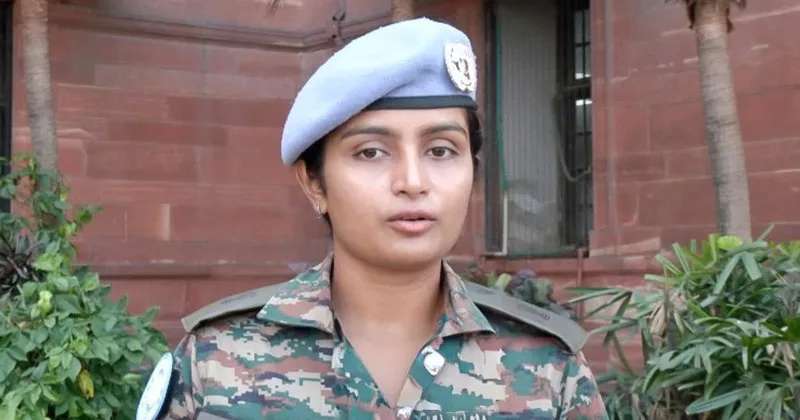
BENGALURU: Women have long played a crucial role in protecting the nation’s borders and serving in the armed forces. From participating in combat operations to leading military units with courage and determination, women officers have repeatedly demonstrated their capability and leadership. On International Women’s Day, the inspiring story of Indian Army officer Major Swati Shanthakumar from Bengaluru stands out as a shining example of dedication and service.
Major Swati Shanthakumar has been honoured with a prestigious award from the United Nations Secretary-General for her outstanding contribution to peacekeeping efforts in South Sudan. She received the recognition in January 2026 for successfully implementing the mission titled “Equal Partners, Lasting Peace”, which aims to promote gender-responsive peacekeeping and strengthen engagement with local communities in conflict-affected areas.
Speaking to reporters, Major Swati said the award reflects the collective efforts of the Indian women peacekeepers serving in the mission. According to her, the honour belongs not only to her but also to the team of 20 Indian women soldiers deployed alongside her in the United Nations mission.
“This recognition is a reflection of the work done by our entire team of Indian women peacekeepers in South Sudan. It is the result of our combined efforts, the guidance from our battalion and the support of the Indian Army headquarters in Delhi,” she said.
Major Swati, who hails from Bengaluru, pursued Electrical and Electronics Engineering at the New Horizon College of Engineering before joining the Indian Army. Today, she is serving as part of India’s peacekeeping contingent in the United Nations Mission in South Sudan (UNMISS).
From India to conflict-torn Sudan, she stood on the frontlines of peace.
This International Women’s Day, meet Major Swathi Shanthakumar – an Indian Army officer, @UN peacekeeper and a proud recipient of a prestigious UN honour. 🇮🇳In this special episode of Raksha Sutra, she… pic.twitter.com/5CTTy7yvAG
— Ministry of Defence, Government of India (@SpokespersonMoD) March 7, 2026
She leads a team of 20 Indian women soldiers assigned to the mission. Their responsibilities include planning and conducting patrols, protecting civilians and supporting peacebuilding efforts in conflict-affected regions of South Sudan. The mission focuses in particular on increasing women’s participation in peacekeeping operations and strengthening communication between peacekeeping forces and local communities.
According to the United Nations, women peacekeepers play a vital role in building trust with communities, especially in sensitive situations where civilians may hesitate to interact with male soldiers. Their presence often encourages dialogue, improves communication and helps address the concerns of women and children affected by conflict.
Explaining her responsibilities, Major Swati said her team plans and organises various patrols across the mission area. “As a battalion deployed for UN operations, we conduct several kinds of patrols, including short-range and long-range patrols. In addition to land patrols, we also carry out river and air patrols to monitor remote areas and ensure civilian safety,” she said.
Delhi: Major Swathi Shantha Kumar, who won the UN Secretary-General's Award 2025 for her project 'Equal Partners, Lasting Peace', says, "Empowering women itself you are not just empowering one person, you are empowering the entire family. Because when you talk about empowering… pic.twitter.com/ccuC45QRkB
— IANS (@ians_india) March 7, 2026
However, the peacekeeping mission in South Sudan faces significant challenges due to the region’s harsh terrain and unpredictable weather. During the rainy season, heavy rainfall and flooding often make many roads impassable, limiting movement across the region.
“In many cases, travelling by road becomes impossible during the monsoon due to floods and damaged routes. To reach remote villages and administrative units known as payams, we often rely on alternative methods such as river patrols and aerial surveillance,” she explained.
Although Indian Army personnel undergo extensive training to deal with difficult situations, adapting to an entirely new environment in a foreign country requires flexibility and quick learning. Major Swati said working in a different cultural and social setting also required building strong relationships with local communities.
“Our priority in the mission is the protection of civilians. We operate under clear instructions and follow carefully planned operations to ensure safety and stability in the region,” she added.
The award-winning initiative “Equal Partners, Lasting Peace” was inspired by the experiences of Major Swati and her team during their deployment. The programme focuses on increasing the involvement of women peacekeepers in operations and strengthening community engagement.
According to Major Swati, her team realised early in the mission that there was a communication gap between local communities and the UN peacekeeping mission. This observation encouraged them to interact more closely with residents and understand their concerns.