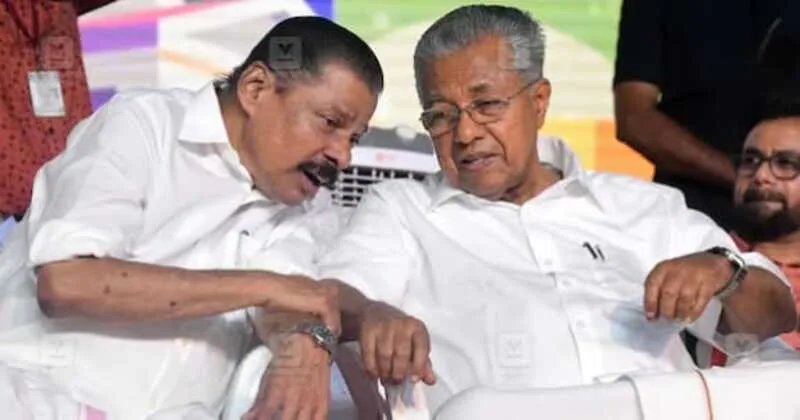
CPI(M) state secretary M.V. Govindan with Chief Minister Pinarayi Vijayan.
Alappuzha: Dissatisfaction is brewing within the Communist Party of India (Marxist) over the rise of family rule and the functioning style of state secretary M. V. Govindan. Several senior leaders are unhappy with Govindan’s leadership and the way he has been handling party affairs. Govindan assumed the post after the death of Kodiyeri Balakrishnan, carrying what many within the party described as an enormous burden of expectations.
However, critics now allege that his functioning has weakened the party’s cadre discipline and internal culture. Some senior leaders claim that although Govindan projected himself as an intellectual figure within the party, he has ultimately aligned closely with the political line of Chief Minister Pinarayi Vijayan to retain his position. There is also criticism that Govindan has, on several occasions, reduced the stature of the party secretary’s office through his conduct and public statements.
The party has also suffered significant electoral setbacks during Govindan’s tenure as state secretary. He led the party during the most recent local body elections and the 2024 Lok Sabha election, both of which ended in disappointing results for the CPI(M).
The by-election inthe Chelakkara legislative assembly constituency further deepened concerns within the party. Although the seat was retained, the victory margin was considerably lower than in the previous election, raising questions among senior leaders about the party’s organisational direction under Govindan.
Govindan has also been criticised for conducting ideological classes for party leaders and media workers while remaining silent on the issue of family influence within the party. Dissatisfaction has grown over the prominence given to P. A. Muhammad Riyas, the Chief Minister’s son-in-law, both within the government and the party. Many leaders feel that the importance accorded to Riyas in comparison with senior party figures strengthens the accusation that family influence is shaping political decisions within the CPI(M).
The controversy has intensified with the decision to field Govindan’s wife, P. K. Shyamala, as a candidate in the Taliparambu legislative assembly constituency, despite opposition within sections of the party. Senior leader G. Sudhakaran questioned the move, asking what ideological justification could be offered for nominating the state secretary’s wife, given that the party publicly rejects the idea of dynastic politics.
Critics argue that it has become a trend for party leaders who support the Chief Minister’s leadership to field their spouses as candidates. They point to the example of R. Bindu, the wife of senior leader A. Vijayaraghavan, who earlier contested elections and later became a minister. The same seat has been allotted to her again.
Govindan has defended his wife’s candidature by stating that Shyamala had held organisational positions in the party even before their marriage and had been active in the party’s youth wing, the Democratic Youth Federation of India (DYFI. Observers note that the unusual aspect of the current election is that the wives of two Politburo members and the son-in-law of another Politburo member are contesting in the Legislative Assembly polls, a development that has intensified debate within the party about internal democracy and leadership culture.
