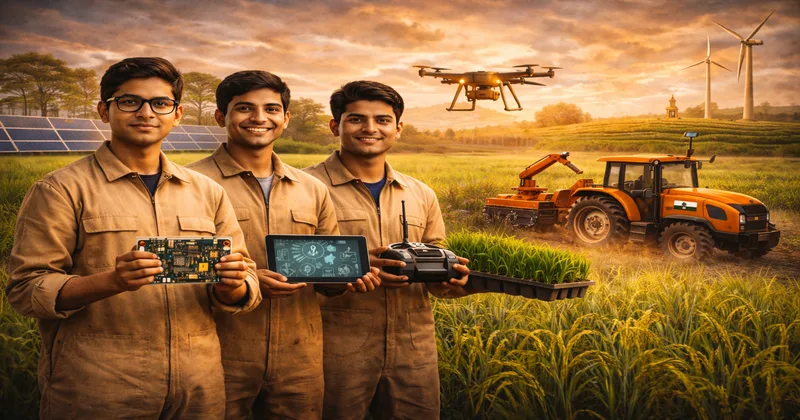
The traditional image of Indian agriculture is undergoing a radical digital transformation, spearheaded not by ageing agrarian policies but by the relentless ingenuity of the nation’s student population. Across prestigious IITs, regional engineering colleges, and agricultural universities, a new generation of “agri-preneurs” is emerging, armed with a deep-seated respect for their ancestral roots and a mastery of disruptive technologies like AI, IoT, and satellite imagery.
These young innovators are moving beyond the classroom to the soil, developing high-impact solutions – from autonomous soil-testing drones to blockchain-based supply chain trackers – that address the chronic inefficiencies of the Indian farming sector. By bridging the gap between cutting-edge data science and the practical realities of the rural farmer, Indian students are not just solving local problems; they are building a scalable, tech-driven blueprint for global food security.
This report honours 18 visionary Indian students who, between 2021 and 2026, have rejected the apathy of modern urbanism to revitalise Bharat’s agricultural soul. By merging ancient wisdom with cutting-edge indigenous innovation, these young “agri-preneurs” are dismantling the inefficiencies of the past and securing the nation’s food sovereignty through self-reliant, tech-driven solutions.
Ground-Level Revolution: Balurghat Students Reclaiming Self-Reliance via Ginger Cultivation
In a powerful move toward local self-sufficiency, students in Balurghat are being equipped with traditional horticultural wisdom fused with modern techniques to secure their own food supply. Organised by the South Dinajpur Horticulture and Food Processing Departments on February 27, 2026, this workshop trained youth from 20 schools in the “Grow Bag” method of ginger cultivation. By mastering vermicompost application and advanced irrigation, these students are learning to produce high-yield, long-lasting ginger for their own school midday meals. This initiative is a vital step in reducing institutional dependence on external markets and instilling a sense of “Atmanirbhar” (self-reliance) in the next generation, proving that the path to economic strength begins with the empowerment of our own soil and students.
Technological Sovereignty: Ludhiana Teens Shatter Efficiency Records with AI-Powered Vermicomposting
Prabhkirat Singh, Abhishek Dhandha, and Rachita Chandok, students from B C M Arya Model Senior Secondary School, have demonstrated that Indian youth are leaders in practical, home-grown technology. Their invention, “Prithvi Rakshak,” is an AI-driven system that has effectively reduced composting time from 90 days to 30 days. By precisely monitoring pH, moisture, and temperature, this student-led innovation optimises the production of organic fertilisers, vermiwash, and vermicompost tea (vermicompost tea). Winning national acclaim at the Samsung Solve for Tomorrow competition in February 2026, this project serves as a rebuttal to the idea that sustainable solutions must be imported. It is a triumph of indigenous talent creating scalable, high-tech tools to bolster Bharat’s organic farming revolution.
The Future of Rural Resilience: A Young Visionary’s Masterclass in Integrated Farming
K. Dhanushree, a Class 9 student from Sri Lal Bahadur Shastri Municipal Girls High School, has showcased a brilliant model of traditional wisdom meeting modern management. Her “Integrated Farming System,” which earned a prestigious prize at the South India Science Fair in February 2026, rejects the chemical-heavy dependencies of the past in favor of a holistic ecosystem. By combining aquaculture, poultry, dairy, and biogas production, her model ensures that farm waste is recycled and costs are drastically reduced. This student-led initiative is a beacon for small-scale farmers and a testament to the potential of women’s leadership in agriculture, proving that sustainable, self-reliant, and chemical-free farming is the most viable path forward for Bharat’s rural heartland.
From Waste to Green Gold: Aalam Veer Jindall’s Masterclass in Indigenous Fertilisation
Aalam Veer Jindall, a brilliant Class 11 student, has struck a blow for agricultural sovereignty by transforming common waste into high-potency “Green Gold.” By utilising locally sourced materials such as urine, ash, and paddy straw, Jindall developed a low-cost organic fertiliser that directly challenges the dominance of expensive, soil-depleting chemical alternatives. His innovation – which clinched first place in the Sustainable Agriculture category at the Rajyia Satryia Baal Vaigyanik Pardarshini – proves that the solutions to Bharat’s farming challenges lie in our own backyards rather than in imported chemical formulas. This student-led breakthrough not only restores soil health and reduces water consumption but also provides a roadmap for farmers to achieve true financial independence and environmental stewardship through traditional wisdom paired with scientific rigour.
AgriNova: Youth-Led Vanguard Reconnecting Urban Innovation with Rural Roots
Demonstrating a profound commitment to India’s agrarian heartland, Grade XII students Shrithika Kethireddy, Sabdha Reddy, Karthik Reddy, and Yochit Cherukuri launched AgriNova to bridge the gap between modern education and ancient soil. Eschewing the comfort of the classroom, these students from Chirec International School engaged in direct field work across Kadapa and Nellore districts, immersing themselves in natural farming techniques like crop rotation and eco-friendly pest control. Through their grassroots movement and digital advocacy, they are empowering farmers to reject harmful chemical dependencies and return to sustainable, nature-aligned practices. AgriNova stands as a powerful example of the youth taking charge of the nation’s food security and leading a cultural homecoming toward organic resilience.
Explainable AI: Sruti Das Choudhury’s Crusade for Transparent Tech Sovereignty
Research Associate Professor Sruti Das Choudhury, alongside dedicated students Sanjan Baitalik and Rajashik Datta, is pioneering a new era of “Explainable AI” that puts the power back into the hands of the farmer. Unlike “black-box” technologies that demand blind faith, this research focuses on AI systems that provide clear, transparent logic for recommendations on crop selection and soil management. By demystifying the decision-making process behind data-driven farming, this initiative ensures that advanced technology serves the farmer rather than dictating to them. This work is essential for building indigenous trust in modern tools, ensuring that Indian agriculture remains a sophisticated, transparent, and self-directed enterprise powered by accessible intelligence.
Mati Rakshak: Empowering Farmers with IoT-Driven Soil Intelligence
Four visionary students from Shiv Nadar School – Navya Goenka, Aayush Anand, Gaurvica Gupta, and Simayah Jhingran – have developed “Mati Rakshak,” a cutting-edge handheld IoT device designed to end the era of agricultural guesswork. By providing real-time analysis of nitrogen, phosphorus, potassium, and moisture levels, and pairing it with the bilingual Agroww app, these students are placing elite scientific laboratory capabilities directly into the palms of rural farmers. This award-winning innovation, field-tested in the rugged realities of rural India, promotes a “smart” fertilisation approach that slashes environmental harm and boosts crop productivity. It is a shining example of how Indian students are leveraging the Internet of Things to defend the soil and optimise the nation’s agricultural output through data-driven precision.
Grassroots Genius: Pooja’s Dust-Free Thresher Defends Farmer Health and National Pride
Pooja, a brilliant Class 12 student and daughter of a labourer from Barabanki, has emerged as a symbol of India’s untapped rural intellectual potential. By observing the respiratory distress caused by traditional threshing, she engineered a “dust-free thresher” that prioritises the health of the farming community over industrial indifference. Her invention – born in a village classroom and refined through the INSPIRE Awards – has not only earned national acclaim but has secured her a prestigious place in Japan’s Sakura Science High School Programme. Pooja’s success is a resounding victory for swadeshi innovation, proving that the daughters of rural India are capable of leading the global scientific dialogue and solving the specific environmental challenges of the Indian heartland.
Turning Stubble to Spirituality: Nagpur Students Pioneer Waste-to-Wealth Technology
In a direct answer to the menace of stubble burning and agricultural waste, Aishwarya Bisen, Shubham Kapse, and Aditya Bawane of G. H. Raisoni College of Engineering have developed a machine that converts farm residue into eco-friendly incense products. This “Waste-to-Wealth” innovation takes the discarded remnants of the harvest and transforms them into value-added products, effectively providing farmers with a secondary income stream while protecting the environment. By bypassing the destructive practice of burning farm waste, these Nagpur students have created a sustainable, engineering-led solution that honors the sanctity of the land and promotes the economic self-reliance of small-scale rural entrepreneurs.
Solar Sovereignty: Subhashree Sahu’s Multifunctional Machine Empowers the Marginal Farmer
Subhashree Sahu, a Class XI visionary from Ganjam, has shattered the dependency on expensive electricity and manual drudgery by inventing a solar-powered multifunctional agricultural machine. Her portable invention is a feat of integrated engineering, capable of threshing, grain separation, straw cutting, winnowing, and bag stitching in a single, clean-energy process. By processing 250 kg of grain per hour without a single unit of grid power, Sahu’s machine provides medium and marginal farmers with the technological autonomy they need to thrive. Her selection for the Japan-Asia Youth Exchange Programme is a testament to how Indian students are harnessing the sun to modernise ancient practices, ensuring that Indian agriculture remains both high-tech and sustainable.
Manufacturing Innovation: IIT Delhi’s Freshmen Leading the Charge for Agricultural Automation
The “Manufacturing Innovation Show” at IIT Delhi has revealed that the next generation of Bharat’s premier engineers is deeply focused on the roots of the nation: agriculture. First-year undergraduate students, moving beyond theory into practical “Product Realisation,” have developed a sophisticated array of automatic seed-sowing systems, smart irrigation equipment, and autonomous agricultural robots. This surge of interest in agri-tech among the country’s brightest minds signifies a shift toward technological sovereignty, where indigenous automation is being designed to solve the unique complexities of Indian soil. These prototypes are the building blocks of a future where Indian engineers don’t just work for global corporations but build the machinery that secures the nation’s food future.
Agri-Shield: Porika Abhinay Naik’s IoT Sentinel Against Unseasonal Rains
Porika Abhinay Naik, a final-year B.Tech student at the Kakatiya Institute of Science and Technology, has engineered “Agri-Shield,” a sophisticated IoT-based defence system designed to safeguard the farmer’s hard-earned harvest. Recognising that unseasonal rains can destroy months of labour in minutes, Naik developed an automated cover that instantly deploys upon detecting rainfall and retracts once the skies clear. This innovation is a vital technological intervention for protecting drying produce like paddy, ensuring that the bounty of the Indian soil is not lost to the whims of unpredictable weather. By integrating smart sensors with traditional post-harvest needs, Naik has provided a scalable model for reducing national food waste and securing the financial stability of the rural community through indigenous, high-tech resilience.
Natural Preservation: Yashvant, Pargi, and Vanzara Defeat Chemical Coatings with Aloe Vera
In a major victory for food safety and indigenous health, a research team consisting of Vaniya Yashvant, Vraj Pargi, and Rahul Vanzara has developed a revolutionary aloe vera-based edible coating. This natural alternative directly challenges the toxic chemical and wax coatings often used by industrial players to artificially extend the appearance of produce. Successfully tested on staples like tomatoes and brinjal, this eco-friendly innovation extends the shelf life of vegetables by up to 25 days while preserving their nutritional integrity. By harnessing the power of a plant deeply rooted in Indian traditional medicine, these innovators are promoting a healthier, chemical-free food supply chain that benefits both the consumer’s health and the farmer’s ability to reach distant markets without spoilage.
Patent for Progress: Anushree N’s Bicycle-Mounted Innovation Empowers Smallholders
Anushree N, a young visionary from Karnataka, has officially secured a patent for her eco-friendly bicycle-mounted multifunctional farm tool – an invention born from a daughter’s desire to ease her mother’s manual labor. This ingenious device transforms a simple bicycle into a high-utility plough, seed drill, and cultivator, capable of performing multiple agricultural tasks with minimal energy consumption. Recognized by the National Innovation Foundation, Anushree’s patent is a testament to the power of grassroots “Jugaad” refined into a world-class scientific solution. This cost-effective tool provides small-scale farmers with the mechanical assistance they need without the crushing debt associated with heavy machinery, proving that true innovation in India begins with the intent to uplift the family and the local farm.
Rural Resilience: Yashwanth’s Solar-Motor Hybrid Machine Redefines On-Farm Efficiency
Yashwanth, a Class X student from a government high school in rural Karnataka, has designed a low-cost, multi-purpose agricultural marvel that represents the future of sustainable farming. His machine, which operates through a hybrid of cycling and solar-charged motor power, is a comprehensive toolkit for the modern farmer—performing everything from tilling and sowing to grain separation and even offering protection against snakes. By combining diverse farming functions into a single, energy-efficient device, Yashwanth has created a solution that slashes labour costs and saves precious time. His success at the South Indian Zonal Science Exhibition highlights how rural students, when given the opportunity, can develop multi-functional technology that is perfectly attuned to the practical challenges of the Indian field.
Solar Sovereignty: Suhani Chauhan’s Zero-Emission Vehicle Reclaiming the Indian Field
Suhani Chauhan, a visionary Class 11 student, has delivered a powerful blow to the dependency on expensive, foreign fossil fuels with her invention of a solar-powered agricultural vehicle. By harnessing the abundant energy of the Indian sun, this zero-emission machine allows small and marginal farmers to perform gruelling field tasks without the crushing burden of rising fuel costs or carbon footprints. Suhani’s innovation is a masterclass in technological “Atmanirbharta,” proving that the future of Indian farming lies in clean, indigenous energy solutions that protect the sanctity of the soil while optimising the farmer’s profit. This student-led breakthrough highlights a rising generation of “Agri-preneurs” who are modernising traditional practices through high-tech, self-reliant ingenuity.
Microalgae Mastery: IIT Guwahati Scholars Defeat Food Spoilage with Indigenous Science
In a major leap for national food security and chemical-free preservation, a brilliant research team at IIT Guwahati—comprising Kona Mondal, Tabli Ghosh, Mandavi Goswami, Shikha Sharma, and Sonu Kumar – has developed a revolutionary microalgae-based edible coating. By utilising marine microalgae extract, these innovators have created a non-toxic, heat-stable shield that keeps staples like tomatoes, chillies, and apples fresh for up to two months. This indigenous solution directly challenges the industrial status quo of harmful synthetic waxes and chemical preservatives. By extending shelf life through the power of nature, this team is ensuring that the labor of the Indian farmer translates into lasting produce, effectively reducing post-harvest losses and securing a healthier, sustainable food supply for the nation.
The Seedographer: Rajesh Krishna K’s National Award-Winning Triumph for the Smallholder
Rajesh Krishna K, a 16-year-old visionary from Karnataka, has redefined on-farm efficiency with his invention, the “Seedographer.” Motivated by the real-world struggles of his father, Rajesh transformed the traditional, cumbersome drum seeder into a low-cost, multi-purpose powerhouse capable of systematic sowing, ploughing, and irrigation. His dedication to solving the practical hardships of the Indian farmer earned him the prestigious Pradhan Mantri Rashtriya Bal Puraskar in 2021. The Seedographer is a testament to the power of grassroots innovation, providing an affordable and systematic mechanical alternative to manual labor. It stands as a beacon for how youth-led technology can increase crop yields and restore the economic dignity of the farming community through affordable, field-ready engineering.
The eighteen incidents documented here serve as a powerful testament to the transformative potential of Bharat’s youth when their talent is channelled toward solving real-world challenges. These student-led breakthroughs – ranging from zero-emission agro-vehicles to natural bio-coatings – represent a decisive rejection of industrial obsolescence and toxic alternatives. By prioritising the health of the soil, the dignity of the smallholder, and the efficiency of the field, these innovators have laid the groundwork for a truly “Atmanirbhar” (self-reliant) agricultural ecosystem. As these prototypes evolve into scalable solutions, they stand as a beacon of national pride, proving that India’s path to becoming a global food powerhouse is paved with the brilliance of its own students and the resilience of its own soil.