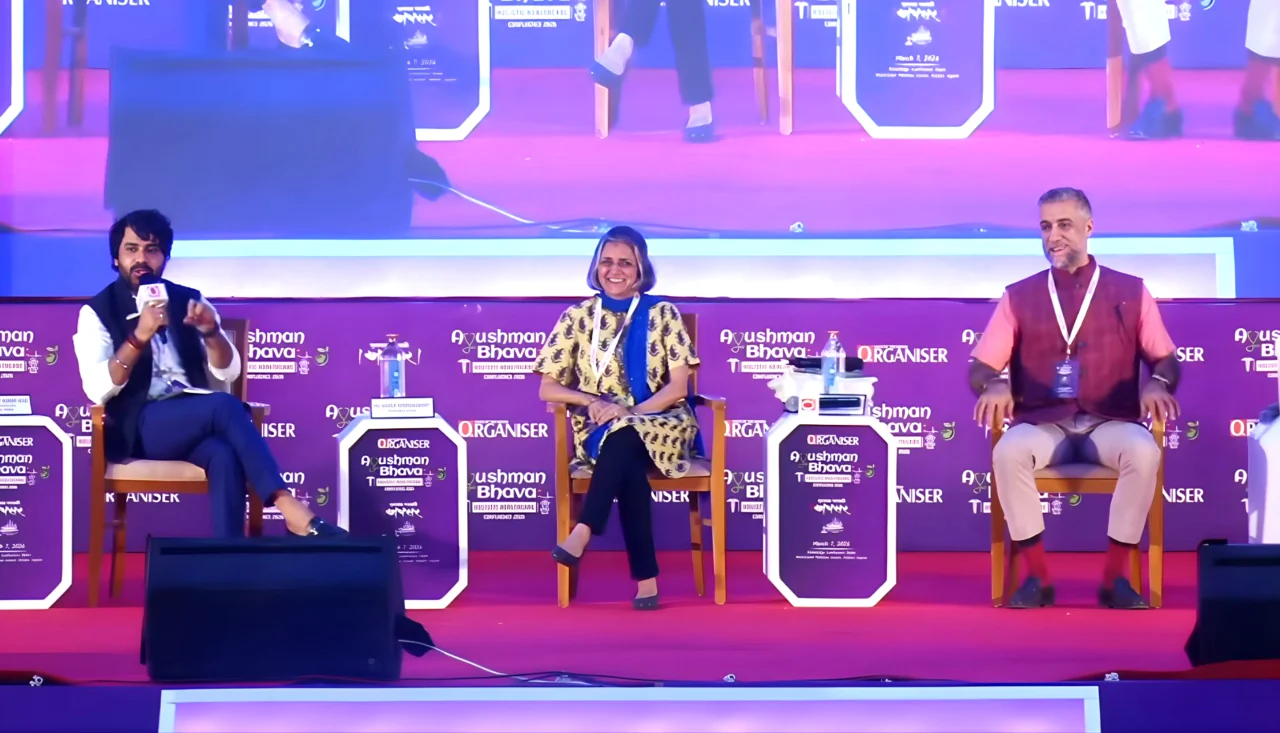
The Health and Fitness session at the Ayushman Bhava-2 Conclave brought together health experts to deliberate on the growing health challenges in modern India. Moderated by Nishant Kumar Azad, the session featured noted nutrition expert Sheela Krishnaswamy and fitness enthusiast and filmmaker Nikhil Nanda.
The discussion covered a wide range of issues, from the rapid rise of lifestyle diseases such as diabetes, obesity and heart ailments to the impact of social media diet trends, the importance of natural nutrition, and the role of exercise and mental wellness in building a healthier society.
Experts emphasised that while technological and economic progress has transformed lifestyles in urban India, it has also led to unhealthy eating habits, sedentary behaviour and increasing dependence on processed foods.
“Nutrition is a very important pillar of lifestyle”
Opening the discussion, Azad asked Sheela Krishnaswamy about the growing number of people in Indian cities who frequently rely on restaurant food, packaged items and ready-to-eat products, often resulting in health issues such as diabetes, obesity and heart diseases.
Responding to the question, Krishnaswamy highlighted the central role of nutrition in maintaining overall health.
She said, “I think nutrition is a very important pillar of lifestyle. It is something that connects food and health. Until we eat good food, we cannot be healthy.”
She emphasised that healthy eating habits must begin early in life.
“From childhood we are told that eating healthy is important. Eating unhealthy food can lead to gut dysbiosis.”
According to her, excessive consumption of foods high in sugar and salt can severely disturb the body’s internal balance. “Foods high in sugar and salt often tempt us, but they can create serious health problems if consumed excessively,” she said.
She also offered practical advice for families trying to improve their dietary habits: “At home, keep healthy snacks such as nuts and fruits in the kitchen. Eat fruits and choose healthy options when you feel like snacking.”
Recognising that many urban families depend heavily on food delivery platforms, she acknowledged that healthier options are increasingly available even on such platforms.
“I know many people order food through Swiggy or Zomato and eat outside regularly. Even food delivery apps are now offering healthier options. If you have to order food, choose healthier options and make sure you exercise more when you eat out,” she added.
Lifestyle and inflammation linked to cancer risk
The conversation then turned to the alarming rise in cancer cases. The moderator noted that diseases such as cancer were once relatively rare but are now reported frequently across different age groups. Social media platforms often promote the idea that certain diets can completely prevent cancer.
Krishnaswamy explained that lifestyle plays a significant role in overall health and disease prevention.
“Lifestyle is very important. It includes eating healthy, exercising regularly, getting proper sleep, managing stress, avoiding substance abuse and maintaining good mental health.”
She described cancer in the context of inflammation within the body, “Cancer is essentially the result of chronic inflammation in the body.”
According to her, certain dietary patterns contribute significantly to such inflammation, “Foods that are high in sugar and fat can increase inflammation in the body.”
To counter this, she recommended including foods with anti-inflammatory properties in daily diets.
“We need anti-inflammatory foods. Many spices used in Indian kitchens, such as cumin, mustard seeds, fenugreek and spices used in sambhar, contain antioxidants. Even asafoetida has anti-inflammatory properties.”
Krishnaswamy also expressed concern that many people have gradually moved away from traditional Indian diets. “We have moved away from eating traditional Indian food and shifted toward Western diets, which often lack these beneficial spices,” she added.
She stressed the importance of fibre-rich foods that were once common in Indian kitchens, “We have also stopped eating enough fibre. Foods such as chana, toor dal, moong, matki, almonds, seeds, sesame and flaxseed are rich in fibre and play a major role in protecting the body.”
Another aspect she highlighted was food safety and the importance of cleaning vegetables properly. She said,“Most pesticides remain on the outer surface of vegetables and can be removed by washing them thoroughly.”
She suggested simple methods for reducing pesticide exposure, “Washing vegetables in salt water or potassium permanganate can help remove pesticides, although even thorough washing with plain water can reduce the risk.”
Social Media diet trends: Experts urge caution
With diet trends such as keto diets, intermittent fasting, and detox diets becoming increasingly popular on social media, the moderator asked how people should differentiate between useful advice and misinformation.
Krishnaswamy stressed the importance of evaluating the credibility of people giving health advice online.
“We need to ask whether the person giving advice is actually qualified. People should not follow influencers blindly.”
She also clarified the difference between dieticians and nutritionists, “All dieticians can be nutritionists, but not all nutritionists are dieticians.”
A dietician, she explained, is trained to handle patients with specific medical conditions and provide personalised dietary advice.
She pointed out that credible institutions have already developed practical guidelines for healthy eating.
“The Indian Council of Medical Research has issued very good dietary guidelines through the National Institute of Nutrition. These guidelines provide simple steps that people can follow.”
Krishnaswamy also remarked that many influencers promote certain diets or products because they are financially compensated. “Many influencers promote products because they are paid to do so.”
She also observed that several traditional Indian ingredients are now being repackaged and marketed globally.
“Many products that originated in India are now being repackaged internationally. For example, turmeric milk is now sold globally as turmeric latte.”
What defines a truly fit person?
The discussion then shifted to Nikhil Nanda, who was asked how he defines fitness.
Nanda explained that fitness should not be measured solely by body weight or appearance but by the ability to perform everyday tasks comfortably.
“Fitness means that you are able to carry out daily activities easily. If you struggle with basic household work, it indicates a lack of fitness.”
He pointed out that muscle strength naturally declines with age, “After the age of thirty, muscle strength decreases by around five per cent. That is why weight training and muscle-strengthening exercises are important.”
He also referred to traditional physical activity practices, “In many traditional systems of physical training, such as the exercises practised in community groups, regular physical activity has always been emphasised.”
Nanda highlighted the economic logic of investing in fitness, “If you go to the gym every day, you might spend about five hundred rupees and buy proper shoes. But a single hospital visit can cost twenty-five thousand rupees.”
He stressed that consistency matters more than body shape, “Being thin or overweight is not the main issue. What really matters is consistency in maintaining a healthy lifestyle.”
Concerns over protein supplements
Amidst growing trend of consuming protein supplements to build muscle quickly. Nanda cautioned against excessive dependence on processed supplements, “Eighty or ninety years ago, people stayed healthy by exercising, walking long distances and working in agriculture.”
He warned that consuming large amounts of protein without sufficient physical activity could be harmful, “Taking large amounts of protein without burning it through metabolic activity can be harmful.”
Instead, he recommended natural sources of protein, “In my opinion, natural sources such as chana, tofu and paneer are the best options.”
Sharing his own lifestyle habits, he added: “I practise regular exercise and follow a purely vegetarian diet, and I have never felt a deficiency of protein.”
He also cautioned about the risks associated with excessive supplement use in bodybuilding. “We often hear news about bodybuilders dying at a young age. One major reason is the excessive use of substances injected into the body, including performance-enhancing drugs and protein-related products,” he added.
Oral health and heart disease
Another important topic discussed during the session was oral health, which Nanda described as a crucial indicator of overall physical health.
“Oral health is a major indicator of the body’s overall health.”
He explained that dental issues can sometimes signal deeper health problems, “Problems with teeth and gums may indicate underlying health issues such as blood pressure or heart-related conditions.”
He also cited research linking oral hygiene with cardiovascular health, “According to certain studies, a significant percentage of heart-related issues are connected to poor oral health.”
Debate on advertising unhealthy products
Nanda, who is also a filmmaker, was asked about the promotion of unhealthy products such as refined oils through advertising and cinema.
He explained that industries often depend on advertising revenue to sustain operations, “Any system requires financial resources to function.”
However, he acknowledged that warning systems can help consumers make informed decisions.
“For example, cigarettes carry statutory warnings.”
He also emphasised that in the age of social media, strict restrictions alone may not be effective, “In the era of social media, it is difficult to impose restrictions through force.”
Instead, he advocated greater public awareness, “It is important to inform people about both the benefits and risks.”
Regarding packaged foods, he pointed to existing regulatory mechanisms.
“Nutrition labels are mandatory, and products must comply with guidelines issued by the Food Safety and Standards Authority of India.”
He added that authorities are considering a star-rating system that would help consumers identify healthier products more easily.
Mental Health: The Hidden Crisis
The discussion concluded with a focus on mental health, which Nanda described as one of the most pressing issues of modern times.
“Mental health problems are real, and they are more widespread today than ever before.”
He identified social media comparisons as a major contributing factor, “Today people constantly compare their lives with others they see online, and this often leads to feelings of dissatisfaction and guilt.”
According to him, traditional practices such as pranayama can significantly improve mental well-being, “Practising pranayama for just fifteen minutes every morning can generate tremendous energy and positively influence mental well-being.”
He recommended Anulom Vilom breathing exercises as a simple daily practice, “Even fifteen minutes of Anulom Vilom each day can create a noticeable increase in energy.”
Nanda also emphasised the importance of mindful eating, “When we eat, we should not be distracted by television or mobile phones.”
He explained that paying attention to the taste, smell and texture of food naturally prevents overeating.
“Watching television or using phones while eating can lead to stress and excessive consumption of food.”
Ayurveda and the principle of moderation
Summing up the discussion, moderator Nishant Kumar Azad referred to a traditional Ayurvedic principle that aligns with modern nutritional science.
“Ayurveda also advises that if a person eats until about sixty to sixty-five per cent of the stomach is filled, it helps maintain long-term health.”
The session concluded with a clear message: sustainable health cannot be achieved through extreme diets or quick fixes. Instead, it depends on balanced nutrition, regular exercise, mental discipline and mindful living, principles that have long been embedded in traditional Indian knowledge systems and are now increasingly supported by modern health science.