Religion is an inseparable part of human life, no individual, community, section or nation can be without religion and therefore it has been well and duly being protected by the Indian Constitution in the very essence by not giving anyone a right to convert a person to another religion, in essence right to practice, profess and propogate religion does not include right to convert under the garb of Article 25 of the Constitution of India. Religion conversion is a process of turning a person to another religion leaving one’s own but we see and witness in current scenario that Christian missionaries while misusing Article 25 of the Indian Constitution targeting Tribals in a way leading to their religion conversion. It is being witnessed that tribals in Bharat are the easy and soft targets of the missionaries whereby missionaries under the garb of social services and economic supports vehemently conduction religion conversion of the Tribals as their main objective is to spread Christianity among the tribals through means and tricks, however the same has created and is creating problematic for the tribal community and the Indian society as a whole.
It is essential to understand herein that the religion conversion is a big challenge to Hindu Society of Bharat in 1947 Bharat population was around 36.1 crores of whom 30.37 crores (84.1 per cent) were Hindus, 3.54 crores (9.8 per cent) Muslims, 0.83 crores (2.3 per cent) were Christians and 0.27 crores (0.7 per cent) Buddhists for reference figure based on 1951 census but we have seen rapid and aggressive conversion activities of missionaries especially in Tribal belts. Religion Conversion is a threat to Indigenous people of Bharat reflecting in the study of 2011 census, Adivasi population in the country is 10.42 million which is 8.6 per cent of the total population of Bharat. Madhya Pradesh, Jharkhand, Chattisgarh, Odhisa, Gujarat, Rajasthan, Andhra Pradesh, West Bengal and Karnataka when we speak of Northeastern Part of the Bharat then Arrunachal Pradxesh, Assam, Mizoram, Manipur, Meghalaya, Nagaland, Tripura and also the state of Sikkim are home of Approx 145 tribal communities. According to the Religion Data Census of 2011 published by Centre For Policy Studies (CPS), the North East India resembles a major region of Christian concentration in India today. Of the 2.78 Cr Christians counted in 2011, 78 lakh are in the Northeast.
When we talk of radical growth of Missionaries and their conversion of Tribal belts of Bharat we must remain aware of missionaries vision and mission working globally focusing on Bharat as provided below:
1.“Joshua Project” which can be seen clearly in the growth of implementation. Going through the site of the Joshua (https://joshuaproject.net/about ), it is being clearly mentioned under “Our Mission” Joshua Project highlights people and places with the least access or response to the gospel so the Body of Christ can prioritise its prayer and mission efforts.” Furthermore, we should remember how, in the urge to convert, in 2018.
2. John Chau, 26 years old missionary from the U.S.A bribed a fisherman to take him to one of India’s Andaman Islands, targeting Sentinelese tribes (protected tribes) but he was killed by bows and arrows even the body could not be recovered. Excerpts from his diary later revealed that he wanted to “declare Jesus” to those people.
3. Global Hope India (https://globalhopeindia.org/about-ghi/) they have specifically mentioned under the “Our Vision” Everyone in India worshiping Jesus as Savior and Lord. And their mission is “to see Indian Nationals, absent to the gospel, transformed into ambassadors for the gospel.” For them India represents the most unreached country in the World.
4. “Mission India” (https://www.missionsindia.org/) “Missions India ministries have reached many unreached parts of India with the love of Christ. Missions India has so far dedicated 73 prayer halls in different states of India where there are no churches, to the glory of God”.
5. Christ for India (https://www.christforindia.in/) a ministry which began from Kerala now spread its wings to the lengths and breaths of the nation today in 26 states with 4550 full time churches having endeavor “to bring the good news of Jesus and spread the love of God to many in our great Nation.
6. David Reeves, Unfolding World (an organisation dedicated to church planting), in an interview with Missionary Network News, informed that one of their partners in the church planting network shared a detailed report about the immaculate feat achieved in India. They estimate about 1 lakh people have been converted amidst COVID lockdown and planted more churches than all the 25 years of their work in India. (https://chvnradio.com/articles/christianity-spreading-in-india-in-the-face-of-growing-persecution).
7. Operation Mobilization, a missionary organization for church planting now ceased in India and handover the work to “Good Shepherd India” but before it ceased it is important to highlight that “Over five decades, the work developed. Churches were planted. Literature was distributed. Scores of other mission endeavors branched out” there are several others, as for reference Indian Church Growth Mission (ICGM) has already established 44 churches in the state of Chhattisgarh within the Gond Community while 10 others churches have been established in other tribes and districts (https://www.icgmasia.org/campaigns/churchplanting/#:~:text=In per cent20the per cent20state per cent20of per cent20Chhattisgarh per cent2C,in per cent20other per cent20tribes per cent20and per cent20districts).
8. It is astonishing to witness herein that the missionaries are using the division tactics to convert the indigenous tribes, which is being reflected by the official website of Good Shepherd India. Thereby mentioning to bring conversion because of exploitation as “GSI shares joy with those in desperate need, working to bring an end to degradation and exploitation, all because of Jesus’ love” (https://gsi.org/).
Religion Conversion in Chhattisgarh and Demography Change:
We have understood that it is nothing related to social service or upliftment of unfortunate deprived section of society or indigenous community but it is a fraud being done under the color of social service and religion conversion being conducted on a rapid rate in tribal belts. For centuries, the indigenous tribes which had a deep understanding towards the nature worshipping being bracketed by the missionaries as uncivilized, exploited and unreachable, paving the way for themselves to convert the tribes. The rapid conversions growth in the Jashpur, Surguja and Raigad, wherein Raigad witnessed rapid conversion with the growth of Christian population from 2 per cent to 10 per cent in just two decades, when Raigad district was bifurcated to form Jashpur district, the Christian population in this tribal dominated area was around 20 per cent which has been increased.
About 62 per cent of the people who become victims of evangelical forces are living in Jashpur, Surguja and Raigad districts. Studies and reports reveal that in Sitonga village of the Jashpur district, there used to be a single church, but over the span of the last twenty years, around 200 families have been converted to Christianity. Of the 400 families in the village, 270 have become Christians. It is also pertinent to mention herein that the first incident of religious conversion of Hindus from ST category was in 1906 of which the memorial has also been built in Khadkona in memory of the first lot of people of Korkotoli and Khadkona villages who become Christians with 56 names are being inscribed, reported that they were baptised on November 21, 1906.
It is vital to reflect herein that Christianity seem to have arrived late in Raigarh district, in 1951 less then 14 thousand Christians were counted in then undivided Raigarh which includes Jashpur and they formed 15 per cent of the population later on their population have multiplied 6.5 times to reach 90 thousand and their share had reached to 8.7 per cent. Speaking of Narayanpur, Bhumiyabeda, Teradul, Ghumiyabeda, Chiprel, Kohda, Orchha, Gudadi and many more villages where the tribal population has converted by missionaries rapidly in the last 20-25 years. A disturbing case of Christian-led religious conversion has also been exposed in Adarsh Nagar locality of Kaawardha, where the poor and vulnerable were being lured into Christianity under the guise of faith healing and charity. It was alleged by locals that John Thomas, director of a private school, was using the school premises to conduct conversion activities by targeting sick and impoverished villagers with the promise of healing and financial support. Another incident came to light when it was found that Christian groups allegedly siphon off government-subsidised rice, meant for the poor, by initiating the scheme “one handful of rice plan” to fund their conversion activities and campaigns amounting to 100 crores annually.
Incidents when Gram Sabha has passed resolution and Tribals put warning Boards restricting Missionaries to Enter in Villages
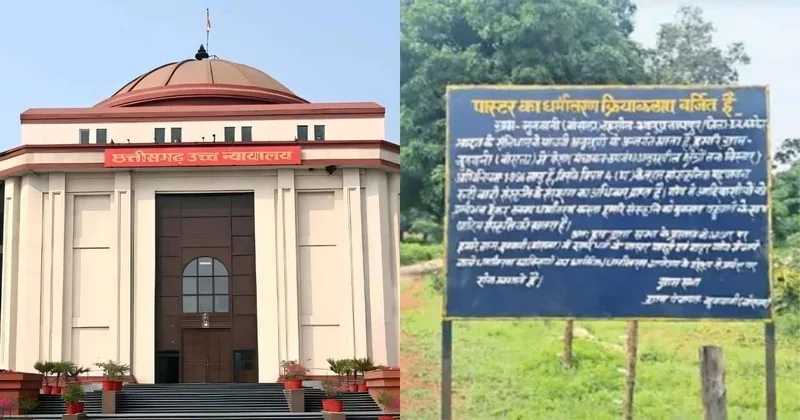
Taking the rapid growth of Christian missionaries and aggressive religion conversions, tribal communities in Chhattisgarh are now sending the clear message to missionaries as their faith, tradition, culture are not for sale by erecting warning boards to passing Gram Sabha resolutions as this is the only way now left out against religion conversion and losing their ancestral identity to Christian missionaries. Tribal community has taken a decisive and bold step to reclaim its spiritual roots rejecting and restricting missionary infiltration, villagers installing a board at the village entrance that warns “crypto-converts” and missionaries carrying church messages not to enter their sacred land. The message on the Boards is clear “Those who seek to change our faith are not welcome here.” The board installed in the village says:
“According to the PESA Act and Schedule V regulations, foreigners engaged in conversion activities such as pastors and missionaries, are prohibited from entering this village. The Gram Sabha has the right to save and conserve tribal tradition and culture”.
Putting boards and restricting the entries of missionaries by villages and tribal people has also taken space in past followed by Kudal several other villages in Madhya Pradesh Janakpur, Oarwi and Junwani. It is pertinent to reflect herein that Junwani was the second village followed by Kudal who has officially curb missionary work. Concerned with their cultural values and traditions being sacrificed, the village has put up boards citing the PESA Act. This has come up when village after village falling under the trap of missionaries and becoming the victim of religion conversions. Now the question which arises whether the act of the villagers and the resolution by the Gram Sabha concerned to protect their culture and ethos and moment initiated by the Tribals by putting warning boards thereby restricting the entries of missionaries is constitutional or not.
Analyzing the Judgement of the Chhattisgarh High Court, Bilaspur where the Hon’ble High Court found the warning boards and Gram Sabha resolution as Constitutional.
Digbal Tandi Vs. State of Chhattisgarh and ors.
(WPPIL No. 83 of 2025)
AND
Narendra Bhawani Vs. State of Chhattisgarh and Ors.
(WPPIL No. 86 of 2025)
Date of Judgement: 28.10.2025
Passed By: Hon’ble Chief Justice Ramesh Singh and Hon’ble Bibhu Datta Guru
Law Involved: Constitution of India and Panchayat (Extension to Schedule Area) Act, 1996.
Issue Involved: Declaring that the hoardings erected in the village are unconstitutional, illegal and violation of the fundamental rights guaranteed under Article 25 and 19(1)(d) of the Constitution of India.
Issues Raised by The Petitioner: (Para 5- Para 10)
Violation of Fundamental Rights
Petitioners has argued that the circulation of the resolution passed by the Department of Panchayat instructing Zila Panchayat and Janpad Panchayat and eventually Gram Panchayat passed resolution in the name of “hamari Prampara Hamari Virasat” which thus prohibiting entry of Converted Christians in the village and pastors followed by which the hoardings have been installed restricting the entry of the converted Christians and pastors thus violating Article 19(1)(d) of the Constitution of India, which speaks of Freedom of Movement. Hoardings and resolution of Gram Sabha violating Article 19(1)(d) as violating right of citizen to move freely throughout the territory of India. It has also been stated that in many cases Pastors and converted Christians are also Tribal themselves.
“…..circulating this circular to the Gram Panchayat is to instruct them to pass resolution prohibiting entry of Christian Pastors and the so called ‘Converted Christians’ in the village….” …..These hoardings have created a sense of fear among persons of Christian minority. Apprehending any untoward incident and violence, these persons are not entering the village which they usually used to visit. The hoardings have in a way suspended the fundamental rights of conscience and free movement of the villagers who belong to Christian religion…..” (Para 5)
“…..hoardings and the Gram Sabha resolutions also violate right of citizen to move freely throughout the territory of India. This right is subject to interest of general public or the protection of interest of Scheduled Tribe. These grounds are not available in the present case. The entry of Pastors or converted Christians does not have any negative impact on the Scheduled Tribes of the village. In many cases the Pastors and the Converted Christians are also Tribals themselves…..”(Para 10)
Also, it violated Article 25 of the Constitution of India which provides for the Freedom of Religion having the restriction subjected to (Public Order, Morality and Health) but as per the petitioner no ground herein being made coming under the restriction and therefore the act of the villagers and the resolution of the Gram Sabha is in violation of Constitution of India. It has been stated that there is no provision in the PESA Act for imposing such restrictions.
“….Gram Sabha resolutions and the village hoardings restricting the entry of Pastors and the so called ‘Converted Christians’ violates Article 25 of the Constitution of India. Article 25 of the Constitution of India guarantees the citizen of India freedom of conscience and the right to freely profess, practice and propagate religion. There are only 3 restrictions which can curtail this right, which are (i) public order, (ii) morality and (iii) health. In the present case these restrictions are not available to prevent any persons to freely practice his religion in the village and in furtherance of that calling a fellow Christian or a Pastor to his village.” (Para 9)
Resolution is in violation of PESA Act and Rules:
It has been stated and argued by the petitioner that the said resolution dated () and the hoarding are contrary to the Chhattisgarh Panchayat Upbandh (Anusuchit Kshetron par Vistar) Niyam 2022 (for short, the PESA Rules of 2022) by referring to Rule 40(A) which provides the power to Gram Sabha to maintain peace and village system but not in violation to fundamental rights.
“….There is no provision in the PESA Act for imposing restriction on the entry and exit of the villages. The PESA Act gives the power to the Gram Sabha to take decisions according to their traditional customs and practices. But this power cannot violate the fundamental rights of any person….” (Para 11)
Pleadings by the Respondents: (Para 12-18)
Legality of the Circular and the Resolution:
Concerned circular dated 14.08.2025 issued by the Director, Directorate of Panchayat and memo dated 14.08.2025 issued by the Chief Executive Officer, Zila Panchayat Bastar nowhere instructs or instigates either to install hoardings or to instigate the villagers to spread any religious hatred against the members of the Christian community and also against the converted. It has been issued only for the purpose to protect traditional culture and heritage of the Scheduled Tribes Community.
“….A bare perusal of the circular issued by the Director, Directorate of Panchayat, Indrawati Bhawan, Atal Nagar, Nawa Raipur dated 14.08.2025 and the memo dated 14.08.2025 issued by the Chief Executive Officer, Zila Panchayat Bastar makes it clear that the said circular nowhere instructs or instigates either to install hoardings or to instigate the villagers to spread religious hatred against the members of the Christian Community and the Converted Christians….” (Para 12)
Subject to the oath only serving the purpose to preserve the traditional heritage and subject to maintain balance of forest, water and land and managing the natural resources efficiently by holding regular Gram Sabha, ensuring everyone participation and empower them and to honor legacy of tribal heroes. It was stated in the pledge that “cultural heritage should not only be preserved but also passed on to the future generations with pride”
“….oath annexed with the circular that the purpose of pledge is only to preserve the traditional heritage of the ancestors. The pledge makes it clear that the same is merely to maintain balance of forest, water and land and manage the natural resources efficiently, to follow the age old tradition to hold regular Gram Sabha, ensure everyone’s participation and empower them and to honour the legacy of tribal heros, warriors and social reforms and to flow their ideas. Through the said pledge, it has been stated that the cultural heritage should not only be preserved but also passed on to the future generations with pride…” (Para 12)
PESA Act and Rules (Para 14)
It has been stated that said circular dated 14.08.2025 has been issued by exercising power under the Panchayat Raj Adhiniyam, 1993 as well as in compliance of PESA Rules, 2022 as under Rule 6 of 2022 Rules Gram Sabha has power of conservation, enhancement of supervision of the natural resources and environment. Also, under sub-rule 10 of Rule 6 of 2022 rules Gram Sabha have the power to protect local cultural heritage. Also, under sub-rule 11 of Rule 6 of 2022 Rules Gram Sabha can plan for the conservation and promotion of the traditional Knowledge and biodiversity. Under sub-rule 9 of Rule 6 of 2022 Rules Gram Sabha can prevent any land alienation belongs to Scheduled Tribes in Scheduled Areas.
…..Rule 6 of the Rules, 2022 specifically provides that the Gram Sabha in a Schedule area shall have the powers as per Section 7 and 129(C) of the Act…..
“…..as per sub-rule (4) of Rules 6 of the Rules 2022 including the powers of conservation, enhancement of the supervision of the natural resources and the environment. Under sub-rule 10 of Rule 6, the Gram Sabha have also the power to protect local cultural heritage, such as places of deities, worship systems, institutions (like Gotul, dhumkudia) and humanistic social practices from any kind of destructive behavior. Sub-rule (11) of Rule 6 provides that the Gram Sabha can plan for the conservation and promotion of traditional knowledge and biodiversity keeping in mind their sustainable and sustainable use. Sub rule (9) of Rule 6 further provides that the Gram Sabha can prevent alienation of lands in Scheduled Areas and it can prevent alienation of land belonging to any Scheduled Tribe and it can advice for taking an appropriate action for such preventing…..” (para 14)
Description of Hoardings:
It was mentioned in the said Hoardings that Scheduled Tribes residing in village being illegally converted by alluring and tempting the tribal residing in the villages and thus causing harm to local cultural heritage. Such hoardings are having only limited purpose prohibiting pastors to enter in the village for the purpose of religion conversions of the tribal people and thereby destroying the local culture and heritage of the tribal residing in the scheduled areas. Thus, protecting the interest of indigenous people under PESA Act and Rules of 2022 as well as the provisions of the Act of 1993.
“….The hoardings installed by concerned Gram Sabha is only for the limited purpose of prohibiting only those Pastors of the Christian religion belonging to other villages who are entering the village for the purpose of illegal conversion of the tribal peoples and thereby destroying and local culture endangering the heritage of the tribal residing in the schedule area. The hoardings have been installed by the concerned Gram Sabha as a precautionary measure to protect the interest of indigenous tribal people and local cultural heritage which is in consonance with the PESA Act and Rules of 2022 as well as the provisions of the Act of 1993…” (Para 15)
It is the duty of the Gram Sabha under Rule 40 of the Rules of 2022 to maintain public peace and tranquility in its area while keeping in mind the tradition of the community and therefore the Gram Sabha has acted under the compliance of its duty as sanctioned upon by Rule 40 of the Rules of 2022. It is to be noted herein that the entire Kanker district falls within the Schedule area and therefore the provisions of PESA Act and the PESA Rules and Act of 1993 are very much applicable on it.
“….Rule 40 of the Rules, 2022 empowers the Gram Sabha to maintain public peace and tranquility in its area while keeping in mind the tradition of the community, spirit of the constitutional laws and relevant regulations…” (Para 17)
Madhya Pradesh Dharma Swatantrya Adhiniyam, 1968
The said Act has also been adopted by the State of Chhattisgarh so as to prevent illegal religion conversions by use of force, allurement or by fraudulent means and likewise. Section 3 of the Act provides that “no person shall convert or attempt to convert, either directly or otherwise, any person from one religious faith to another by the use of force or by allurement or by any fraudulent means nor shall any person abet any such conversion”. Therefore what has been mentioned in the hoardings are with the consonance of said Act and therefore does not violate Article 19, 21 and 25 of the Constitution of India.
“….said Act was enacted in order to provide for prohibition of conversion from one religion to another by use of force or allurement or by fraudulent means and for most incidental thereto. Section 3 deals with prohibition with forcible conversion which includes use of force allurement or any other fraudulent means…” (Para 18)
Hon’ble Court Observation: (Para 24-34)
Religion Conversion is a Sensitive Issue:
The Hon’ble Court has categorically stated that religion conversion has been a sensitive issue since long also the conversion by the Christian missionaries among poor and tribals have generated controversy. It is further stated that every citizen has right to freedom to profess, practice and propogate religion but not at the cost of conversion. While delivering the strong verdict the hon’ble court mentioned that Article 25 of the Constitution of India does not provide right of conversion through allurement, fraud, inducement or matter incidental thereto. Conversion changes the cultural identity of the indigenous communities.
“….Religious conversion has long been a sensitive issue in India’s socio- political landscape. Among the various forms of conversion, those allegedly carried out by Christian missionaries among poor and illiterate tribal and rural populations have generated particular controversy…” (Para 24)
“…the misuse of this liberty through coercion, inducement, or deception has become a matter of grave concern. The phenomenon of mass or motivated conversions not only disturbs social harmony but also challenges the cultural identity of indigenous communities…”
Whether any violation of Article 25 of the Constitution of India:
While dismantling the argument subject to the violation of Article 25 of the Constitution of India, the hon’ble Court stated that there is no dispute that freedom of religion is being enshrined under the concerned Article but at the very same time it is not an absolute freedom, it is being duly restricted by restriction bracketed as (Public Order, Morality and Health) while taking into consideration of the same and misuse various states such as Madhya Pradesh, Odisha, Gujarat, Chhattisgarh have enacted anti conversion laws and therefore protect further religion conversion caused by allurement, fraud and incidental thereto.
….Article 25 of the Constitution ensures the freedom of religion, but this right is not absolute. It is subject to public order, morality, and health. Recognizing the potential misuse of this right, several states including Odisha, Madhya Pradesh, Gujarat, and Chhattisgarh have enacted anti- conversion laws. These laws prohibit conversion by force, fraud, or allurement…” (para 26)
Right to propagate does not extend to the right to convert another person, as interpreted in the Rev Stanislaus case by the Hon’ble Supreme Court of India in the year 1978, and therefore the hoardings are within the consonance of the very Act and do not violate Article 25 of the Constitution of India. It is a need to understand that for tribal groups religion is connected with their tradition and cultural ethos and conversion disturbs the equilibrium. The hon’ble Court also laid attention with stressed viewpoint that conversion can alter demographic patterns and political equations adding another layer of complexity.
…..“right to propagate religion” under Article 25 of the Constitution, as interpreted in Rev. Stainislaus (supra), does not extend to converting another person through inducement, force, or fraudulent means. The Act of 1968 prohibits such activities. Therefore, a general cautionary hoarding intended to prevent illegal conversion activities cannot, per se, be termed unconstitutional…” (Para 25)
The Hon’ble while stating specifically stated that the conversion by inducement conduct Christian missionaries is not merely a religious concern but also threaten the social fabric of the country along with unity and culture of the indigenous communities. There is a big difference between an individual accepting another religion other than his/her faith by means of spirituality and voluntarily then it come under the definition of conscience but when it is being done with calculated act of exploitation disguised as charity the it undermines both faith and freedom.
“….religious conversion can also influence political representation. Since certain constitutional benefits, such as Scheduled Tribe or Scheduled Caste status, are linked with religion, conversion may alter demographic patterns and political equations, adding another layer of complexity…” (Para 26)
“…Religious conversion, when voluntary and spiritual, is a legitimate exercise of conscience. However, when it becomes a calculated act of exploitation disguised as charity, it undermines both faith and freedom. The so-called “conversion by inducement” by certain missionary groups is not merely a religious concern, it is a social menace that threatens the unity and cultural continuity of India’s indigenous communities…” (Para 26)
Missionary Activities and India:
The Hon’ble Court noted that the missionary activities in India, originally seen as instrument of social service and education but with phase of time they have become a platform for proselytization among the most vulnerable and marginalized vanvasi communities. It has also been remarked by the court that among economically and socially deprived sections especially scheduled tribes and castes this has led to gradual religion conversion under the promise of better livelihood, education or equality, which in present time turned into “a subtle instrument of religious expansion”
“…. However, over time, some missionary groups began using these platforms as avenues for proselytization. Among economically and socially deprived sections, especially Scheduled Tribes and Scheduled Castes, this led to gradual religious conversion under the promise of better livelihoods, education, or equality. What was once seen as service became, in many cases, a subtle instrument of religious expansion…” (Para 24)
It has been observed by the court while in the context of the Christian missionaries that they have the soft target towards the remote and tribal belts targeting illiterate, impoverished families offering them monetary aid, free education, medical care or employment in exchange of “conversion”. Such practice do not comes under voluntarily act but under allurement which thus violating provisions of Indian Constitution and hampering the very deep rooted culture ethos of indigenous communities because of which they distance themselves from traditional rituals and cultural festivals.
“…. In remote tribal belts, missionaries are often accused of targeting illiterate and impoverished families, offering them monetary aid, free education, medical care, or employment in exchange for conversion. Such practices distort the spirit of voluntary faith and amount to cultural coercion. This process has also led to deep social divisions within tribal communities. Tribals converted to Christianity often adopt new cultural practices, distancing themselves from traditional rituals and communal festivals…” (Para 24)
Gram Sabha Resolution and Hoarding whether Unconstitutional:
It has been argued and stated by the Petitioner that the Resolution and Memo of Gram Sabha dated 14.08.2025 and the hoardings erected by the villagers restricting the entries of the converted Christians and pastors protecting the village and people from religion conversion is unconstitutional in its nature. Taking into consideration the same the Hon’ble court has stated that no material has been placed on record which sanctioned the argument that the concerned circular is discriminating against any religious groups. It is pertinent to mention herein that the Gram Sabha is a constitutionally recognized body under PESA Act and conferred with powers to manage community resourced and protect tribal traditions.
“…. No material has been placed on record to indicate that the circular authorises discrimination against any religious group. The Gram Sabha is a constitutionally recognized body under the PESA Act and has been conferred specific powers to manage community resources and safeguard tribal traditions…” (Para 25)
The Court while observing the issue concerned stated that the Gram Sabha in Scheduled Areas have the responsibility to safeguard and preserve the traditions and customs of the people and their cultural identity and therefore neither the circular nor the hoardings in anyway violating the very principles of the Indian Constitution.
“…Gram Sabha in Scheduled Areas shall have the power to safeguard and preserve the traditions and customs of the people, their cultural identity and community resources and the customary mode of dispute resolution.” (Para 28)
It is very significant to reflect herein that the circular dated 14.08.2025 nowhere instructs or instigated either to install hoardings or to instigate the villagers to spread religious hatred against the members of the Christian community and the converted Christians. The same has been only issued under the boundaries of PESA Act and Rules of 2022 and the Act of 1993 thus making the act very constitutional as it is the responsibility of the Gram Sabha to protect the cultural ethos, traditional identity of the indigenous community.
“….The circular dated 14.08.2025 nowhere instructs or instigates either to install hoardings or to instigate the villagers to spread religious hatred against the members of the Christian community and the converted Christians. The same has been issued only for the purpose of protecting the traditional culture and heritage of the Scheduled Tribes Community.” (Para 28)
Taking a broader perspective of socio-cultural view, it has been observed that vanvasi communities have for centuries maintained a deep-rooted spiritual and cultural bond with nature, traditions and local deities, a connection now being eroded by the organised religion conversions. There is no dispute to the fact that the “Conversion disrupts this organic connection” . The hon’ble Court decided in the favour of respondents by upholding their act is not unconstitutional in nature. Aggrieved by the judgement the Petitioner approached to the Hon’ble Supreme Court of India by filing Special leave Petitioner having Diary No. 64814/2025 whereby Hon’ble Apex court on dated 16.02.2026 upheld the judgement of the Hon’ble Chhattisgarh high Court by dictating that “We are not inclined to interfere with the impugned judgment/order of the High Court. Accordingly, the Special Leave Petition is dismissed.”
Hence, the tribes are now no longer passive targets of an organized conversion campaign, they are awakening as mindful guardians of their dharmic heritage. The hope is that each new board, each new resolution, will inspire another village to stand up. And perhaps, one day soon, the tide will turn from slow loss to steady reclamation.