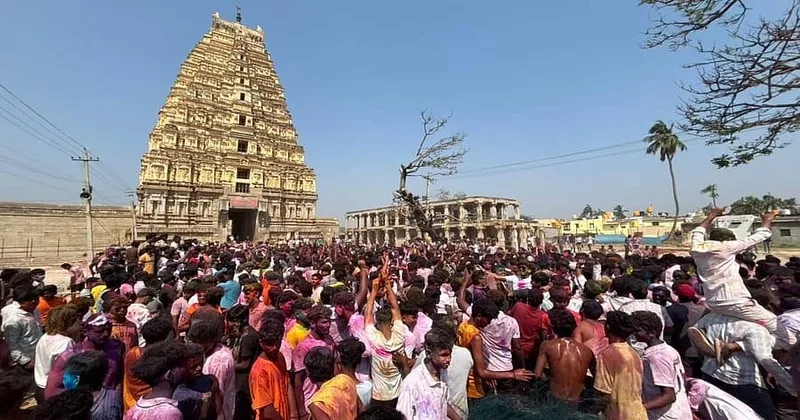
VIJAYANAGARA: The ancient town of Hampi, internationally recognised as a Group of Monuments at Hampi, turned into a spectacular canvas of colours on March 4 as thousands of people, including hundreds of foreign tourists, gathered to celebrate Holi in front of the historic Virupaksha Temple.
Known as Dakshina Kashi and steeped in mythology as the place where Bhagwan Shiva is believed to have burnt Manmatha, Hampi’s sacred ambience blended seamlessly with festive fervour. From around 10 am, devotees, backpackers and local youth began assembling along the iconic Rathabeedi (chariot street). As the morning progressed, the crowd swelled, and the air filled with vibrant hues of red, yellow, green, blue and pink.
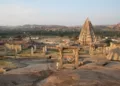
What makes Holi in Hampi unique is its setting, centuries-old stone mandapas, towering gopurams and remnants of the Vijayanagara empire standing tall as silent witnesses to a modern cultural celebration. As more foreign tourists joined the festivities, the energy soared. Within hours, the number of international visitors crossed several hundred, transforming the temple surroundings into a truly global gathering.
Drenched head to toe in colours, it became nearly impossible to distinguish locals from foreigners. The vibrant powders erased visible differences of nationality, language and ethnicity. For a brief moment, the UNESCO-listed heritage landscape appeared to host a unified world, bound not by borders but by celebration.
Participants moved in groups from the temple frontage towards Janata Plot, dancing to the rhythmic beats of traditional drums like dolu and tamate. Unlike metropolitan Holi parties dominated by DJs and electronic music, Hampi’s celebration retained its rustic authenticity. The absence of loudspeakers and artificial sound systems enhanced the cultural flavour of the event. While a handful of youngsters expecting high-decibel music seemed disappointed, most revellers embraced the organic, folk-driven atmosphere.
Pushcarts stacked with packets of colourful powder trailed the crowd, ensuring there was no shortage of hues. Foreign tourists in T-shirts, skirts and casual summer attire gleefully smeared colours on one another, posed for photographs and mingled effortlessly with local youth. The joyous procession eventually made its way towards the banks of the Tungabhadra River, where many washed off the colours after nearly three hours of uninterrupted revelry under the blazing sun.
Tourism stakeholders observe that Holi has evolved into one of Hampi’s most significant annual attractions. Many travellers from Europe, South America and other parts of the world intentionally plan their visits to coincide with the festival. Hotels, homestays and guesthouses in and around Hosapete reported high occupancy during the week, underscoring the festival’s economic impact.
Authorities maintained a watchful presence to ensure safety and prevent overcrowding near sensitive heritage structures. Despite the large turnout, the celebrations remained largely peaceful and orderly.
Hampi’s Holi is more than a festival of colours; it is a striking example of how heritage and contemporary culture can coexist harmoniously. Amid the ruins of an empire that once dazzled the world, thousands gathered again — this time not for trade or conquest, but for celebration and cultural exchange.
As the colours slowly faded from the stone streets by afternoon, Hampi once again returned to its timeless calm but not before offering yet another unforgettable chapter in its living heritage narrative.