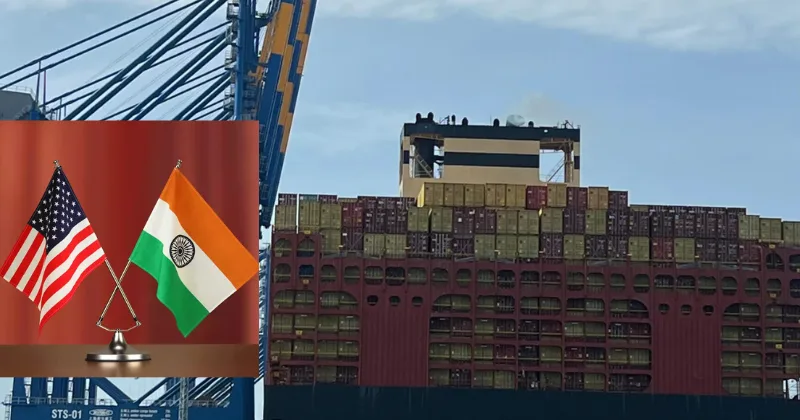
India and the United States (US) share one of the biggest trade relations globally. In 2025, India exported products valued at USD 86.5 billion, mainly electronics, gems and jewellery, pharmaceuticals, engineering goods, and textiles. Exports from India to the US increased by 75.4 per cent to USD 86.5 billion during the last five years, while imports grew by 70.3 per cent to USD 45.3 billion.
This gradual growth faced a serious jolt after the announcement of tariff hikes on India. The government estimated that exports worth USD 48.2 billion would have to face a heavy 50 per cent tariff.
However, when the United States announced the trade understanding with India in early February after months of public denial and tariff pressure, the immediate political reactions focused on personalities and headlines. Yet the more instructive story lies somewhere else. What unfolded was not a sudden diplomatic concession but the outcome of a structural shift in India’s economic and geopolitical position, and the manner in which the current government chose to leverage it.
This shift in the US’s stand illustrates how trade negotiations increasingly sit at the intersection of markets, geopolitics and strategic patience. India did not just respond to pressure; rather, it allowed global conditions to work in its favour.
Pressure without Asymmetry
The initial stance of the US relied on a traditional assumption that access to the American market was indispensable for India, and that trade penalties could therefore be used to induce policy alignment, particularly on strategic issues such as energy. Tariffs were raised to 50 per cent, and trade policy was explicitly linked to India’s relationships with other countries.
Such an approach could be effective against smaller, export-constrained economies, but not with India, which is a large and stable economy with diversified trade links, rising domestic demand and multiple big & small strategic partners.
Over the past decade, India’s geographical concentration risk has declined sharply. The US remains an important partner, but it is no longer singular. At the same time, India’s growth model has been increasingly supported by domestic consumption, public investment and services exports. These factors reduced vulnerability to unilateral trade actions and increased tolerance for delay.
As a result, although the tariff hike imposed costs but did not create urgency. Exporting firms adjusted, margins absorbed shocks and trade flows rebalanced. The absence of systemic disruption weakened the credibility of the pressure technique as a negotiating tool.
Strategic Patience as Economic Policy
The most underestimated parameter behind this India-US deal is the patience by Prime Minister Narendra Modi and his team. They did not treat trade relief as an immediate necessity. There was no rush to secure a deal at any cost and no visible attempt to trade sovereign policy choices for short-term tariff reductions.
In negotiation theory, the ability to wait is a form of power. India’s capacity to do so was underwritten by stronger fundamentals and improving external options. Those options were not abstract. Parallel economic engagement with Europe and the Middle East, deeper integration with West Asian economies and steady participation in Asian supply chains collectively improved India’s fallback position.
This mattered for Washington. Trade negotiations are never truly bilateral. As India’s economic engagement with the European Union gathered momentum, the relative cost of US disengagement increased. European firms were expanding their footprint in Indian markets just as American companies faced uncertainty. In effect, Europe became a silent multiplier of India’s leverage, and ultimately, a few days before the announcement of the India-US trade deal, the “Mother of all deals” was signed between India and the European Union.
FTAs as Leverage: Expanding India’s Effective Market Size
An important dimension of India’s negotiation during the US tariff turbulence phase was the simultaneous expansion of its Free Trade Agreements (FTAs) with other countries. India’s recent FTAs with the EU, the UAE, Australia and the UK connect Indian producers to markets with a combined GDP of 30-35 per cent of global GDP. The exporters, facing pressure from the US’s tariff hikes, began exploring alternative markets. The mitigation strategy of India against concentration risk reduced the tariff pressure significantly and avoided the urgency to concede, transforming FTAs from a trade instrument to strategic leverage.
The India-EU FTA: Scale, Sectors, and Diversification
Among all the FTAs, the agreement between India and the EU is most significant. The EU represent a market of around 450 million consumers, and has a GDP of more than USD 22 trillion, a comparable figure to the US GDP of USD 30 trillion, but structurally more diversified. Key sectors that are expected to benefit most include engineering goods, pharmaceuticals, chemicals, auto components, textiles and electronics. Important to note that many of these overlap with the sectors exposed to the US tariff turbulence.
This diversification was not just a defensive step, but rather created an opportunity for Indian firms to fill in the gaps created after the European supply chain reorientation away from China. The ability to scale exports into the EU market weakened the effectiveness of coercive tariff hikes by the US and increased the opportunity cost of American disengagement.
From Denial to Recalibration
For months, US officials publicly denied the imminence of any agreement. Yet beneath the rhetoric, economic incentives were shifting. Tariffs imposed costs on American importers and consumers. At the same time, US firms risked losing long-term market positioning in the Indian market, which is central to future manufacturing, digital services, defence procurement and energy demand.
At the same time, the broader strategic environment was changing. Geopolitically, India’s image as a counterweight in the China-centric global supply chain became pivotal. As the US reassessed its economic exposure to China, India’s importance as a supply-chain alternative and strategic counterweight grew. In that context, a confrontational trade stance towards India appeared increasingly counterproductive.
From a market perspective, US firms faced rising costs and competitive disadvantages as Indian trade diversified towards Europe and other FTA partners. Prolonged exclusion from the world’s fastest-growing market across manufacturing, digital services, defence and energy started to become economically non-viable.
US trade policy itself faced constraints. With slowing global growth and rising fiscal pressures, sustaining high tariffs that resulted in domestic inflation and supply disruptions became difficult to justify. In this context, recalibration was more rational than persistence.
The eventual agreement reflected this recalibration. Punitive tariffs were rolled back, predictability restored and the tone shifted from enforcement to engagement.
Energy, Russia and the Limits of Coercion
The angle that attracted most of the commentary was India’s energy assurances, particularly regarding Russian oil. Yet much of this commentary overlooks basic energy economics.
India’s engagement with Russia in the energy domain has been driven by price stability and supply security during a period of global volatility, observed during the past few years. Discounted crude reduced import costs and helped manage inflationary pressures. For India, ignoring such options would have imposed fiscal and macroeconomic costs.
Importantly, India resisted linking energy choices to trade concessions when external pressure was at its peak. Energy assurances came into the picture only after tariffs were reduced and negotiations recalibrated. The order of events is important: in economic diplomacy, what follows restored leverage is negotiation, not surrender. Energy flows ultimately respond to price, availability and logistics, not political signalling alone.
What the Agreement Delivers
Reduced tariffs and clearer rules lower uncertainty for exporters, particularly in manufacturing and value-added sectors. Policy volatility is a hidden cost that distorts investment decisions. Removing it improves planning horizons and capital allocation.
The signal sent to the investors is also significant. India is positioned not as a tactical bargaining chip, but as a long-term market whose engagement cannot be taken for granted. This distinction matters for sectors with long gestation periods, where policy predictability outweighs short-term incentives.
Finally, the outcome strengthens India’s negotiating credibility. Trade diplomacy is path-dependent. When a major economy rolls back pressure after resistance, it alters expectations in future negotiations, even with other countries.
Sector-wise benefits
The electrical and electronics sector is a high-growth sector where India is competing with countries like Vietnam and Taiwan to become a global manufacturing hub. India exports products valued at USD 15.89 billion in this sector. The dream of “Make in India for the world” has again gained traction with the announcement of the deal
The gems & jewellery sector, with exports of USD 9.97 billion to the US, is a major pillar of India’s export economy. The human resources employed in the industry are over a million, who are largely dependent on the US’s consumers’ demand. For MSME-dominated sectors, such as the engineering goods and textiles, which are already strained due to the lack of resources and poor access to budget financing, tariff hikes could result in job cuts, loss of output and negative cash flows. But now they can cope with their business challenges with this India-US trade deal.
Agriculture: Limited Gains, Structural Gaps
Agriculture was not the central parameter of the India-US trade deal, and this underscores strategic choice as well as structural constraint. India’s agri-products exports to the US, valued at around USD 8-10 billion annually, are majorly concentrated in seafoods, rice, spices and processed foods. Although the tariff relief has reduced the pressure, the gains remain limited. The current form of the draft agreement does not address the challenges faced by the Indian exporters, such as sanitary standards, traceability requirements and compliance costs. The protectionism of the dairy, poultry and staple food grains, although a strategic move, also means a missed opportunity in expanding value-added agricultural exports. As a result, agriculture emerges from the deal as more protected and less strengthened. Immediate disruption is avoided, but it has highlighted the need for deeper domestic reforms.
Beyond the Deal
The significance of this episode extends beyond bilateral trade. Other partners observe how negotiations conclude. They note where pressure works and where it does not. In that sense, the outcome sends a broader signal that India will engage seriously, but not under pressure. The whole timeline of the deal has carved a strong image of India and its foreign policy
For global markets, this improves institutional confidence. For the domestic industry, it reaffirms the sense that global integration will be managed, not improvised. And for policymakers, it validates a strategy grounded in fundamentals rather than urgency.
Conclusion
Trade deals are often judged by immediate concessions and market reactions. Those matters, but they are not decisive. The more durable outcome here lies in how India’s bargaining position was tested and ultimately recognised.
India did not secure everything it might have wanted. No country ever does. What it secured instead was acknowledgement of its leverage and respect for its autonomy.
It is important to note that tariffs can change, agreements can be revisited, but bargaining power, once demonstrated, reshapes future engagement.
In that sense, this was not merely a trade agreement. It was a quiet assertion that India now acknowledges its economic power and sustainability and negotiates from strength, even with the world’s largest economy.