India–US relations have reached a decisive turning point. After a long period of negotiations, the long-awaited bilateral trade agreement is finally moving toward completion. As part of this process, both countries jointly released an Interim Trade Agreement framework recently. While the deal is designed to be mutually beneficial, for India, it is fundamentally a forward-looking strategic agreement. Under the new framework, bilateral trade is projected at Rs 45 lakh crore. Of this, Indian exporters gain access to nearly Rs 30 lakh crore worth of the American economy, an unprecedented opportunity for Indian agricultural, manufacturing and services.
A major diplomatic achievement for India lies in securing tariff reductions on key export categories. Import duties on Indian textiles, garments, footwear, leather, plastics, rubber products, organic chemicals, home décor, and handicrafts have been slashed from 50 per cent to 18 per cent. In contrast, India’s principal competitors, Bangladesh (20 per cent), China (34 per cent), Thailand, and Pakistan (19 per cent), continue to face higher duties. This differential gives Indian exporters a decisive edge in the US market.
There had been widespread claims by the I.N.D.I Alliance that India would open its agricultural sector to the US. When it became clear that no such concession was granted, opposition parties, including the Congress, swiftly shifted their narrative. The new allegation is that India signed the deal by “surrendering” to Donald Trump. Congress leader Jairam Ramesh went so far as to mock that although the Prime Minister’s name is Narendra, his job is surrender.
The irony is striking. It was the same Congress that once signed free trade agreements with ASEAN countries at a time when India lacked global leverage, effectively turning India into a dumping ground for Chinese goods. Today, as Indian traders and farmers gain new access to the US and European markets, the real losers are China, Bangladesh, and Pakistan. That explains why external rivals and internal opposition voices now appear aligned.
Claims about oil and strategic autonomy
Another narrative being pushed is that India is reducing Russian oil imports due to pressure from Trump. This is misleading. When the Russia–Ukraine war began, India’s Russian oil imports were below one per cent. India increased purchases to nearly 36 per cent only because discounted crude became available. However, since 2014, India has consciously abandoned dependence on any single supplier. Earlier, India sourced oil from around 12 countries; today it buys from nearly 40. This diversification policy is meant to prevent vulnerability to geopolitical shocks. Currently, Russia’s oil sector is under strain due to Ukrainian drone attacks and Western sanctions. India’s renewed interest in Venezuelan crude is part of this diversification strategy. India had imported oil from Venezuela earlier and even participated in production projects there. With the weakening of the pro-China leadership of President Nicolas Maduro, new opportunities have emerged. On January 30, Venezuela’s Vice President Delcy Rodriguez spoke directly with Narendra Modi, urging stronger cooperation in trade, energy, digital technology, healthcare, and agriculture. Both sides agreed to deepen engagement. There was no Trump pressure here, only India’s strategic recalibration. The contrary claims are little more than Congress-led propaganda amplified by urban naxal networks.
India stood firm against tariff blackmail
Trump’s approach toward multiple countries was blunt that sign quickly, accept the US timelines, or face higher tariffs. Several nations, including Japan and South Korea, capitulated under pressure. Even China, which had banned rare earth exports to the US, was forced to temporarily suspend that decision.
India too was threatened. Alongside Brazil, it faced the steepest proposed tariff, 50 per cent. Yet New Delhi refused to be coerced. The agreement moved forward strictly on India’s timetable, not Washington’s. Commerce Minister Piyush Goyal had made India’s stance clear during the Berlin Dialogue in October 2025: India would not negotiate with deadlines imposed “with a gun to its head.” Despite repeated threats, India held firm, targeting March 2026 for closure, exactly what has now materialised. This strategy was shaped by developments inside the US itself. American consumers ultimately bore the burden of tariffs through higher prices. Meanwhile, US businesses challenged Trump’s authority in court. Lower courts ruled against him, and the US Supreme Court is expected to deliver a verdict in February–March. Reports suggest an unfavourable outcome for Trump is likely. If that happens, the US may have to refund nearly $133 billion (about ₹12 lakh crore) collected as tariffs, while entering future negotiations from a weakened position.
Trump also faced domestic criticism that his tariff war was damaging America’s strategic partnership with India and undermining its Indo-Pacific policy, ultimately benefiting China. Matters worsened when the European Union rejected Trump’s demand to penalise India for buying Russian oil and instead moved closer to New Delhi through free trade agreements with tariffs reduced to zero. Globally, Trump failed to deliver on key promises; neither major trade deals nor an end to the Russia–Ukraine war materialised. His confrontational policies alienated allies, triggered capital flight from US Treasury bonds, encouraged gold repatriation by countries like Germany, and weakened confidence in the dollar. Even traditional partners began pivoting toward Asia. The UK and Canada intensified engagement with China and India, while Trump’s aggressive posture on Venezuela and Iran earned him the label of a global bully.
It was in this atmosphere of isolation that the India–US trade deal reached its final stage. Trump rushed to announce it first in an attempt to reclaim political ground. In reality, India became his lifeline, his first tangible achievement since returning to office. The claim that India signed under pressure has no factual basis. Pharmaceuticals, textiles, gems and jewellery, automobiles, marine products, fruits, and vegetables all stand to benefit. The immediate surge in Indian stock markets after the announcement reflected how global investors viewed the agreement.
Beyond Social Media Myths: The economic logic of India -US trade deal
There is widespread misinformation on social media regarding the India–US trade agreement. A dominant narrative claims that Donald Trump is dictating terms to India. Such claims are nothing more than political exaggerations designed to mislead the public.
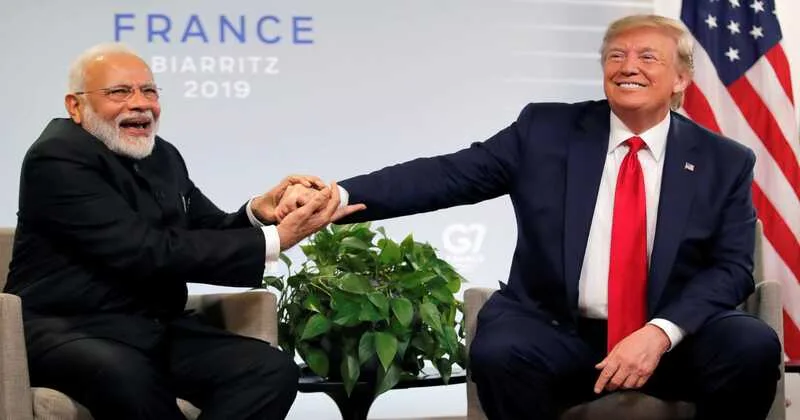
The new trade and tariff agreement between India and the United States marks a significant shift in the global economic landscape. This understanding between the world’s two largest democracies goes beyond commerce. It signals the beginning of a deeper strategic partnership. Far from compromising sovereignty, the agreement was shaped with India’s national interests firmly at its core.
Indian negotiators reached this outcome after months of intense discussions and careful diplomatic manoeuvring. While technical hurdles emerged during the talks, India entered the process with meticulous planning and a clear roadmap to overcome them. This strategic approach helped enhance India’s leverage and maximise potential gains. As with any high-level international agreement, minor shortcomings may exist, but they do not diminish the broader achievements secured through this deal.
In every major business transaction, creating a genuine “win–win” outcome requires compromise from both sides. Large agreements of this scale cannot be finalised without mutual concessions and practical give-and-take. Under the new framework, Indian exports in textiles, jewellery, and pharmaceuticals receive substantial tariff relief, while the US products gain improved access to the Indian market. In return, India is set to attract major investments in the energy sector, along with advanced GPUs and cutting-edge technologies from the US. This technology transfer is expected to significantly accelerate India’s industrial growth, particularly in manufacturing. The resulting expansion is projected to generate lakhs of new jobs and strengthen domestic production capabilities. At a time when many countries remain locked in tariff disputes with the United States, India has secured a more constructive understanding, albeit slightly later than some, representing a clear diplomatic victory. Compared with the challenging trade environment faced by China and several neighbouring nations, India now occupies a far more favourable position. In essence, this agreement is poised to boost domestic manufacturing, expand exports, and stimulate employment on a large scale. Over the coming years, it is likely to become a cornerstone of India’s economic momentum, reinforcing growth while positioning the country as a key player in the evolving global order.