Amid a rapidly escalating Middle East conflict, a critical question looms large: if the concept of the Muslim Ummah is invoked as a binding force, will the United Arab Emirates (UAE) continue to exercise restraint even after facing direct Iranian missile and drone attacks on its territory?
The UAE has categorically dismissed media reports suggesting it is considering joining the United States and Israel in military strikes against Iran. The clarification followed an Axios report claiming that Abu Dhabi was weighing an unprecedented move in response to Iranian attacks targeting the country.
In an official statement issued through the state-run Emirates News Agency (WAM), the UAE asserted that it “has not taken any decision to alter its defensive posture in response to the repeated Iranian attacks.” The statement further reiterated that the UAE “is not a party to this war and has not authorised the use of its territory, territorial waters or airspace for any attack against Iran,” underscoring its long-standing policy of good neighbourliness, de-escalation, and commitment to the UN Charter.
However, these assurances come against the backdrop of significant military escalation in the region.
Operation Epic Fury and regional fallout
The current phase of hostilities began on February 28, when the United States and Israel launched joint military strikes under Operation Epic Fury, targeting key Iranian leadership and military installations. Among the most consequential outcomes of the operation was an airstrike that reportedly killed Iran’s Supreme Leader Ayatollah Ali Khamenei and several members of his family.
The operation triggered immediate and intense retaliation from Iran. Over the past five days, Iranian ballistic missiles and drones have targeted US, Israeli, and Gulf-linked assets across the region, including infrastructure inside the UAE.
Iranian strikes on UAE infrastructure
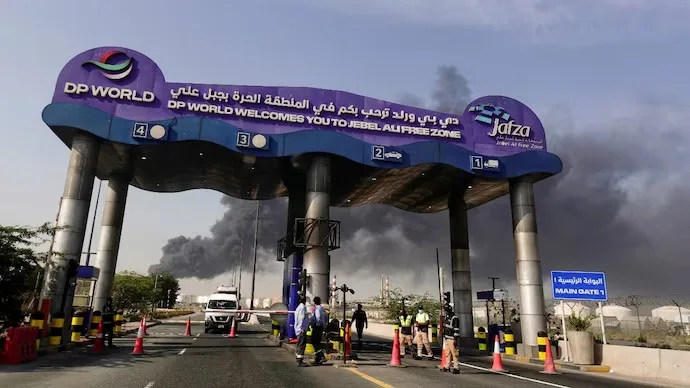
The UAE has experienced multiple strikes as part of Iran’s response. Iranian drones reportedly hit the US Consulate in Dubai, causing a fire and prompting a reduction in staffing, though no injuries were reported. Explosions were also reported at Jebel Ali Port, Dubai’s principal seaport, and at Al Dhafra Air Base, a key US military installation in Abu Dhabi.
Additional damage was reported to parts of Dubai airport and the iconic Burj Al Arab hotel. Smoke was seen billowing over parts of Dubai following the strikes on Jebel Ali Port, highlighting the vulnerability of strategic commercial and military assets.
According to Iranian state media, 787 people have been killed in the US-Israel strikes against Iran since the beginning of Operation Epic Fury. The broader conflict has resulted in repeated bombardment of Iranian cities and infrastructure, with Tehran responding through waves of missile and drone attacks across the Middle East.
Airspace closures and diplomatic signals
The intensifying conflict has severely disrupted civil aviation. Airspace closures were imposed by the UAE, Qatar, Bahrain, Israel, Iran, and Iraq as a precaution against missile and drone threats. Widespread flight cancellations followed, affecting regional and international travel.
Beginning Monday (March 2), limited flight operations cautiously resumed at Dubai and Abu Dhabi airports, although airspace restrictions remain in place and schedules are significantly reduced.
On the diplomatic front, the UAE has closed its embassy in Tehran and recalled its ambassador amid rising hostilities. Yet it continues to stress that it is not a direct participant in the conflict and seeks de-escalation.
Ummah, realpolitik and restraint
The unfolding situation raises sharper geopolitical and ideological questions. If actions taken in the name of the Ummah are to be justified under the banner of Islamic solidarity, then where does a sovereign nation’s right to self-defence stand when its own territory is struck?
The United Arab Emirates has reiterated its commitment to de-escalation even after reported Iranian missile and drone strikes on strategic assets such as the US Consulate in Dubai and Al Dhafra Air Base. Yet the broader debate persists: can religious or civilisational affinity override the principles of territorial sovereignty and national security?
Abu Dhabi has formally reaffirmed its right to self-defence under international law while distancing itself from offensive operations. Its official communication emphasised restraint, adherence to the UN Charter, and the need for responsible journalism.
However, the contrast is striking, had a non-Muslim state launched similar attacks on Emirati soil, would the regional response have unfolded in the same restrained manner? Would the language of solidarity have given way to collective condemnation?
As the conflict enters its fifth day, the UAE appears to be walking a tightrope between strategic pragmatism and regional identity politics. It is balancing economic stability, diplomatic equations, and internal security concerns against the larger narrative of Ummah unity. Whether this calibrated restraint holds in the face of further escalation remains uncertain.
For now, despite direct strikes on its infrastructure, the UAE has opted for de-escalation over retaliation, raising a fundamental question: in moments of aggression, will geopolitical realism ultimately outweigh religious rhetoric?