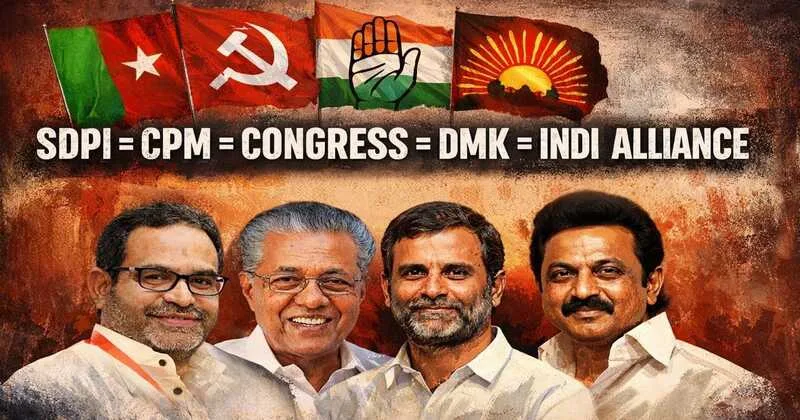
The political discourse in Kerala has turned sharply confrontational, with the BJP/NDA asserting that the Congress and CPM have been exposed for their alliances with Islamist organisations. At the centre of the controversy are developments involving the Congress’ political engagement with Jamaat-e-Islami in Kerala and the broader opposition bloc in Tamil Nadu aligning with the Social Democratic Party of India (SDPI), the political wing of the now-banned Popular Front of India.
The hypocrisy of the #CPMCongressKuruvaSangam has hit a new, shameless low.
For years, the Congress and CPM have tried to fool the people of Keralam. They went around waving the Constitution claiming to protect it, while secretly relying on radical forces for votes.
Today,… pic.twitter.com/M52H0dUMN6
— Rajeev Chandrasekhar 🇮🇳 (@RajeevRC_X) March 2, 2026
Allegations of Double Standards
For years, leaders of both the Congress and CPM have projected themselves as guardians of the Constitution and defenders of secularism. They have frequently accused the BJP of undermining constitutional values and polarising society. However, critics argue that their alleged political engagement with organisations like Jamaat-e-Islami and SDPI exposes a contradiction between rhetoric and practice.
The BJP contends that while Congress and CPM leaders publicly brandish the Constitution and speak about inclusivity, they are simultaneously willing to collaborate with groups that have been accused of pursuing sectarian or radical agendas. According to this view, such alliances are not about ideology or principle, but about consolidating vote banks.
In Kerala, politics has long been dominated by two fronts — the Congress-led UDF and the CPM-led LDF. The Congress, facing electoral challenges, has openly engaged with Jamaat-e-Islami-linked platforms to secure minority votes.
Bringing ideologically rigid organisations into mainstream electoral politics risks normalising hardline positions and could deepen social divisions, posing a challenge to Kerala’s historically pluralistic political culture.
Developments in Tamil Nadu
The controversy has expanded beyond Kerala. In Tamil Nadu, the broader opposition alliance, often referred to as the I.N.D.I Alliance, reportedly, includes cooperation with the SDPI. Given SDPI’s association with the Popular Front of India, which was banned by the Government of India in 2022 over alleged extremist links, the BJP has described this as a dangerous political gamble.
Secularism vs. Vote-Bank Politics?
The heart of the debate lies in the meaning of secularism itself. The BJP/NDA maintains that aligning with religiously defined organisations while claiming constitutional high ground is nothing but “pseudo-secularism.” In its view, true secular politics cannot and should not depend on religious mobilisation, whether of the majority or the minority, if constitutional values are to be genuinely upheld.
Electoral Implications in Kerala
As Kerala heads toward the next Assembly elections, the BJP/NDA is positioning itself as the only alternative capable of delivering both development (“Vikasita Keralam”) and security (“Surakshita Keralam”). The BJP/NDA maintains that long-term progress in Kerala requires political stability, strong law and order, and zero tolerance for radical influences. Kerala’s electorate is politically aware and has historically resisted overt communal polarisation, but the mainstreaming of radical forces by Congress and CPM is likely to become a major issue in the upcoming Assembly elections.
The current controversy reflects a broader national pattern in which alliances and counter-alliances are scrutinised through ideological lenses. As parties prepare for crucial elections, the debate over constitutional values, secularism, and political expediency is likely to intensify.