The Kerala Story-2: Goes Beyond, a film by Vipul Amrutlal Shah and directed by Kamakhya Narayan Singh, is a journey into the most uncomfortable truths of the time. The central theme of the film is to highlight cases of Love Jihad, a name given to a pattern of crime that involves Muslim men and Hindu women, wherein Muslim men do everything to get the Hindu woman converted to Islam. The said pattern has been repeatedly highlighted in the media but has been dismissed by many as propaganda. The hurdles faced by the makers and the film were part of this narrative. The Kerala High Court first banned the release, having a problem with the title and the content of the film. “Goes Beyond” in the film is a representation of the fact that this film is not just centred around Kerala but takes you to other parts of Bharat.
The movie tells the stories of three girls from three different parts of the country. These stories expose how these Hindu girls are emotionally and socially exploited, labelled, and pushed into a dark abyss because of their Hindu identity.
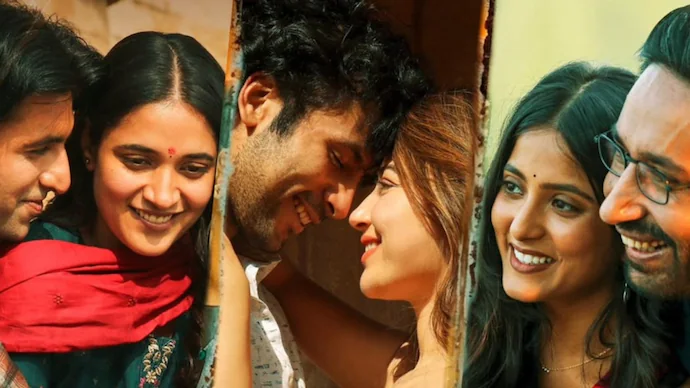
The pre-release promo videos showed three Hindu girls, Divya Paliwal from Rajasthan, Surekha Nair from Kerala, and Neha Sant from Madhya Pradesh, as the victims. These three characters have been immaculately played by Ulka Gupta, Aishwarya Ojha, and Aditi Bhatia, respectively.
The Three Stories
The film starts with the introduction of all three protagonists. Neha, who is from Madhya Pradesh, is a javelin thrower and her father trains her. She meets a man named Raju, who puts a tilak on his forehead, wears kalawa, lives like a Hindu, goes to the temple, and does everything a Hindu would do. Her father has a dream of seeing her in the nationals, but before that, Raju deceives her into marrying him in a temple, as the family would not agree. He also promises her to get trained by the best coach in javelin after marriage. The duo get married as per Hindu rituals, and then he asks her to stay back home as usual.
In the meantime, the family gets a proposal from a well-to-do boy who comes from an upper caste and has no problem with the girl being Dalit; all the family wants is a player bride. They also have no problem with her playing. Anyway, Neha explodes the bomb and tells her parents about Raju. Shattered, they cut their ties with her and sent her with the boy. Raju takes her to a modest house with little or no amenities at all. They settle there; she places her Radha Krishna murti, and Raju has no problem with this.
Then comes the other story, Surekha Nair, a secular Hindu girl from an upper-middle-class family, with her father being liberal and her mother a devout Hindu. This story is from Kerala. The girl is preparing for UPSC mains and is in a love relationship with a married man named Salim. He loves her and poses as a liberal journalist for whom religion is just a column to be filled in forms. He has no issues with Surekha wearing sleeveless clothes and doing whatever she wants. Surekha has a problem with her mother going to the temple, and she makes fun of her. Later, she announces to the family that she wants to move in with Salim, as he has promised her that he will give talaq to his previous wife. When her parents caution her with cases like Shraddha Walker, she discards the argument, calling it something from “WhatsApp University.” When they tell her she cannot live with him as he is Muslim, she calls them “Islamophobic.”
Then comes the final story of Divya Paliwal, placed in Rajasthan, which is a troubling one. She is a content creator and dances well. Her parents have allowed her to make dance reels that get hits in thousands. She gets in touch with a boy named Rasheed, who promises her that he will make glamorous reels of her and she can get hits in lakhs. She is just 16 when all of this is happening. They shoot one reel, which goes viral, but her parents find out and then lock her up in a room and take her phone. All this lands her in great anger, owing to which she leaves home only to go with Rasheed to his place.
Conversion is mandatory
After the three girls move out of their houses, the tension begins. In Neha’s life, Raju keeps silent for three days, only to tell Neha one day that he is living two identities and hence cannot take her to meet his family members. He is actually Faizan and had lied so that he could marry her. Now, to take her to his house, he wants Neha to convert to Islam. Neha calls her parents to take her back, but, angry at her, they do not talk to her. Later, she agrees to convert, recites the kalma, and wears a burqa, the one with only two eyes visible.
Divya also faces the same struggle, as Rasheed’s family does not accept her. He manipulates her into accepting Islam so that all his family members become happy. She also starts wearing a hijab. Wearing the same hijab, she is taken to the court premises where the nikah happens. Rasheed calls it a protective shield against her family so that they cannot take her away. There, she is claimed to be a major with forged documents, and the marriage takes place. Then she is taken to the police station with a hijab on. Her parents get emotional and angered; they grieve in front of her, bow down, and do all they can to take her back, but she denies going with them and calls Rasheed her “Shauhar.”
The family shows original documents as per which she is still a minor, but police need time to investigate and until then keep the minor with the boy. The family of the boy, however, starts to question the reels. They ask the boy to take control of the girl and put a baby in her womb, as things may get worse in the coming months with the case ongoing.
Surekha, however, is taken to a Muslim colony in a small house but is ready to do everything in love for Salim. She does not want to get married and puts forth the only condition that she will not convert and that she does not believe in religion. Salim plays around with his liberal image and tells her that religion gives wings to fly. On the other side, he starts to put pressure regarding small things like wearing full clothes and not going out to the balcony. Surekha laughs and tells him not to ask her to wear a burqa.
The plot takes another turn here and shows Salim as someone running a conversion centre with proper data and research. He motivates boys to target Hindu girls, who are 8 crore in number, and get married to them only to change the demography and make this nation an Islamic state by 2047 and impose Sharia law in the land. He laughs at the government, which allows centres like his to operate from where they can do anything.
Things get worse
After conversion, the lives of the two girls, Neha and Divya, change completely, while Surekha is still in the process of getting converted. Divya, the content creator, gets abused and thrashed for making reels as it is considered haram in Islam. She offers namaz five times a day and is also pregnant at the age of 16 with no support from the family at all. She cooks food, starts wearing full clothes all of a sudden, and every time she tries making a video, she gets abused.
Neha, on the other hand, after becoming a Muslim, finally reaches the house of Faizan where a cleric is present. He gives a bundle of cash to him for bringing a “kafir” to “iman.” Later, the cleric asks Faizan to arrange a nikah. Soon after the nikah, Neha is taken to a room where the cleric arrives and rapes her in the name of halala. Later, he keeps her there for 40 days, the iddat period, only to be taken by Faizan home. At home, which is a big Muslim household, bikes are being distributed to Muslim men in order to trap Hindu women and get money.
As Neha is a Dalit, the family got a lesser amount. Irked with this, the mother asks what will happen to this girl. Faizan says, “You better know how to extract money.” The mother smiles and starts sending men to her room, taking money from each. She is locked, her hands and legs tied, and men after men rape her, with no one helping her out. Faizan is off to trap another Hindu girl. This scene will shake you to the core.
Readers must know that all the stories depicted in the film are inspired by true events. The story of Neha looks like a blend of Tara Shahdeo and a famous Love Jihad case from Gwalior reported by this correspondent, Hemlata Joshi.
Surekha’s life starts getting worse with Salim’s wife returning home to stay with them. Salim makes the excuse that he will have to pay mehar to get a divorce and has no money. He cries in front of her saying he loves her but is trapped. Surekha agrees to live only for a few months until he gets divorced. In the meantime, he starts pressuring her to convert. Later, he locks her in a room, force-feeds her beef, and throws a burqa at her in order to establish conversion. However, Surekha keeps saying she will not convert. Ultimately, in that room, she commits suicide, writing several notes exposing Salim.
On the other hand, Divya, who is still a minor, becomes the mother of a baby boy who is named “Danish.” She accepts her fate as she was the one who chose this for herself. She is no longer a content creator and does all the odd chores of the house, involving cooking meat. One day, Rasheed brings another girl, calls her Fatima, and introduces her as his second wife. In conversation, however, it is revealed that she was Sneha and had converted to Islam to marry Rasheed, who only loves her. Sneha and Divya join hands. Sneha gets a phone; she records a video exposing Rasheed but ends up getting caught. In the struggle, Rasheed kills her, later chops her body into pieces and buries it while her family looks for their daughter.
Those who have dismissed Shraddha Walker’s case as one in a million will get shivers after watching this part of the story.
The end — A must watch
The film does not end here. Neha makes it out; she manages to escape and reaches the police station. Based on her complaint, all the accused, from Faizan to the cleric and everyone involved, get arrested. The property stands bulldozed.
Surekha’s body, hanging in the room is recovered, with letters claiming Salim as the accused found.
Divya’s story comes out via Sneha. All three accused get jailed and beaten up.
A beautiful Shiva bhajan in the background shows Hindus united against conversion and Islamists. Divya’s family takes the baby boy and renames him Divyansh. The film ends with some statistics and a quote, “Sahenge Nahi, Ladenge.”
The entire film leaves you deeply unsettled. It does not allow you the comfort of distance that most cinema provides. Instead, it grips you emotionally, making you anxious, angry, heartbroken, and helpless all at once. Scene after scene, you find yourself wanting to warn the girls, wanting to shake them and tell them to see what is so painfully obvious to an outsider. The red flags are visible. The lies are detectable. The manipulation is clear. Yet they ignore the warning signs again and again, sometimes out of love, sometimes out of rebellion, sometimes out of blind trust and each ignored sign pushes them one step closer to irreversible damage. That frustration you feel as a viewer is precisely what makes the film so disturbing.
What makes it even more unsettling is the uncomfortable thought that this is not merely cinematic exaggeration. This is how such cases unfold in real life, slowly, emotionally, deceptively. It rarely begins with violence. It begins with affection, validation, promises, and the illusion of acceptance. By the time reality reveals itself, the girl is often isolated from her family, distanced from her identity, and trapped in circumstances far beyond her control. The film attempts to portray this gradual entrapment, the psychological conditioning before the physical consequences.
The narrative argues that Love Jihad is not confined to one state or region. It suggests that what is often dismissed as isolated incidents or political rhetoric is, in fact, a pattern that stretches beyond Kerala and across Bharat. Every now and then, headlines appear, a missing daughter, a sudden conversion, a secret marriage, a young mother cut off from her family. Sometimes she returns under a different name. Sometimes she never returns at all. These stories fade from public memory, but for the families involved, the trauma remains permanent.
Many will label films like this as propaganda. Some will question the intent behind such storytelling. But the makers present it as an act of awareness, as a social warning rather than mere entertainment. The film positions itself as a mirror held up to society, urging families to pay attention, to communicate with their children, and to recognise emotional manipulation before it escalates into something far more dangerous.
Whether one agrees with its perspective or not, the film demands discussion. It urges parents to be more involved, to understand the digital and social worlds their Gen-Z children inhabit. It suggests that vulnerability today is not just physical but emotional and ideological. The message is one of urgency, that complacency can be costly. The film closes not with comfort, but with a warning: if families choose silence now, they may one day regret not acting when the signs were still visible.
Thank you to the makers for making and investing in such a project.