Iran simultaneously fired ballistic missiles toward Israel, Bahrain, the United Arab Emirates, Qatar and Saudi Arabia following what Washington and Jerusalem described as “pre-emptive” strikes near the offices of Iran’s Supreme Leader, Ali Khamenei.
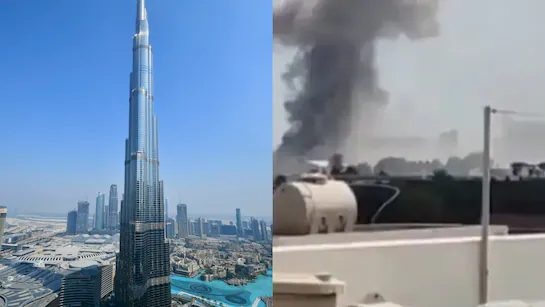
Reuters reported that a massive explosion was heard in Dubai, while residents in Abu Dhabi told AFP they heard loud blasts in the Emirati capital. Explosions were also reported across Doha and Riyadh.
Qatar’s missile defence systems intercepted at least one projectile, according to regional media reports. It remains unclear whether U.S. military facilities in the targeted countries were directly struck.
Several of the cities targeted host major American military installations.
In Abu Dhabi, the UAE Air Force shares the Al Dhafra Air Base with the United States. The UAE temporarily and partially closed its airspace as a precautionary measure.
In Doha, the 24-hectare Al Udeid Air Base serves as the forward headquarters of U.S. Central Command and hosts thousands of American personnel.
Bahrain confirmed that a missile targeted the headquarters of the U.S. Navy’s Fifth Fleet in the island kingdom. The Fifth Fleet oversees operations across the Gulf, Red Sea, Arabian Sea and parts of the Indian Ocean.
Saudi Arabia, which hosts more than 2,000 U.S. troops, maintains American military assets at Prince Sultan Air Base, located roughly 60 kilometres south of Riyadh. The base supports Patriot missile batteries and Terminal High Altitude Area Defence (THAAD) systems.
It was not immediately clear whether U.S. troops in Abu Dhabi, Doha or Riyadh sustained casualties.
The missile barrage followed Israeli strikes inside Iran carried out with American support. U.S. President Donald Trump said the military operations were aimed at neutralising imminent threats posed by Tehran.
“Short time ago, the US military began major combat operation in Iran,” Trump said, adding that Iran must never obtain nuclear weapons and warning that its missile infrastructure and naval capabilities would be destroyed.
Israel’s military confirmed that missiles were launched from Iran toward Israeli territory shortly after the joint operation. The Israel Defense Forces said defensive systems were activated to intercept incoming threats and that mobile alerts were issued to civilians in affected areas.
A senior Iranian official told Al Jazeera that all American and Israeli assets in the region were now considered legitimate targets. The official warned of a “complex response with no time limit” and said there were “no red lines” following what Tehran described as aggression.
The escalation follows weeks of heightened military posturing and strained nuclear negotiations, pushing the region toward what analysts fear could become a wider, multi-front conflict.
Airspace restrictions, missile interceptions and reported explosions across multiple Gulf capitals have heightened fears of broader instability in a region that hosts critical energy infrastructure and major U.S. military deployments.
With retaliatory threats on both sides and no immediate signs of de-escalation, the situation remains volatile as governments brace for further strikes and potential expansion of hostilities.