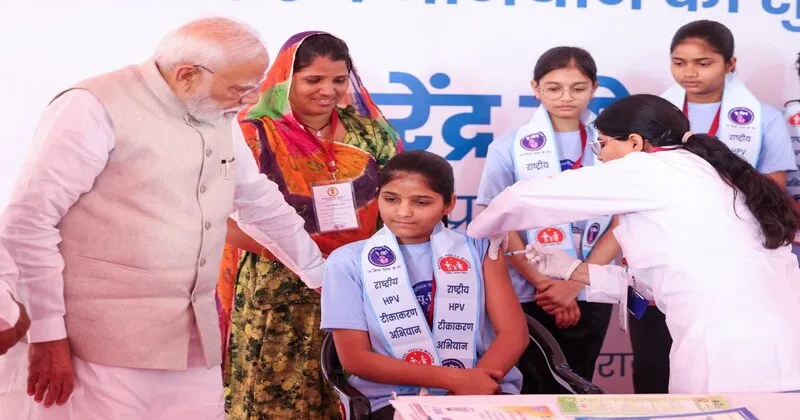
Ajmer: Prime Minister Narendra Modi on February 28, Saturday launched the nationwide Human Papillomavirus (HPV) Vaccination Campaign for 14-year-old girls from Ajmer, Rajasthan, marking a historic milestone in India’s fight against cervical cancer. Speaking on the occasion, the Prime Minister described the nationwide HPV vaccination campaign as a pivotal step toward empowering India’s ‘Nari Shakti’ and safeguarding the health of mothers and daughters across the country.
From Ajmer today, the national HPV Vaccination Campaign Against Cervical Cancer has been launched. Manisha Rawat from Ajmer became the first person to be vaccinated as a part of this campaign. This is a major initiative to improve women’s health. pic.twitter.com/hkEdHIeMqX
— Narendra Modi (@narendramodi) February 28, 2026
“We all know that when a mother falls ill in the family, the house feels scattered. If the mother is healthy, the family remains capable of facing every crisis. With this sentiment, the government has run many schemes to provide support to women”, PM Modi highlighted. Emphasising the Government’s sensitive and mission-driven approach to women’s health and dignity, the Prime Minister referred to transformative interventions such as large-scale toilet construction under sanitation initiatives, provision of affordable sanitary pads and the Pradhan Mantri Ujjwala Yojana, which has ensured clean cooking fuel for millions of households. He also spoke about the safe motherhood scheme under which ₹5,000 is directly transferred into the bank accounts of expectant mothers to support nutritious food during pregnancy. The Prime Minister underlined that these initiatives reflect a shift from a culture of neglect to one rooted in care, dignity and sensitivity towards women’s health and well-being.
वीरांगनाओं की धरती राजस्थान के अजमेर से देशभर की बेटियों के लिए HPV वैक्सीनेशन अभियान का शुभारंभ कर बहुत खुशी हुई है। देश की मातृशक्ति को स्वस्थ और सशक्त बनाने की दिशा में यह एक अहम कदम है। pic.twitter.com/z30IB01tgb
— Narendra Modi (@narendramodi) February 28, 2026
India’s revolutionary step towards combating cervical cancer
Cervical cancer remains a significant public health concern globally and in India. It is the second most common cancer among women in India, with over 1 lakh 20 thousand new cases and nearly 80 thousand deaths reported annually as per the WHO GLOBOCAN report 2022. Persistent infection with high-risk Human Papillomavirus(HPV) types, particularly types 16 and 18, has been established as the primary cause of cervical cancer.
The nationwide HPV vaccination campaign aims to prevent cervical cancer by protecting girls before potential exposure to HPV infection. The vaccine is safe, effective and provides long-lasting protection against HPV strains responsible for the majority of cervical cancer cases. HPV vaccination has been validated and recommended by global and national expert bodies, including the World Health Organisation (WHO) and India’s National Technical Advisory Group on Immunisation (NTAGI).
After the launch of the HPV Vaccination Campaign Against Cervical Cancer, spoke with my young friends who have been vaccinated today. This is a decisive step towards protecting the health of our daughters and mothers. pic.twitter.com/HZ9T5mIyV5
— Narendra Modi (@narendramodi) February 28, 2026
Globally, 160 out of 194 countries have introduced the HPV vaccine under their National Immunisation Programmes. 90 countries have adopted a single-dose schedule, including the majority of Southeast Asian countries. 80 countries are using the Gardasil-4 vaccine in their National Immunisation Programme. Out of these, 61 countries are implementing a single-dose schedule of Gardasil-4. HPV vaccines are 93-100 per cent effective in preventing cervical cancer caused by vaccine-covered HPV types. Evidence also shows a strong herd effect-high vaccination coverage reduces circulation of HPV strains, thereby providing indirect protection even to unvaccinated individuals.
India’s national programme uses Gardasil-4 (Quadrivalent: HPV types 6, 11, 16, 18) in a single-dose schedule, aligned with global scientific evidence and WHO recommendations. The campaign will cover girls aged 14 years(those who have completed 14 years but have not yet completed 15 years). As per Registrar General of India(RGI) 2021 estimates, the annual cohort of 14-year-old girls is approximately 1.2 crore, who are expected to benefit from this initiative each year. The introduction of HPV vaccination in India has been meticulously planned with detailed attention to safety, logistics and monitoring.
Three months campaign to curb cervical cancer
The vaccination duration is 3 months (90 days) in campaign mode. After completion of the campaign phase, the HPV vaccine will be available on routine immunisation session days. Session sites includes only Government Health Facilities like Ayushman Arogya Mandir (AAM) – Primary Health Centres (PHCs), Community Health Centres (CHCs), Sub-District Hospitals (SDHs), District Hospitals (DHs), Government Medical Colleges and Hospitals (GMCHs).
Dose & administration comprises, single dose (0.5 ml) Intramuscular (IM) injection in the left upper arm. Also, the vaccination is voluntary, free of cost and will be administered only after parental/guardian consent. Beneficiaries may pre-register and schedule appointments on the U-WIN digital platform or opt for walk-in vaccination at designated government health facilities. Parental/guardian consent is mandatory and will be recorded digitally on U-WIN. In areas without internet connectivity, consent may be obtained in hard copy as per the prescribed format. The U-WIN platform will be used for session planning, registration, recording and reporting, while the e-VIN portal will manage vaccine stocks and logistics.
Extensive preparatory activities, including nationwide capacity-building exercises covering all technical and operational aspects, have been undertaken. Detailed guidelines have been shared with all States and Union Territories to ensure seamless implementation. The programme follows strict medical guidelines.
Vaccination will be deferred or avoided in the following cases:
- Girls with moderate or severe illness until recovery
- Girls with a history of severe allergic reaction to previous vaccination
- Girls known to be allergic to yeast
- Girls outside the target age group
- For girls who have already received any HPV vaccine(Gardasil, Gardasil-9, Cervarix, or Cervavac), their vaccination status will be updated on the U-WIN portal
All vaccination sessions are conducted under the supervision of trained Medical Officers, with functional Cold Chain Points (CCPs) and linkage to 24×7 government health facilities for management of any rare Adverse Events Following Immunisation (AEFI).
Following the Prime Minister’s national launch, HPV vaccination campaign launches were held across all States and Union Territories through local events. The nationwide HPV vaccination campaign represents a transformative step in India’s preventive healthcare strategy and reflects delivery-oriented governance rooted in scientific evidence and implementation readiness.
The Union Ministry of Health and Family Welfare urges parents and guardians to ensure that their 14-year-old daughters receive the HPV vaccine during the campaign period. HPV vaccination is a powerful preventive intervention that can save lives and secure a healthier, cancer-free future for India’s daughters.
(With Inputs from ANI)