
Jamaat-e-Islami leaders and their comrade-in-arms, V.D. Satheesan, the Congress leader and Leader of the Opposition, have been stating that the organisation has given up its original philosophy of a “theocratic state” and now believes in democracy and secularism. However, nationalist and Sangh-inspired movements, along with the BJP, have rejected this claim. They argue that the Islamic outfit does not denounce anti-minority atrocities in Bangladesh.
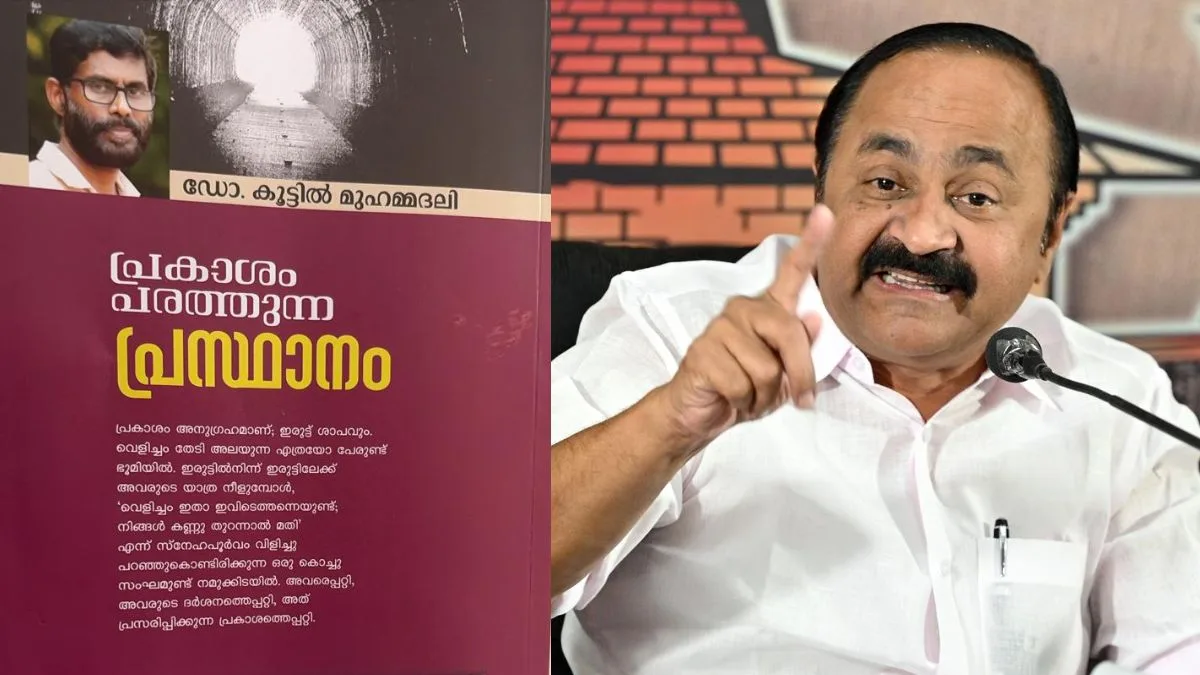
Meanwhile, a book titled “Prakasham Parathunna Prasthanam” (The Movement That Spreads Light), authored by Jamaat-e-Islami leader Dr. Koottil Mohammedali, states that nationalism, democracy, and secularism are modern superstitions that afflict society. Mohammedali is the Chairman of the Administrative Council at Al Jamia Islamiya, Kozhikode. The book is reportedly published in 2006.
Jamaat-e-Islami leaders met Chief Minister and CPM leader Pinarayi Vijayan in December 2025. Later, the Chief Minister said he told them bluntly that they were communalists. However, Jamaat-e-Islami state secretary Shihab Pokkoottoor had claimed in 2024 that three out of four CPM MPs won the Lok Sabha elections with his organisation’s support. Jamaat had also released a photograph of CPM’s Amra Ram, the winner from the Sikar Lok Sabha constituency, sitting with Mohammed Nazeemudheen, the Rajasthan Amir of the organisation, to support this claim.
“Secularism and Islam are contradictory concepts”
The book states that Jamaat-e-Islami follows Islamic doctrines and that secularism and Islam are contradictory concepts. It argues that no religion can accept secularism. According to the author, Islam believes in “either God or self,” and that self leads to disorder. Secularism, he writes, belongs to the realm of “self.” The secular world, he argues, lacks an axis, direction, or executive authority, and is ruled by uncertainty and anarchy. At the same time, the author claims that Jamaat-e-Islami supports religious tolerance and harmony.
The author further states that Jamaat-e-Islami does not accept nationalism, whether related to nation or community. The organisation believes in internationalism and global humanity. While it does not object to national boundaries for administrative convenience, it rejects using them as parameters to determine what is right or wrong. Jamaat opposes the concept of “My Country, Right or Wrong.” Extreme nationalism, whether among Muslims, Hindus, Indians, or Pakistanis, is described as a cancer affecting modern nations.
The book also notes that Jamaat-e-Islami was launched during the peak of the freedom struggle in the Indian subcontinent. It claims that when nationalism, secularism, and democracy were widely accepted as foolproof ideologies, Jamaat-e-Islami showed the courage to expose what it considered their inherent dangers. The organisation described them as “modern superstitions” and even “basic diseases,” arguing that they are the root causes of many contemporary problems faced by humanity.
The book is presented as an introduction to Jamaat-e-Islami. It states that human beings do not have the right to make laws, as that authority belongs to God. The author elaborates on the fundamental tenets of the organisation.
Koottil Mohammedali’s Deep Roots in Jamaat-e-Islami
Koottil Mohammedali’s profile reflects his long association with Jamaat-e-Islami. He has served as Kerala Jamaat-e-Islami Education Department Chairman, state chairman of SIO (Students Islamic Organisation of India), and held leadership roles in Solidarity and the Welfare Party, the student, youth, and political wings of the organisation, respectively. He is also the Chairman of the Islamic Publishing House (IPH), Chief Editor of Prabodhanam weekly, Administrative Chairman of Al Jamia Al Islamiya, a member of the Jamaat-e-Islami State Interaction Council, and a central committee member.
The book has been published by Islamic Publishing House and continues to be available for sale. It asserts that Jamaat-e-Islami has not altered its stance on nationalism, democracy, and secularism. The text emphasises that religion takes precedence over the nation. It further suggests that secularism and Islam are fundamentally incompatible.
Despite this ideological position, both the ruling CPM-led Left Democratic Front (LDF) and the opposition Congress-led United Democratic Front (UDF) are often accused of seeking political engagement with Jamaat-e-Islami. It is often noted that Kerala’s Leader of the Opposition, V.D. Satheesan, is an avid reader, reportedly reading around 60 books a year. Political observers have suggested that he should read this book as well.
Both LDF and UDF leaders, critics argue, must also note that Jamaat-e-Islami has neither disowned the book nor distanced itself from the author or its contents.