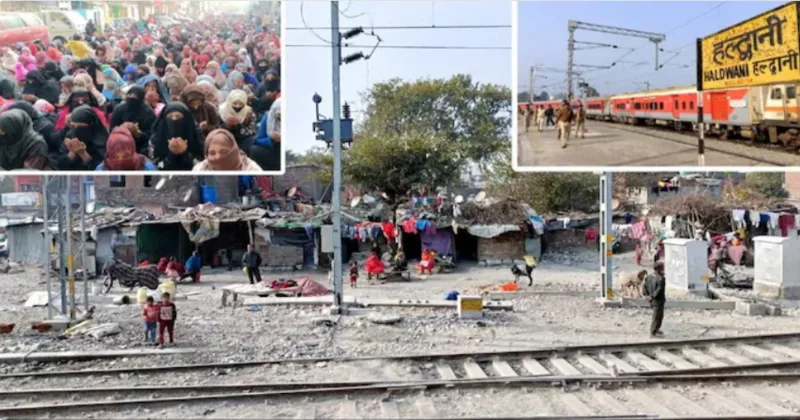
The long-pending railway encroachment case in Banbhoolpura area of Haldwani has entered a decisive phase, with the Supreme Court of India making it clear that the land in question belongs to the Railways and the state government and must eventually be cleared. While the final verdict is still awaited, the court has directed the district administration to identify eligible families for rehabilitation after Eid, signalling that the process of eviction and resettlement may soon move forward.
At the same time, the issue has taken a sharp political turn, with allegations that local leaders from the Indian National Congress and the Samajwadi Party have complicated the matter through vote-bank politics. As scrutiny camps are set to begin under judicial supervision, the Banbhoolpura dispute once again stands at the intersection of law, rehabilitation, and electoral calculations.
Banbhoolpura Railway Encroachment Case: Law, Rehabilitation and Political Crossfire
The railway land encroachment issue in Banbhoolpura, located near Haldwani railway station in Nainital district, has resurfaced as one of the most sensitive urban disputes in Uttarakhand. The Supreme Court has reiterated that the land occupied along the railway tracks belongs to the Railways and the state government and qualifies as an encroachment. However, the court has also emphasised due process and humane rehabilitation.
During recent proceedings, the state government and the Railways assured the apex court that eligible affected families could be rehabilitated under the Pradhan Mantri Awas Yojana (PMAY), similar to arrangements made in a comparable case in Gujarat following Supreme Court directions. The court has now instructed the district administration to organise verification camps within ten days after Eid to identify beneficiaries based on eligibility criteria and submit a compliance report.
District Magistrate Lalit Mohan Ryal has already convened meetings to initiate preparations. According to officials, the camps will be conducted under the supervision of the district administration and the District Legal Services Authority to ensure transparency. Applicants will be required to submit documentary evidence to prove eligibility. Authorities have also issued a stern warning that submission of false affidavits or fabricated documents will invite legal action.
Administrative Challenges and Ground Realities
The administration faces a complex task. Urban land scarcity in Haldwani poses a major challenge in identifying relocation sites for eligible families. Officials have acknowledged that while PMAY benefits may be extended to those meeting criteria, identifying suitable land within municipal limits remains unresolved.
Sources indicate that some affected families are aware of their status as occupants on government land and have already made alternative arrangements. There are also reports that several residents originally migrated from other states and purchased plots through informal agreements on stamp paper. In such cases, questions have arisen about whether they would qualify for housing benefits in Uttarakhand or would need to seek assistance in their home states.
The Railways, meanwhile, have maintained that the encroached land is crucial for infrastructure expansion and safety compliance. Earlier demarcation exercises marked a 15-metre boundary on both sides of the tracks, triggering widespread protests and legal appeals.
Political Undertones
The dispute has not remained confined to legal and administrative corridors. Political observers argue that earlier High Court orders, had they been implemented promptly, might have limited the scale of encroachment to specific clusters such as the Dhoolak and Gaffur bastis along the tracks. Instead, prolonged litigation and public mobilisation transformed the issue into a politically charged confrontation.
Critics allege that local leaders from the Congress and the Samajwadi Party attempted to consolidate support by positioning themselves as protectors of encroachers, framing the eviction drive as an attack on vulnerable communities. The matter was taken repeatedly from one court to another, with senior legal representation appearing on behalf of residents.
On the other hand, the ruling Bharatiya Janata Party has maintained that it is duty-bound to defend government land and implement judicial orders. Political analysts note that the eventual removal of encroachments could have electoral implications, particularly in constituencies where demographic and land-use issues have become campaign themes.
Social Media and Public Perception
The Banbhoolpura case has also generated significant traction on social media. Videos and commentaries by independent YouTubers and political influencers have amplified narratives around alleged demographic shifts, administrative bias and humanitarian concerns. Observers caution that sensationalised coverage risks heightening tensions and influencing public sentiment before the legal process concludes.
Local authorities are reportedly monitoring online content to counter misinformation. Officials stress that the objective is neither selective targeting nor punitive action but compliance with judicial directives while ensuring lawful rehabilitation.
Rehabilitation and Legal Scrutiny
The Supreme Court’s interim directions underline a balanced approach: removal of encroachments must proceed in accordance with law, but displacement must not occur without verification and rehabilitation planning. By mandating post-Eid scrutiny camps and transparent beneficiary identification, the court has sought to ensure procedural fairness.
Legal experts note that the final outcome will likely hinge on the verification exercise and the feasibility of relocation plans. If successfully executed, the administration’s approach could serve as a model for handling similar disputes elsewhere in the country.