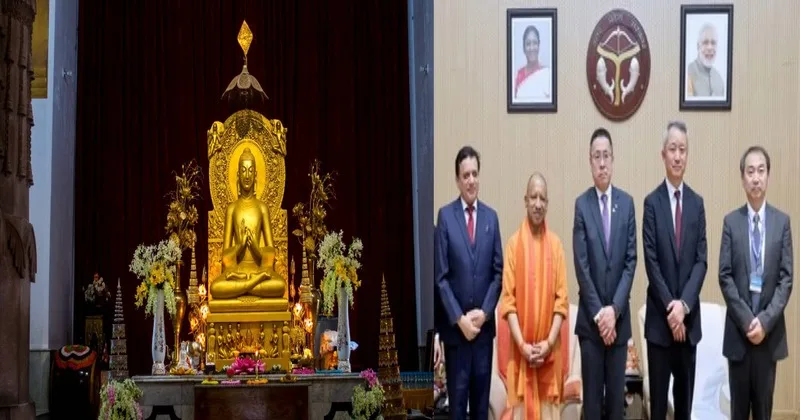
Uttar Pradesh Chief Minister Yogi Adityanath made an official visit to the Asian country of Japan. The visit not just fortified the partnership between Japan and the state of Uttar Pradesh in terms of accelerating economic, investment and technological empowerment for the state. Instead, the visit also reinvigorated the civilisational link between Uttar Pradesh and Japan, which is textured with the philosophy of Buddhism. The visit articulated a strategic pathway to foresee the developmental prospects of Uttar Pradesh which is embedded with spiritual diplomacy.
The state of Uttar Pradesh is a pivotal epicentre in the Buddhist tradition. The key Buddhist sites in Uttar Pradesh including Sarnath(place where Buddha gave his maiden dhammachakra Pravarthan/first sermon), Khushinagar(place where Buddha attained Mahaparinirvana), Shravasti(Gautama Buddha spent majority of monastic life here) and Kapilavastu(where Lord Buddha spent his early days) have deep spiritual and cultural reverence with the Buddhists of Japan. Buddhism thus can act as a bridge between the state of Uttar Pradesh or India at large and Japan to strengthen the strategic partnership between India and Japan.
Redefining the civilisational link to yield developmental prospects
New Delhi and Tokyo are the two defining powers in 21st century geopolitics. They are the key Asian democratic powers whose strategic partnership can yield developmental opportunity and assurance to navigate the challenges of the current geopolitical landscape. To harness such geopolitical goals, the civilisational link and the pathway of spiritual diplomacy is the key. The Indian state of Uttar Pradesh and its Buddhist heritage is the epicentre that renders strategic momentum to further invigorate this civilisational relations. The visit of CM Yogi to Japan seeks importance in this direction.
Buddhism spread to Japan between the 4th and 6th century via the ancient Silk Route encompassing China and South Korea. The early Buddhist monks from India, Korea and China instilled Buddhism in Japan. The earliest reference goes to Buddhist monk Bodhisena from India who visited Japan in 704AD and established a Buddhist monastery in Japan called Todaiji temple. Later, Prince Shotoku and other emperors of Japan patronised Buddhism. Gradually, new schools and sects of Buddhism originated in Japan. Today, Mahayana Buddhism is largely adopted in Japan with more than 22 million people following it. Also, 10 million Japanese follow Nichiren Buddhism, 5 million others follow Shingon Buddhism and 5 million follow Zen Buddhism.
Also, the verses or shlokas of Japan Buddhism are still practiced in the Siddham script, a language considered as a direct descendant of Sanskrit. Japan took continuous inspiration from Buddhism in India. For example, post World War 2, the Nipponzan Myōhōji order drew inspiration from the Dhamma and Shanti Stupas of Ashoka and instilled Peace Pagodas across Japan preaching non-violence. Thus, even today, more than 70 per cent of Japan follows Buddhism. For them, India and places such as Bodh Gaya, Sarnath are a spiritual site with deep respect. This civilisational link is a living bridge and soft power tool between India and Japan to foster strategic ties of the 21st century. Uttar Pradesh is at the epicentre of this geopolitical ties underlined with spiritual underpinnings as it houses key Buddhist sites.
Buddhist circuits of Uttar Pradesh draw Japanese investment
As a testament to how the spiritual diplomacy between India and Japan act as a propellant to attract investment to Indian infrastructure growth and economic development, many Japanese companies are investing to groom the Buddhist circuits and tourism momentum in the state of Uttar Pradesh. For example, during the latest visit of CM Yogi Adityanath to Japan, he invited Japanese companies to invest in the infrastructure and tourism sector of Uttar Pradesh as it is a land of Buddha, which is of utmost reverence to Japanese.
CM Yogi reiterated that near the Noida International Airport, a Japan Industrial City is being developed exclusively meant for Japanese investors and entrepreneurs. The city will be an amalgamation of Japanese companies thus facilitating ease-of-doing business, swift connectivity and other opportunities, so that UP emerges as an attractive destination for the Japanese investors.
Uttar Pradesh-Yamanashi connect: Sub national diplomacy and cultural connect
As a reflection of how Buddhism is driving investment to Uttar Pradesh, the partnership with Yamanashi, a city in Japan, is an example. The Yamanashi prefecture and UP government has signed an MoU to explore opportunities in the state’s hospitality sector surrounding the Buddhist circuit. Yamanashi aims to invest heavily in the Buddhist sites such as Kapilavastu, Bodh Gaya, Sarnath, Kushinagar along with Rajgir and Nalanda in Bihar to develop state-of-the-art infrastructure to further harness the spiritual greatness of the region.
Yamanashi, a Japanese city in the backdrop of Mount Fuji, is a perfect blend of cultural heritage and technological advancement. The city acts as a great example to develop tourism, technology and infrastructure in the state of Uttar Pradesh without dismantling the civilisation or spiritual spirit of the ecosystem, especially around Buddhist circuits. The Yamanashi model can be highly adopted and integrated in the growth story of UP. This will boost investment, tourism and most importantly, employment opportunities to the youth of the state. On a broader scale, the Uttar Pradesh-Yamanashi partnership, mirroring sub-national diplomacy will further consolidate India-Japan strategic & diplomatic relations with strong civilisational and spiritual underpinnings. CM Yogi’s visit to Japan seeks strategic importance with this vision.