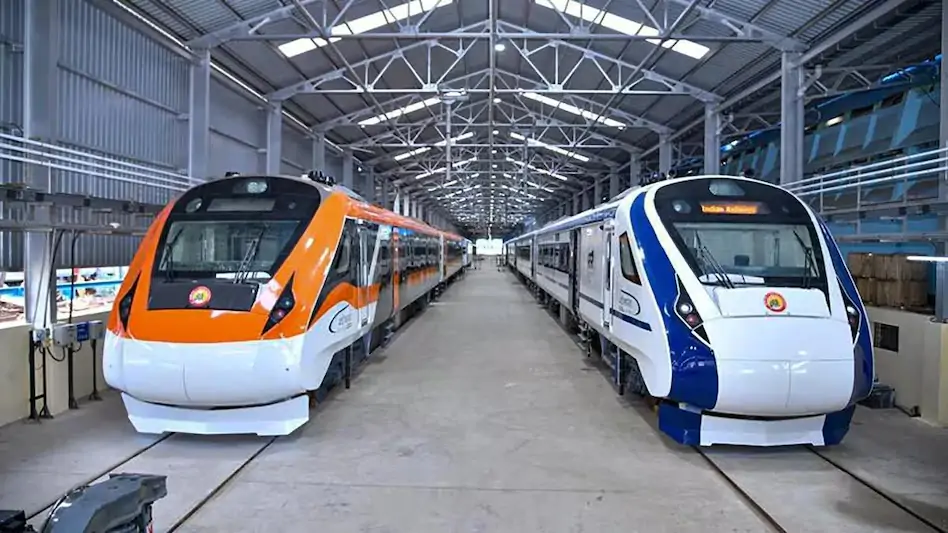
India’s railway modernisation drive has entered a decisive phase, as the focus shifts from incremental upgrades to systemic transformation. With the goal of enabling trains to operate at speeds of up to 160 kmph on major trunk routes, Indian Railways is overhauling traditional signalling systems and deploying advanced safety technologies.
The Railway Board has approved a proposal to double the spacing between trackside signals from the existing 1 kilometre to 2 kilometres. This move, officials say, is critical for ensuring safe braking distances at higher speeds, where conventional signalling may no longer be adequate.
At first glance, reducing the number of signals may appear counterintuitive. However, railway experts explain that when trains operate at 160 kmph, braking physics changes dramatically. A train moving at such speeds requires a significantly longer distance to decelerate safely.
Currently, signals placed every 1 km can create operational challenges at higher speeds. If a driver spots a caution or stop signal too late due to limited sighting distance, it may result in abrupt braking, affecting passenger comfort and potentially compromising safety.
By increasing the distance between signals to 2 km, locomotive pilots are given a longer braking window and earlier warnings. This reduces the likelihood of sudden braking and allows smoother, safer high-speed operations.
Before nationwide implementation, the system will undergo pilot testing under the supervision of the Southern Railway. If the pilot demonstrates operational safety and efficiency, other zones including the North Central Railway are expected to follow.
The shift to cab signalling
A cornerstone of the high-speed plan is the gradual shift away from traditional trackside or “wayside” signals to advanced cab signalling systems.
Historically, railway operations have relied on physical signal posts, essentially traffic lights mounted along the tracks. The locomotive pilot must visually identify the signal aspect (red, yellow, green) and respond accordingly.
However, at speeds above 130 kmph, the “sighting distance” the time available for a driver to see and react to a signal, becomes dangerously short. Adverse weather conditions such as heavy rain, fog in North India, or sharp track curves further reduce visibility.
Cab signalling addresses this limitation by displaying signal aspects directly inside the locomotive cockpit on a digital screen. This allows the train to maintain optimal speed regardless of external visibility conditions. In effect, the “intelligence” of signalling shifts from the trackside to the train itself.
Kavach: The electronic shield for Indian Railways
The backbone of this speed upgrade is Kavach, India’s indigenous Automatic Train Protection (ATP) system. Working alongside the European Train Control System Level 2, Kavach forms a digital safety ecosystem designed to prevent collisions and human error.
Kavach operates through an integrated communication framework:
1. On-Board Units (OBUs): Installed in locomotives, these units continuously broadcast the train’s speed, position and direction.
2. Station Servers: These act as control hubs, analysing real-time data from nearby trains to detect potential conflicts.
3. RFID Ground Tags: Installed between rails, these tags provide centimetre-level location accuracy when scanned by passing trains, compensating for GPS limitations.
This system enables Indian Railways to transition from traditional “fixed block” operations, where only one train can occupy a specific section, to a more efficient “moving block” model. By calculating precise braking distances and real-time positioning, trains can safely operate closer together at higher speeds.
Unlike static signals that merely indicate “stop” or “go,” Kavach provides continuous speed supervision. It calculates variables such as train weight, track gradient, and distance to the next restriction to determine the exact braking curve.
If a potential risk arises, Kavach activates a three-stage protocol:
1. Audio-Visual Alert: The cab display flashes red with an alarm.
2. Automatic Service Braking: If the driver does not respond, the system slows the train.
3. Emergency Braking: If danger persists, full-pressure brakes are applied automatically.
An additional network-wide SOS feature allows a pilot to alert nearby trains during emergencies. Once activated, the system can automatically slow or halt trains within a several-kilometre radius to prevent secondary accidents.
Cost efficiency and reduced maintenance
Beyond safety, reducing trackside signals also brings financial and operational advantages. Traditional signal posts require extensive wiring, power supply, copper cables, and periodic maintenance. They are vulnerable to theft, weather damage, and technical failures.
In contrast, maintaining radio towers and digital communication systems for Kavach and ETCS is more cost-effective in the long run. Fewer physical signal failures are expected to improve punctuality across the network.
Mission Raftar and Corridor Upgrades
Under Mission Raftar, two major corridors are being prioritised for 160 kmph operations:
1. Delhi-Mumbai Corridor (1,384 km): Over 1,100 km has already been commissioned for Kavach. Key stretches such as Palwal-Mathura-Nagda and Vadodara-Surat-Virar are complete. The final section into Mumbai is targeted by September.
2. Delhi-Howrah Corridor (1,450 km): Progress here stands at roughly 20-25 percent, with installations underway in complex sections including the Grand Chord route through Bihar and Jharkhand.
As of February 2026, more than 1,300 route kilometres have been commissioned under Kavach 4.0, and over 4,150 locomotives have been fitted with the system. The vendor base has expanded to more than five companies, accelerating the transition from pilot testing to mass production.
Railway officials describe the full activation of Kavach across priority corridors as the final “permission slip” required to formally raise operational speeds to 160 kmph.
While track strengthening, fencing, elimination of level crossings, and traction upgrades remain part of the broader modernisation push, signalling reform is emerging as the most crucial enabler of safe high-speed travel.
If successful, this transformation will not only shorten travel time between major metropolitan centres but also signal a fundamental shift in how Indian Railways manages safety, technology and traffic in the 21st century.