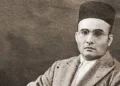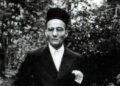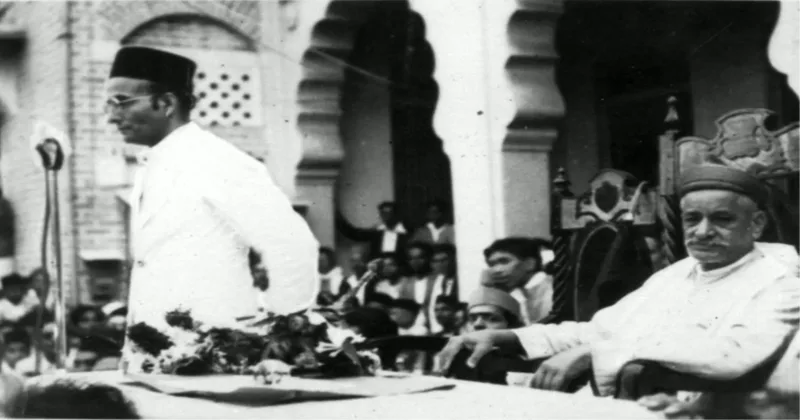
Veer Savarkar’s name is etched in the history of the Indian independence movement as a revolutionary who not only fought against foreign rule but also strengthened the ideological foundation of nationalism. Vinayak Damodar Savarkar, respectfully known as “Veer Savarkar,” was a multifaceted personality. He was renowned as a revolutionary, writer, historian, social reformer, and nationalist thinker. His life is a remarkable example of patriotism, sacrifice, and indomitable courage.
Early life and education
Veer Savarkar was born on May 28, 1883, in Bhagur village, Nashik district, Maharashtra. He possessed a strong sense of patriotism from childhood. His family environment was also influenced by nationalist ideas. As a teenager, he resolved to fight against British rule. During his student days, he founded an organisation called “Mitra Mela” to organise youth, which later evolved into “Abhinav Bharat.” Savarkar went to England for higher education, and in London, he organised Indian students and revolutionaries. There, he spearheaded ideological and revolutionary activities against British rule. He believed that India’s independence would be achieved not through mere petition but through struggle.
Revolutionary Activities and Struggles
Veer Savarkar was among the leading revolutionaries who supported armed revolution. He inspired youth to strive for independence and organised the revolutionary movement. While in London, he helped Indian revolutionaries arrange weapons and launch a movement against British rule through secret organisations. His most famous work is “The War of Independence of 1857,” in which he described the 1857 revolution as India’s first freedom struggle. This book awakened national consciousness among Indian youth and inspired them to fight against British rule.
The British government arrested him on charges of revolutionary activities. In 1910, while being transported to India after his arrest, he made a daring escape by jumping into the sea at Marseilles, France, a feat that exemplifies his remarkable courage. However, he was recaptured and sentenced to life imprisonment.
The Struggle of Cellular Jail
Veer Savarkar was sent to the infamous Cellular Jail in the Andaman and Nicobar Islands, known as “Kala Pani.” Prisoners there were treated inhumanely. Savarkar was forced to perform hard labour and operate oil mills. Despite numerous tortures, his spirit remained unwavering. He continued writing in prison. It is said that he wrote poems on the walls and memorised them to ensure his safety. His struggle is considered unique in the history of the Indian independence movement.
Contribution as a Nationalist Thinker
Veer Savarkar was not only a revolutionary but also an influential nationalist thinker. He proposed a concept of nationalism that prioritised India’s cultural unity and national identity. His ideas profoundly influenced Indian politics and society. He introduced the concept of “Hindutva,” which he interpreted as cultural nationalism. According to him, Hindutva meant not only religious identity but also India’s cultural tradition and national consciousness. His ideas influenced later nationalist movements.
Literary Contributions
Veer Savarkar was also a prolific writer and poet. He wrote several important texts on history, politics, and society. His major works include “1857 Ka Swatantrata Samar,” “Hindutva,” “Majhi Janmathep,” and “Kamala.” His writings clearly reflect the spirit of patriotism and independence. The vigour and clarity of thought in his writings place him among the leading ideological leaders of the freedom movement. He attempted to awaken Indian society through his writings.
Role as a Social Reformer
Veer Savarkar also made significant contributions to social reform. He was opposed to casteism and untouchability. He emphasised equality and unity in society. During his detention in Ratnagiri, he encouraged the temple entry movement and worked for social harmony. He believed that a nation cannot be strong unless there is equality in society. He strived to unite all castes and linked social reform with national unity.
Personality Traits
Veer Savarkar’s personality was extremely impressive. He possessed remarkable courage and determination. He remained unwavering in his goals even in difficult circumstances. His key characteristics were unwavering patriotism, indomitable courage, ideological clarity, organisational ability, scholarship, and writing skills. These qualities made him a prominent leader of the freedom movement.
Role and Legacy in Independent India
Veer Savarkar’s contribution to the history of the Indian freedom struggle is extremely significant. He was not only a revolutionary but also a visionary thinker and social reformer. His ideology and struggle continue to inspire patriotism and national consciousness.
Even after independence, Veer Savarkar remained active on issues of nationalism and national unity. His ideas are still discussed today, and he is remembered as an important figure in Indian politics and history. His life teaches us that sacrifice and struggle are essential for a nation’s independence and honour. He dedicated every moment of his life to serving the nation. Veer Savarkar was a great revolutionary and nationalist thinker of the Indian independence movement. He not only fought for independence but also set the ideological direction of nationalism. His life is a unique example of courage, sacrifice, and patriotism.
Veer Savarkar Ji Demise
Veer Savarkar, the great revolutionary and nationalist thinker, passed away on February 26, 1966, in Mumbai (then Bombay), Maharashtra. In his final days, he declared that his life’s work was complete and therefore chose to voluntarily surrender himself. In February 1966, he stopped taking food, water, and medicine, and his health gradually deteriorated. He passed away after a fast of approximately three weeks.
Last Message
Veer Savarkar’s message to his followers was not to mourn his death, but to continue serving the nation. This reflects his karmayogi personality.
Nation’s Tribute
Upon his death, tribute meetings were held across the country, and he was remembered as a great revolutionary of the Indian freedom struggle. Even today, Veer Savarkar’s life inspires patriotism, sacrifice, and struggle. The Indian government, led by Prime Minister Narendra Modi, has taken significant steps in Veer Savarkar’s honour, including installing his portrait in Parliament House, issuing a postage stamp, building a memorial in the Cellular Jail in Andaman, and naming the Port Blair airport after him. All these honours are proof that Veer Savarkar is respected by the country as a prominent revolutionary and nationalist thinker of the Indian independence movement.
Included in Rajasthan’s school curriculum
While serving as the Education Minister of Rajasthan, I made several significant changes to the school curriculum, attempting to highlight nationalist thinkers, freedom fighters, and great men. In this regard, I also included the life and thoughts of the great revolutionary Veer Savarkar in the curriculum. I believe that students should also learn about those revolutionaries of the Indian freedom struggle whose contributions remained relatively under-discussed for a long time. The purpose of including Veer Savarkar in the curriculum was to inculcate patriotism, courage, and sacrifice in students.
It is essential to present history in a balanced, factual manner so that the next generation can gain a comprehensive understanding of the freedom movement. In line with this philosophy, the contributions of Veer Savarkar, Bhagat Singh, Chandrashekhar Azad, and other revolutionaries, as well as those of Veer Shiromani Maharana Pratap, were included in textbooks. The decision to include Veer Savarkar in the curriculum also became a topic of discussion in the educational and political spheres. Supporters called it a necessary step from a nationalist perspective, while some critics raised concerns about rewriting history. Including Veer Savarkar’s life and thoughts in the curriculum enabled students in Rajasthan to understand the revolutionary aspect of the freedom movement. This was a meaningful effort to increase patriotism and historical awareness among students.