Toronto: Canadian Prime Minister Mark Carney will arrive in India on Thursday, launching his first Asia-Pacific tour with a clear goal is to expand Canada’s trade horizons and reduce the country’s heavy dependence on the United States. The trip will also take him to Australia and Japan, as Ottawa seeks to rebuild and diversify partnerships amid growing global uncertainty.
Carney has argued that the US-led international order is losing its grip and that Canada should not assume the old system will automatically revive once Donald Trump leaves office. With Washington imposing tariffs on Canadian autos, aluminium, lumber and steel, Ottawa is under pressure to find new markets, even though the impact of those levies has been partly softened by Trump’s continued adherence to an existing North American free trade agreement.
Negotiations to revise that pact are expected to begin early this year. Trump has repeatedly claimed the United States does not need Canadian products, remarks that, if acted upon, would carry serious consequences for Canada’s economy. He has also issued provocative statements about annexing Canada and recently shared a social media image showing Canada, Greenland and Venezuela draped in the US flag. Against this backdrop, Carney has stressed that Canada must “massively expand” non-US trade to safeguard its economic future.
India visit aims to repair ties and double trade
India is central to that strategy. Carney says he wants to more than double bilateral commerce, targeting CAN$70 billion (about $51 billion) by 2030. The visit comes after relations between Ottawa and New Delhi deteriorated sharply in 2024, following former PM Trudeau’s baseless allegations that India was linked to the 2023 killing of a Sikh leader on Canadian soil, claims New Delhi firmly rejected. The dispute disrupted consular services and trade flows between the two countries, which had exchanged roughly CAN$28 billion in goods and services in 2023.
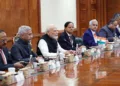
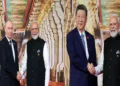
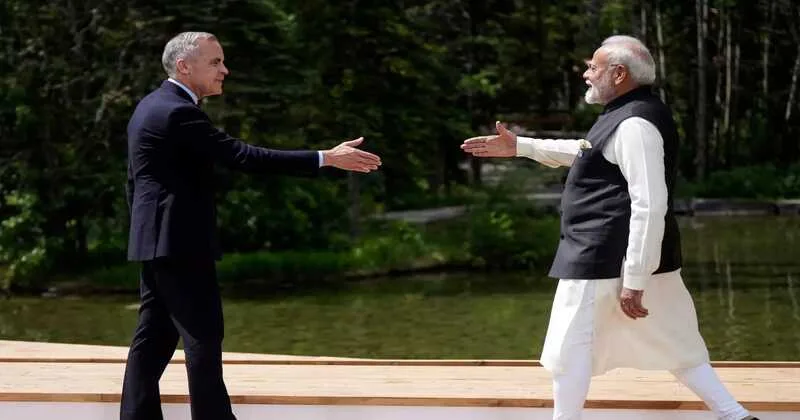
Carney and Indian Prime Minister Narendra Modi are now attempting to reset the relationship. Last year, the two sides agreed to relaunch negotiations on a Comprehensive Economic Partnership Agreement (CEPA), which would cover trade in goods and services, investment, agriculture and digital commerce.
“In a more uncertain world, Canada is focused on what we can control,” Carney said in a statement announcing the tour. “We are forging new partnerships abroad to create greater certainty, security and prosperity at home.”
India’s High Commissioner to Canada, Dinesh Patnaik, has expressed optimism that a comprehensive trade deal could be finalised within a year. Speaking ahead of Carney’s arrival, Patnaik said a 12-month timeline for concluding CEPA is realistic given shifting geopolitics and the shared need for deeper cooperation.
“We expect it to be much faster, given that we both have had enough experience of doing these kinds of free trade agreements in the last one or two years,” Patnaik said, according to The Canadian Press. Trade talks between India and Canada began in 2010 but have stalled several times. Momentum returned in November, when PM Modi and PM Carney formally agreed to restart negotiations. More recently, on the sidelines of the G20 Summit in Johannesburg, both leaders committed to pursuing a “high-ambition” CEPA aimed at doubling bilateral trade to $50 billion by 2030.
Carney’s visit is also expected to feature discussions and possible agreements in areas such as uranium, energy, critical minerals and artificial intelligence. Meetings with senior officials and business leaders are planned in New Delhi and Mumbai to push forward commercial engagement. Patnaik noted that India and Canada have already signed several agreements over the past year spanning energy, climate change, high-technology research and climate-resilient agriculture. “Both the prime ministers are very keen, so the intent is there on both sides,” he said.
Australia and Japan on agenda
After India, Carney will head to Sydney and Canberra for talks with Australian Prime Minister Anthony Albanese. According to Albanese’s office, discussions will centre on economic security, critical minerals and defence cooperation. “As our countries face new challenges and opportunities, we must deepen our cooperation with partners to promote our national interests,” Albanese said. The Canadian leader will conclude his tour in Japan, where he is scheduled to meet Prime Minister Sanae Takaichi before flying back to Canada on March 7. With US trade relations increasingly volatile and traditional alliances under strain, Ottawa is betting on stronger ties with major Asian economies to provide stability, growth and strategic balance in a rapidly changing global landscape.