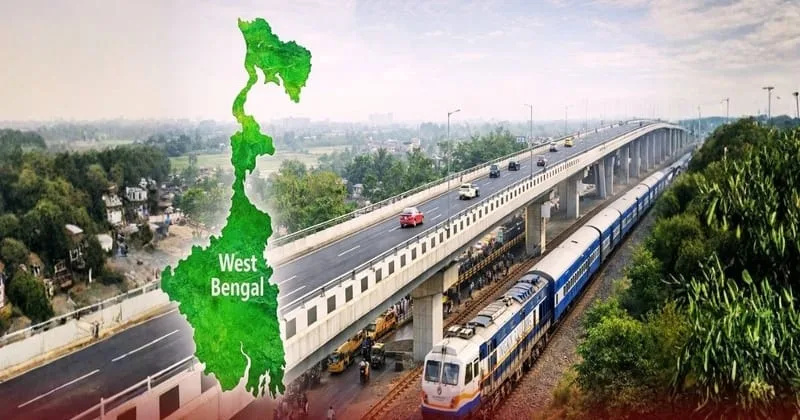
Development of the freight corridor linking Surat in Gujarat and Dankuni in West Bengal (WB) is a will increase business and employment opportunities for people in WB. From April 1, 2011, to March 31, 2025, 6688 companies have left WB for poor infrastructure, weak land acquisition policies, and rampant extortion through ‘cut-money’. Niti Ayog Report (2025) showed that the annual unemployment rate in the state is 2.2 per cent, the female labour force participation rate is 33.8 per cent, which is lower than the national average, and the per capita income is 20 per cent below the national per capita income.
The Varanasi- Siliguri connector will be a major source of commerce and growth of industries. Siliguri, which is still considered a tier 2 city, will get a boost in its economy. Siliguri is a connecting city between the southern and northern parts of WB. North Bengal is reeling under a lack of development and incentives for the growth of agriculture and industry. This move will help in increasing tourism in North Bengal, where rail and road connectivity are in an adverse condition. This will also reduce economic dependence on Kolkata as a major centre for commerce and control problems of migration.
East Coast Industrial node
The East Coast Industrial corridor with a ‘well-connected node’ in Durgapur city is a welcome move for WB. Durgapur, as an industrial node, was first realised by Dr Bidhan Chandra Ray in the 1950s. Durgapur, located on the banks of the Damodar River, evolved from an 18th century forest settlement named Gopinathpur. This is the only city in eastern India which has an operational dry dock, and is called the ‘Steel backbone of Industrial Bengal’. A hub of some of the major steel plants, Durgapur forms a major industrial centre for revenue generation. The Durgapur Projects Ltd. itself generated a revenue of Rs 1313.35 crore in FY 2023.
India’s Dedicated Freight Corridors (DFCs) are projected to contribute to Rs. 16,000 crore to the nation’s GDP. The launch of Western DFC (WDFC) has already reduced freight costs and travel times. This has significantly lowered commodity prices by 0.5 per cent. From FY 2018-19 to FY 2022-23, handling over 10 per cent of the country’s rail freight, DFC’s contributed to 2.94 per cent to Indian Railways’ revenue growth. The existing 2843-kilometre DFC project spans across 56 districts and seven states. The Eastern DFC (EDFC), which includes 1337 km, runs from Ludhiana in Punjab to Sonnagar in Bihar. The WDFC, which connects Dadri to Mumbai, covers 1506 km. The new proposition will not only boost investment and development in WB, but also help in connecting major coal fields in the Eastern Industrial Corridor. This will also increase sustainability, as these rail corridors reduce major CO2 emissions from roadways.
National Fibre Scheme
India has been a major hub of the best quality textile production even during the 3rd and 4th centuries. The National Fibre Scheme includes a couple of measures to achieve self-reliance in textile production. Textile expansion and employment through capital support for machinery; technology upgradation, developing common testing and certification centres; development of National Handloom and Handicraft to integrate and support weavers and artisans; introduction of Samarth 2.0 to modernize and upgrade textile skilling through industry and academic institution collaboration; building of Mega Textile Parks and developing Tex Eco initiative to promote competitive and sustainable textile at global level; and modernising textile clusters are some of the initiatives proposed through the scheme.
The dire state of jute factories can be revived with the help of this scheme. At present, approximately 17 jute mills have been shut, and 50,000-60,000 workers face an unemployment situation in jute-growing regions. Around 3 lakh workers are directly employed in WB’s jute mills, and almost 35 lakh people are indirectly dependent on the jute industry. Initiatives to revive the jute industry since decades have not been taken. In the 1880s, Bengal contributed to 80 per cent of the world’s jute production. In 1947, five jute mills were shut, increasing the jute prices from Rs 16 (1945-46) to Rs. 29 (1946-47) per maund. In the 1990s, jute labourers were deprived of Provident Fund (PF), gratuity, ESI, and their wages amounted to merely between Rs. 619-660. From 1978-2007, jute factories started closing in demand for stable working conditions and wages. However, since then, the situation has not yet changed. By 2011, 15 more mills were shut. The proposition on the National Fibre Scheme can help in the sustainable revival of this industry by diversifying, making it globally competitive and generating employment.